I've put together 14 high-quality original podsafe instrumental tunes from my Penmachine Podcast into a CD album you can buy. It also includes a bonus data DVD with a bunch of cool stuff that isn't on this website. Find out more...
Since words are what count, I don't care which web browser you use at this site. Okay, I do. I prefer you avoid Internet Explorer for Windows, but that's mostly for your own good. It works fine here.
This is "Penmachine.com: June 2006," a page that archives an entire month's entries from my online journal. The latest material for that month is at the top. For my newest entries, visit the home page.
Friday, June 30, 2006 - newest items first # 5:59:00 PM:
(I missed 10 minutes at the beginning of the session, as well as most of the previous aggregator-feature session.)
Steve Gillmor's "Attention Economy"/"Attention Trust" concept, which he brought up at last year's Gnomedex (which was the first I'd heard about it, is something I've never understood properly. I'm still not sure I do.
Marc Canter: how is this attention economy supposed to work?
Steve: after I've gotten through my own personal, obvious attention priorities, how can I find new stuff that is interesting to me?
Google is already doing this to some degress: I get free software in exchange for my attention.
Trying to create a process where we can decide for ourselves what we'll subscribe to.
Winer: as users, the big companies take us for granted.
Steve: eventually, really soon, we'll build the infrastructure for users to collect the data themselves and share it without Yahoo! or Google being able to own it.
Chris: I know this is important, but how can I see it.
Steve: go to Attention Trust and download the recorder to see what it's creating.
Links are dead because they're being gamed. The pageview model creates crap leads.
The fundamental coin of the next architecture is not about what the cloud sends to me, it will be about what the user affinity groups want.
Information is looking for us, we're not looking for information.
Sex and relationships in geekland at Gnomedex. A topic that might have made some people uncomfortable, but the discussion was fascinating, and even Chris Pirillo's mom was part of the conversation...
Every geek has a secret subset of stuff they read or write that's related to sex. Often that's a secret.
Personas and identity as a freedom to be able to talk about issues they wouldn't otherwise.
The average sex blogger isn't doing anything non-sex bloggers don't do—they just admit it.
What can we learn from these revelations?
Remember that the stuff you post never goes away: Google may not be your friend.
Your family and friends and co-workers may have very different opinions about what's appropriate to put online.
It's not just sex, it's relationships. There's mental illness, moral opinions, political feelings.
You don't know who's reading, but don't forget the power of communities that you might not even know you have built.
In print we're also more successful, prettier, and taller than in real life.
How much can we believe: what's fictional, what's not?
How do these bloggers and others protect themselves and their identities as they wish?
Has this conversation made everyone uncomfortable?
Not a lot of people cross their identities over from the personal ads into blogs and Flickr streams.
Does the current generation (the "Survey Generation") understand that all the information they put out will stay there, and that they might not like that as they get older?
In the future you might not know when you're being recorded.
Society will need to evolve to accommodate that.
"I was 14 and I did dumb 14 year old things."
It's not a matter of educating young people that the web has a long memory—it's a cultural difference.
A lot of them do understand it, and they don't care that much.
And maybe we shouldn't care so much.
Try to think differently: don't think it's just people under 25. That's a lie. Your friends and family and colleagues and parents are the people who are doing this too.
This is a profound shift in communication into the power of individual voices about all sorts of topics.
Talking about net neutrality/network discrimination at Gnomedex. Starting with a 5-minute lecture, then we'll talk about it. He has strong opinions, and thinks "network discrimination" is a good term.
Why you should be scared: phone and cable companies will fundamentally alter the Internet, and they've announced plans openly to do so.
They have the ability and permission to do it.
Until last year, U.S. Internet content delivery was regulated.
In reality, there is little or no choice of broadband access.
Only 1% have more than two choices (cable or DSL).
They're working together to rip you off.
As Telus in Canada demonstrated, the companies will restrict content they don't like.
Closed fast lane vs. open slow lane.
Also a paid police escort in the slow lane.
There is no incentive for the providers to do this in a fair way.
The only way to accomplish it is to deteriorate service for others who have not paid.
Preferential local on-ramps. High quality inserted at the last mile, for which the content provider must pay.
How can end users be safeguarded for this?
Freedom to access content, use applications, attach personal devices, obtain service plan information, obtain guaranteed basic Internet service.
Defeated in the Commerce Committee.
There is no network neutrality now, what we have is network discrimination.
Paying money is good, you need to pay for it.
That's not what we're afraid of—Amazon and Google et. al. wouldn't exist if net discrimination were in place a decade ago.
Akamai will give the same deal to anyone who can pay. What the cable and telcos want is to provide preferential access to the content providers that they are associated with.
We've dropped from a president to a former candidate for vice-president, but he is here at Gnomedex. He says, "I came here primarily to learn from you."
Using podcasting, vlogging, blogging: this is the way America is going.
He was convinced about net neutrality.
This stuff is important for the country and "in my own selfish way, to the political process."
The potential to change our democracy, to get people involved.
Less speaking at, more speaking with.
Where are we today, where we are going, how or should we manage how we go forward?
I want to come away knowing more than I did when I walked in the door.
Recommending "Wisdom of Crowds," where people make better decisions in groups.
Marc Canter: in the U.S., the Democrats need to get some balls.
Do you hear it in your own voice when you slip into politician robo-voice?
It's a long period of conditioning. You need to shed it to become normal again.
The next president, or certainly the one after, is likely to be the single candidate who doesn't sound like a politician.
I'm trying every way I can to be normal, but it is hard.
I'm trying to recondition myself that when I get asked a question to actually answer it.
We've been trained to do the wrong thing. I'm getting better at it, but it's not long.
How do you as a politician create vibrant local bases to build and govern and change communities?
What about people whose communities are virtual?
"I don't know the answer to that question."
Concerned that there is too much energy spent on strategy and not enough on doing things that matter.
And yet, framing the language is important.
But don't forget to focus on the problems that need solving.
The people who decide the election are in the middle. You don't appeal to the people who decide with moderation.
But language does affect substantive issues, from net neutrality to abortion.
What will be the technology that affects the next election? How can it change the political process itself, rather than just amplifying what traditional campaigns have always done?
The problem is two things: people don't have the information they ought to make informed decisions, and they're not engaged in the process.
There's a reason people are cynical and distrusting, because they have good reason to be.
Be able to follow presidential candidates around for the non-staged stuff.
PT: let's get a paper record from voting machines, and source code.
"I'm such a huge rock star I have to carry my own mic stand."
You are a contentious and feisty bunch.
Communications divide between you people and artists' business model.
Instead of win-win, we're all acting like junkies. There's no clear legitimate way to do it.
You have an artist manager who takes 15-20%, business manager 5% or hourly, lawyer 5% or hourly, independent publicist $3000+/month, marketing $3000+/month.
Revenue: touring (corporate gigs, fairs and festivals), master recordings (sell records, licensed, downloaded), publishing (if you write your own, mechanicals, sync, folio), performance royalties, merchandise (anything that's not the music).
So, what's your business model?
Ted Rheingold, dogster.com, catster.com—bring the love with advertisers and everyone.
The PotUSA now own the rights to their first album, after licensing it to Sony.
"How to we move our store to the web?" is what music people are asking. It's the wrong question.
Had lunch with Chris, and realized, "I'm not in the music business anymore. I'm in an online business."
What will help music people get it?
The extending and growing skinny tails argument is one way to look at it.
IODA: the problem is explaining how it works.
Is it a matter of finding a way for fans and artists to get closer together, like EventfulDemand?
What's the endgame? Everyone using iTunes would be great for Dave, but what do people here think?
There is a huge bunch of money for someone
Online music is at about 0.5% of its potential.
But there are a lot of people who are just in it to get laid.
The record label is incubating a whole bunch of businesses (musicians) and gambling on each of them, to varying degrees.
How come Osama can use the web as his promotional vehicle, but a blogger can't link to a song?
Subset was a band with PotUSA and Sir Mix-a-Lot.
Where Dave wants to see it go is to have old material available, or current material that can be remixed with tracks available.
All record labels have the same business model, but some are better capitalized than others.
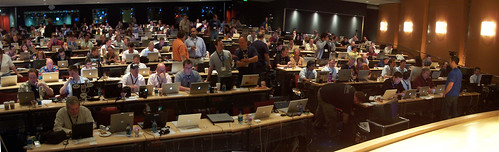
Mike Arrington of TechCrunch asked himself last night, What to talk about? Companies in the Web 2.0 arena, for sure. But then what? He talked to and with the Gnomedex crowd about it.
This was a bit of raucous session. Milots of disagreements with Mike and within the audience about whether and how many startups can succeed, what success means, whether net discrimination-net neutrality will affect that, and whether Canadians are cool. (Okay, no one disagreed about that last one.)
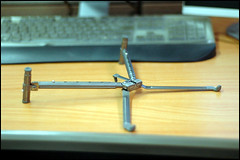
Aside: By the way, everyone who's asking about my (Derek's) laptop stand, it's one of these XT Stands.
CouchSurfing is a community of 90,000 users for swapping places to stay, and it accidentally ate itself yesterday.
Web 2.0 is *not* a non-monetizable echo chamber. But what will work?
What 1 in 10 will succeed?
Digg is becoming the size of the New York Times.
YouTube and MySpace have certainly made the jump into the mainstream.
Net neutrality - what will happen with that?
Was YouTube lucky or smart?
Derek - it's not all about the big IPO, you can make money selling to specific markets, who will pay real money, not all about advertising.
"Network discrimination" might be a better term than "net neutrality."
Mike: focus on the successful ones, never mind all the Digg clones.
What is success? Making money, and making the Internet a better place to hang out.
Mike: "Don't use my own facts against me."
Chris: Do you want to argue about soccer or net discrimination?
As I did last year, I'll be cross-posting blog entries from Navarik about the Gnomedex conference in Seattle in the next few days. Updates should be frequent. Lip Gloss and Laptops will also be dropping some short podcasts.
|
Tuesday, June 27, 2006 - newest items first # 1:57:00 PM:
Hey, look at that. It's the new silly summer surfin' theme song for the Gnomedex conference this weekend in Seattle. Karaoke and instrumental versions too.
Licensed for sharing, copying, remixing, mashing up, video syncing, whatever. Have at it (2.6 MB MP3 file).
(Incidentally, this marks the first time in the entire history of my podcast and album that I actually recorded my own drums, rather than using samples or loops. For details, listen to Inside Home Recording episode 16.)
Parts of the song include samples from this video interview of Chris and Ponzi by Sarah Pullman at Northern Voice 2006. Thanks to them, and to all the other people who called in to Chris's voice mail line with speech samples to be included in the recording.
My Mac encryption post from last week has transmogrified into an article in the latest issue of TidBITS. If you don't know it, TidBITS is one of the oldest Internet publications out there, having run continuously since 1990. I've written for them a few times before, but it's been almost three years since my last article.
It also looks like I'll be rewriting the encryption piece for Macworld, which will be my first appearance in that magazine.
If you make websites or otherwise move files around on the Web, you probably use file transfer protocol (FTP). If you do, an article from Steven Frank of Panic Software explains FTP briefly, but with enough interesting detail that it's worth reading even if, like me, you've been working with the protocol for more than 15 years.
|
Saturday, June 24, 2006 - newest items first # 10:33:00 AM:
Mr. Podcast Pedant has good advice: if you're recording a podcast or other voiceover, smile when you talk and you'll sound better. (Others also advise standing rather than sitting, and moving your hands when you talk if that's your style.)
A caution, however: my co-host Paul, a long-time audio engineer, recommends not forcing yourself to smile when you sing, since it tends to make your pitch sharp.
|
Friday, June 23, 2006 - newest items first # 10:29:00 AM:
Tony pointed me to this video of BumpTop, a prototype pen-based user interface from the University of Toronto that, as he put it, could be "taking the desktop metaphor too far."
I'm not so sure. The mouse-icon-desktop metaphor we use on computers now has changed little since the first Lisa and Macintosh computers nearly 25 years ago. Apple Computer and others investigated the concept of piles of icons (hello? Bruce Tognazzini, famous interface design expert? how about a putting a date on your web page from 2000?) in the '80s and '90s, but abandoned it. BumpTop tries again.
It might indeed be taking the realism a little far, but I think the spatial concepts could help make UI interaction more efficient now that computing horsepower can handle it. Whether it could work well with a mouse rather than a pen is another question. But it would be fun to try out, and I'd like to see whether any of these concepts make their way into everyday computing in the next decade.
My wife's podcast, Lip Gloss and Laptops, is about to turn four months old, and to hit 18 episodes. To celebrate, they're giving away a $37 tub of sea salt scrub skin smoother, which I (even as a guy) declare smells just fabu-dabulous and is worth entering to win.
We haven't formally announced on the show yet, but I am the new full-time co-host of the Inside Home Recording podcast with Paul Garay, and I've completely rebuilt that show's website in the past week too.
It looks like I'll be writing my first-ever article for Macworld, which is pretty damn cool. Somewhere in my parents' basement I have the first-ever issue of that magazine, from 1984. I should dredge it out.
I'm not yet sure whether there are enough registrants for my July 6 Onscreen Editing workshop in Vancouver to go ahead, but they haven't pulled the page down, so that's a good sign. Please sign up if you're interested.
If you like computer networking and databases and servers and have some mad skillz and live in or are eligible to move to and work in Vancouver, check out my employer Navarik's Jobs page for the internal systems lead position. Look at the other jobs too, and subscribe via RSS to the job postings if you want.
|
Wednesday, June 21, 2006 - newest items first # 8:34:00 PM:
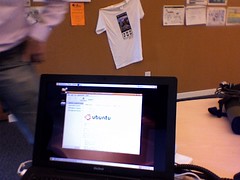
I kept hearing from the likes of Tim Bray that Ubuntu Linux is, among Linux operating systems, the cat's meow, and from the likes of TidBITS that Parallels Desktop is a great way to run PC operating systems like Linux and Windows on newer, Intel-based Macs.
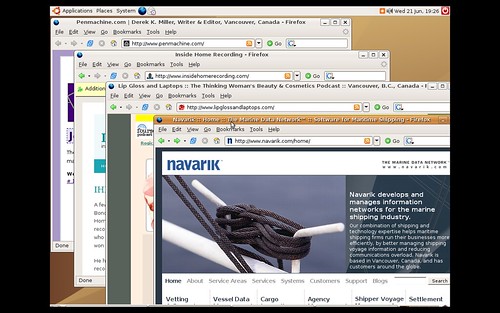
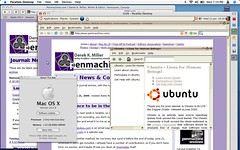
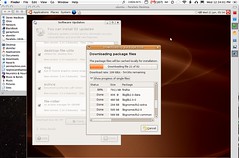
So today I downloaded and installed the 15-day trial of Parallels, and the full CD install image of Ubuntu, and went to town on my MacBook. The initial boot up into Ubuntu from CD was painless—less than 15 minutes from when I had finished the downloads. There were a few hiccups getting everything working, but now it does, and it wasn't really significantly harder than getting Mac OS X or Windows XP to install on new hardware:
The verdict? Not bad at all. Since I spend much of my day in Gmail, Flickr, Blogger, WordPress, and other web-based applications, and since many of the tools I use on my Mac, like Firefox and Audacity (how the hell do I install that, anyway, with all the dependencies?) are available for Linux, what would I miss if I switched over?
If I could get GarageBand or Logic Express and Photoshop Elements, plus a good UI-based text editor like BBEdit (any suggestions?—and no, Emacs and vi are not what I'm looking for), I'd have most of what I need. I actually prefer the look and feel of Ubuntu to Windows XP or what I've seen of Windows Vista so far. Ubuntu has brought desktop Linux a long way.
Still, it doesn't quite have the fit and finish of Mac OS X. I could certainly get much of my work done in Ubuntu (I'm typing this in it now, in fact), but it's missing some of the very cool applications from Apple and others, and I don't think I'd enjoy living with it quite as much.
But I'm impressed with how far Ubuntu has come from the complete command line–makefile–geekitude of desktop Linux just a few years ago. In a few years more, this could get really interesting.
Gnomedex starts next week in Seattle, so if you want to be a part of the semi-official Gnomedex song I'm recording, you don't need to sing—just record a brief bit about what you think of Gnomedex and email it to me as an MP3 file:
If you'd prefer another method, let me know. But send it before the end of today, June 21, otherwise it won't get included. I already have a number of contributions, so if you don't have time, no worries, and maybe I'll see you down at Gnomedex itself.
|
Tuesday, June 20, 2006 - newest items first # 4:12:00 PM:
I've long been a fan of Peter Gabriel. Nearly four years ago, when his most recent album, Up, came out (about the time Avril Lavigne began her major label recording career, incidentally), I wrote that "I don't know what [the strongest piece on the album] is yet." Okay, it took me four years, and it's "No Way Out," which is, in its own way, sadder than anything Morrissey or Joy Division or The Cure ever moped down onto tape.
Go head, give it a real listen, and think about the story-inside-the-song about the goldfish, silly at first, and how it ends, abrupt and clear:
I remember how you held the goldfish
Swimming around in a plastic bag
Swimming around in a plastic bag
You held it up so high
In the bright lights of the fair
It slipped and fell
We looked everywhere
Then put it in its context in the song. It's not a loud song by any means, but there's real power and brilliance in it.
Okay, it took me four years, but Gabriel took ten years to make the album, so that's not so bad, is it?
The [recording] industry's idea of a "perfect" DRM scheme is one that is not controlled by either Apple or Microsoft, and which gives only them (the record industry) complete control over what users can do with their downloads. Such a scheme does not exist, and it does not exist because it isn't possible.
But interoperability already exists: you get it with MP3 files, and any other non-DRM-laden file formats.
[...]
But that's not what the music industry wants. Yes, there exist legal download stores that sell music in MP3 format (e.g. eMusic.com)—but they don't have content from the major record labels, because the major record labels refuse to allow their music to be sold for download without DRM. The music industry's insistence upon DRM is what put the [iTunes Music Store] in the position that Apple now enjoys; the record industry is decrying a lock-in advantage that they themselves handed to Apple so they could deny their customers (i.e. us, the people who listen to music) the interoperability they now say they want.
These two corduroy things arrived by air mail from Australia today. Canada Customs opened the package and sealed it back up with no harm. One's for my wife, and one's for me. They are not pillows:
And while I'm using the iSight camera, I may as well go for the wacky effects:
Although I live right next door to my parents, circumstances seem to conspire that my father is regularly out of town on Father's Day, so the best I could manage was to send him an email yesterday. That's good, though, because I know he and my mom are having a good vacation trip. And we gathered the family out at my wife's parents' place last night, with our kids running around in the cul de sac in the sun—good fun there too.
Over at our house, my own dad's day present was finally being able to pick up a print of "Blues Come Through," a painting by Alice Dalton Brown that wife and I have had our eye on since we saw it in Victoria, B.C. a few years ago. I spotted a framed version (about 60" x 40" in size) I liked at a good price. It's now hanging in our front hall, after my slightly death-defying adventure with a ladder, our steps, a hammer and picture hook, and a bubble level with which to put it up.
I think it will be especially refreshing to look at during the dreary winter months here in Vancouver.
|
Saturday, June 17, 2006 - newest items first # 11:55:00 PM:
Okay, this is weird. I was at a party for my cousin's two-year-old today, and one of the people there, a guy named Ernie Culley, is a pastor at a church.
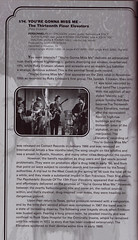
But, as the conversation turned, I discovered that back in 1965–66, before he enlisted in the U.S. Navy, he was the bass player for a band in his native Texas called the The Spades, which renamed itself as The 13th Floor Elevators, and apparently had a small hit.
"Hey, I know that name," I said. "What was the song?"
"You're Gonna Miss Me," he said. "But I never went on tour—the other guys in the band kept getting busted for dope, back when it was still a big deal. So the cops kept following me around, even though I didn't smoke it, and I decided I had to get out of town."
I was a bit blown away. "You're Gonna Miss Me" is one of my favourite garage rock tunes of all time, in part because of the bizarre "electric jug" one of the guys on it plays. It was featured on the original Nuggets album and later box set that I own—it is, in its own way, totally legendary.
What blew me away is that HE HAD NO IDEA. "You've heard that song?" he said. I sang him a bit of it. So I sent him the MP3 today, and linked him to the newly-released 13th Floor Elevators: Going Up "Very Best Of" collection that was just released this year.
Who cares if I've never met Bob Dylan or Paul McCartney or Gene Simmons? I met the original bass player for the 13th Floor Elevators!
|
Friday, June 16, 2006 - newest items first # 12:29:00 PM:
UPDATE: These instructions have now been translated into Chinese (but not by me!).
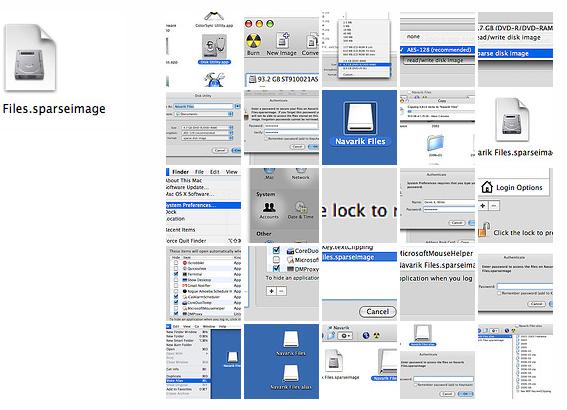
If you want to keep certain files on your Mac from prying eyes (have a company laptop that might get stolen?), it's not too hard to create an encrypted disk image that you can open with a password at login, and which acts like a regular folder once you've done that. I did that today at my work at Navarik. I've posted a slideshow and photoset at Flickr about the process, in order, with commentary:
Once you've set this up, whenever you log out, or if you eject the virtual disk, no one can get at the data in it without the password, because without your password, it is mathematically scrambled gibberish—even if someone steals your laptop and takes the hard disk out. So it is important to choose a good password that they can't guess, but that you won't forget either.
P.S. This is a better method than using Apple's FileVault, which encrypts your whole Home folder (and that could be huge), including files that don't need to be encrypted (downloaded music? web cache files? preferences?) and could slow down your machine.
|
Thursday, June 15, 2006 - newest items first # 3:27:00 PM:
Regender (via Chris) takes any website, Google search, etc. and converts all the male references to female, and female to male, in the text. Interesting results—they can be suble (this boy site or this girl site) or not (Billie, Stephanie, and, uh, Oprah):
Time magazine wrote, "Few people would have bet on Oprah Winfrey's swift rise to host of the most popular talk show on TV. In a field dominated by white females, he is a black male of ample bulk. As interviewers go, he is no match for, say, Phyllis Donahue."
Liezel was the first employee, is the most senior programmer, and manages the entire development team at Navarik, where I work. She's also fashionable, pretty, and happily married, rides a motorcycle, paddles dragon boat, and has 20/20 vision.
I think that last one means she has to turn in her geek credentials. Are you even allowed to be a heavy-duty computer programmer without glasses?
I'm on my second episode of co-hosting the popular Inside Home Recording podcast with Paul Garay. This time I review the Blue Snowball microphone and interview musician Craig Northey. You can subscribe if you'd like to get new episodes automatically.
I've posted part 1 and part 2 of the audio from my sold-out website workshop last Friday to the Penmachine Podcast. My slides are also available. (Again, you may subscribe if you wish.)
Maybe the neatest thing: Darren Barefoot pointed me to the iTunes Signature Maker, which compiles songs from your iTunes Music Library into a mishmash of semi-recognizable audio that summarizes your taste in music. My signature (500 KB MP3 file) is pretty much dead on for my tastes: bluesy, crunching guitars, aggressive drums, a fair share of classic rock (Beatles, Bowie), some retro keyboards, and it ends with one of my favourite songs of all time, "What I Like About You" by the Romantics, which is also a song my band plays pretty much every single show. Amazing.
|
Tuesday, June 13, 2006 - newest items first # 3:48:00 PM:
I'd never heard of Mt. Augustine in Alaska before today, but apparently it has been erupting recently. It is perhaps the most amazing volcano I've ever seen a photo of:
That's more than 1200 metres (4000 feet) from sea level to the summit you're looking at, built straight out of the ocean by the heat of the earth:
The last laptop I worked with was made in Taiwan, but all the new Apple devices I'm using—an iMac Core Duo, a MacBook, my iPod—came from factories in China. (In the case of my MacBook, directly from there to here via FedEx.)
The first Apple computer I had, back in 1982, was built in the U.S.A., while my 1993 Macintosh Centris 660AV came from Ireland. You'd be hard pressed to find a new pre-assembled computer (or TV, or toy, or even oceangoing freighter) not from China now. And while I'm living with it, I'm not quite comfortable with the moral compromise.
Yes, I know that Apple's contracting to a factory in China is what let me get the swell new MacBook I'm typing on for less than $2000 with taxes. Yes, I know there are arguments that the working conditions of those who built it for me are probably better than those of many of their fellow citizens. I know that.
Today, Lucian at the Planet TV Show (disclosure: I wrote the theme song) eschewed his usually funny-techie-robot focus in favour of the most cogent explanation of global climate change that I've seen so far. Here's the transcript:
According to the math, we cannot know for certain how close we are to the point of no return, until it is too late. So if you are looking for absolute proof, you will not get it unless you are willing to sacrifice everything. Because, you cannot have absolute confirmation that a catastrophic change is occurring—until it has begun and cannot be stopped.
[...] Even if our contribution of CO2 is not the main reason for climate change, it is still important that we reduce and eventually eliminate the release of CO2 from fossil fuels. If we are close to the tipping point, then any small amount of increase may be the amount that pushes us over the edge. By the same token, if we are close to the tipping point, then any small decrease will take us that much further from the edge of a catastrophic shift in climate.
[...] Global warming does not pose a threat to the Earth. Nor does it pose a threat to life on this planet. Both the Earth and life on the planet will survive the effects of global warming and catastrophic climate change. What is in danger is us.
I wrote something very similar in a letter to the editor in a local newspaper more than 12 years ago. It makes me a bit sad for the point to have to be made still.
In the past week three families I know welcomed new babies—Mark and Mandy had a son whom I met Saturday night, Tim and Lauren had a daughter, and Alastair and his wife now have a younger sister for their daughter M.
There have been several other births among my friends in the past year, and there are more young 'uns coming along at work and elsewhere. That boom I was talking about rolls on.
Incidentally, these new faces come mostly to parents who are in their mid-thirties or older, which is a trend in itself.
|
Friday, June 09, 2006 - newest items first # 11:04:00 AM:
I've worked at Navarik for close to three years now, and before that did freelance work for the company since its inception in 2000. Navarik is particularly cool for a tech company because it's using all those cool "Web 2.0" technologies and techniques to solve real problems for real companies in a huge industry (ocean shipping).
It's a great place to work. Nice office, near where they're building the 2010 Olympic Village. Good people, attacking real intellectual challenges in software and Internet development. Genuine customers paying actual money. And we need developers (also posted at Craigslist) and a director of software engineering (Craigslist). If you're interested, hr@navarik.com is the place. There's a Jobs page (listing summaries), Jobs blog (with full listings), and Jobs RSS feed (more info) if you want to keep track of future openings too.
|
Thursday, June 08, 2006 - newest items first # 11:41:00 PM:
If you've read this site for any length of time, you have no reason to doubt my geek credentials. Still, something came up today that reinforces the point.
My wife and I were talking about how we have no shortage of computers in this house: her laptop, my laptop, a desktop in the basement, and three fully functioning older Macs that are on a shelf because we simply don't need them right now. And that's after I purged out most of my electronic clutteralia last fall.
I recalled how, when I began my bachelor living phase, with three roommates, back in 1987, we were all geeks, even then. We had met through online bulletin board systems (BBSs). We've moved on a little. Today, one of us is head of Digital Design at Vancouver Film School, a second helps run the campus-wide network for the British Columbia Institute of Technology, and the third has been the official Tall Skinny Guy With Screwdriver for Simon Fraser University's Faculty of Business Administration for lo many years now. Plus there's me.
Anyway, back when we moved in together, we owned among us seven computers. Twenty years ago, that was not only nerdy, it was absurd.
Here is the key point. We had those seven computers, but we didn't have an iron.
Simon Fraser University here in Burnaby has started a major podcasting initiative, with course lectures (for registered students and faculty only), public lectures, and links to recordings of other public events. Looks spiffy.
|
Wednesday, June 07, 2006 - newest items first # 10:10:00 PM:
I mentioned last month that my dad bought himself a Canon Digital Rebel XT camera for use in astrophotography.
He's now started putting it to use, taking several beautiful shots of the Moon through his 8-inch Celestron Schmidt-Cassegrain reflector telescope.
I remember when he picked up that distinctive orange telescope from the factory in Torrance, California (in 1978, I think), and it was a staple of my childhood from then on. He used to make prints of photos in his own darkroom in our basement, but now that's no longer necessary.
My dad was only two years older than I am now when he bought the Celestron, yet he seemed very grown up and wise, more grown up and wise than I feel. On the other hand, I was nine years old, and I suspect I seem pretty grown up to my daughters. Maybe they'll have similar fond memories of the gadgets their mom and I purchase right now.
|
Tuesday, June 06, 2006 - newest items first # 5:08:00 PM:
I know I ranted and raved rather too much about my black MacBook (a.k.a. BlacBook) recently, but does that really mean I should be the #4 result for "black MacBook" on Google? I mean, the only things ahead of me are Apple itself, the Apple Store, and Digg. That's nutty.
A couple of months ago I switched from Apple's Safari browser to Camino, but now I'm switching back. There are three main reasons:
Camino only stores a single username and password for a website, sometimes even apparently for an entire domain. That's silly. I have multiple account numbers at my bank alone, for instance, and for my browser to remember only one of them makes autofill features useless. Besides, Safari's form-filling is better than any other browser's anyway.
Mysteriously, Camino sometimes refuses to save files when I right-click or ctrl-click on a link and choose to save. I haven't been able to figure out why.
Camino's hacked-in CamiTools bookmark synchronization is a pain. Safari's .Mac synchronization is seamless and happens without my having to do anything. I like that better.
I wish Safari had some of the funky skins that Camino does, but that's not enough of a reason to stay. Besides, on my new Intel Macs, Safari seems faster than Camino, which wasn't true before. Camino's still nice, but Safari gets in my way less. Luckily, migrating between the two is about a 30-second process (File > Export Bookmarks, File > Import Bookmarks, Preferences > Default Browser).
Here's the way the Web is supposed to work. bpx has been posting sons of photos of old Soviet-era posters at Flickr for awhile now. A few days ago, Jason Kottke, one of the most popular bloggers in the world, linked to the collection. I saw the link, and it got me talking to Darren at work (who's an artist and designer) and thinking about how different people's attitudes are toward Communist and Nazi propaganda.
Anyone who blogs, as I have done for six years, has different intentions for different posts. Most of the time I'm either just writing compulsively or posting something so that I'll remember it and can search through it later. But when I posted about art and genocide, I was hoping to provoke a bit of discussion, and was disappointed when I got only a single comment.
Then today I dropped into my website and found 10 new comments (my first thought: oh no, spambots!), in an intelligent discussion of the topic. What was going on? My server logs told me: Kottke linked back, and that of course had its halo effect of numerous other sites linking in as well (and some great links). Plus my site traffic, which isn't insubstantial to start with, more than doubled yesterday too, surpassing even the spike I got last summer when I linked to this freaky spillway at a California dam, or two years ago when I linked to all the then brand-new Blogger templates and everyone in the web design comminity came to visit.
So let's keep it going. What's your take on the totalitarian art subject?
|
Monday, June 05, 2006 - newest items first # 12:15:00 PM:
I've given my MacBook geeking out enough of a break now. Here are my first impressions after having the "BlacBook" for a week and a half:
Yes, it's hot. CoreDuoTemp regularly reports CPU temperatures in the 55 to 72°C range, with peaks of as high as 82°C under heavy CPU load. The underside of the housing gets noticeably warm in the high 60s, and the fan tends to kick in at the low to mid 70s. By comparison, my Core Duo iMac at work (which is essentially the same computer under the hood) routinely runs around 37 to 45°C—25 or 30 degrees cooler, on average. There have been no performance problems, but I'd advise against rendering videos with your MacBook while it's sinking into a big soft feather duvet.
One very slick way to lower the temperature a bit and place the keyboard in a comfortable typing position is the XT-Stand (pictured). It's folding, adjustable, and comes with a carrying box that fits in a laptop bag and also holds a swath of digicam memory cards, if you need a place for those.
Replacing memory really is super dead easy—all you need is a teeny Phillips-head screwdriver. Replacing the hard drive is almost as simple, but requires a #8 Torx screwdriver to get the drive on and off its carrying sled. Oh, and just so you know, external 2.5" FireWire hard disk enclosures usually use pin-style IDE connectors, but the MacBook's SATA disk drives have blade-style SATA connectors, which means that almost every external case made right now won't work if you take out the stock drive and want a way to hook it up via FireWire or USB.
Glare from the glossy screen is rarely a problem, because the screen is crazy bright—if I use it in bed or another dark room, I have to turn the MacBook's screen brightness down to its lowest setting or my eyes hurt. A benefit of the glossy screen is that it has a hugely wide viewing angle—you can still see the screen quite clearly without colour shifts even from nearly 90° to the side of the laptop, which is good when a group of people wants to look at what you're doing.
Performance is generally very good—GarageBand flies, most applications launch quickly, and so on, as long as you get more than the stock 512 MB of RAM, which is not adequate. But you must know that, as with all Intel Macs, old PowerPC plugins (for web browsers, audio software, etc.) won't work inside new Intel-native applications, and old PowerPC applications that haven't yet been ported to Intel will run more slowly, at something like G4 speeds.
Apple's purported six-hour battery life, as with all of its battery-life claims in recorded history, is a total lie. The most I've gotten is around four and a half hours with light use.
The black case is pretty, but it does show fingerprints and other smudges easily. I don't mind that much, but keeping it pristine would require wearing gloves. The smudges wipe off easily with a damp cloth.
Too bad the podcasts aren't a bit more prominently listed, especially on the CBC Radio sub-page (which doesn't validate), where they're in the "Services" blob near the bottom left rather than under "Listen to CBC Radio" at the top right, where they'd make more sense.
Otherwise I quite like the redesign.
|
Friday, June 02, 2006 - newest items first # 4:00:00 PM:
Listen to Steven Page from the Barenaked Ladies talk to Mark Blevis about why suing customers is a bad idea for musicians:
Any other business follows their consumers and offers them the products that they want in the way that they want. For some reason, the music business [...] drags their heels. They think they can re-educate fans and make things the way they were in the old days.
Jason Kottke points to this huge Flickr photoset of nearly 1500 advertising and propaganda posters from the USSR. I had a brief conversation with Darren at work about why these images don't repulse us the way Nazi propaganda does.
There have, of course, been many very large books written about the subject, including Martin Amis's Koba the Dread, in which he asks why we can laugh at Stalinism but not Nazism—why, indeed, do so many wear faux–Socialist Realism T-shirts as symbols of ironic humour, while wearing a swastika in any form could easily get you beaten up or at least ostracized from any kind of polite company?
Not an easy question to answer. Reviewing Amis's book, Charles Taylor writes that perhaps "Stalin's ends—collectivization, industrialization, even the attainment of absolute power—were at least comprehensible (which is not to say right, desirable or even thought-out) although the means he used to achieve them were barbaric. Hitler employed rational, industrialized means (one could even call them 'neat' and therein lies part of the offense) toward an irrational end: the physical elimination of every Jew."
Maybe, maybe. It remains true that many of us can browse those Soviet posters without feeling ill, in fact even admiring them.
Darren also pointed out that in China, Mao's Cultural Revolution sent many artists, like those who would have made such posters, out into rural forced labour camps, to die by the millions too. And yet one description reads, "An almost mint-condition vintage propoganda poster (present from Jamie) from Mao's cultural revolution of the 1970s....love it!"
|
Thursday, June 01, 2006 - newest items first # 11:45:00 PM:
Jill Duggan makes great wedding cakes. Now, she and my wife also grew up together, but that doesn't make me biased—even CBC TV's Canada Now thinks so (RealPlayer required).


![[Creative
Commons License - You may reuse my original content from this site non-commercially, with attribution.]](https://www.penmachine.com/images/somerights.gif)

![[RSS syndication feed]](https://www.penmachine.com/images/rssfull.gif)
![[RSS comments feed]](https://www.penmachine.com/images/rss_comments.gif)
![[Penmachine Podcast]](https://www.penmachine.com/images/rsspodcast.gif)








![[Powered by Blogger]](https://www.penmachine.com/images/blogger_button.gif "Blogger powered")
![[Powered by BlogRolling]](https://www.penmachine.com/images/blogrolling_button.gif "Blogrolling makes the link list")


![[Layout with CSS and no tables]](https://www.penmachine.com/images/css_tableless.gif)
![[Viewable with any browser]](https://www.penmachine.com/images/allbrowsers_button.gif)
![[Meets U.S. Section 508a accessibility guidelines]](https://www.penmachine.com/images/sec508a.gif)
![[Weblog Commenting by HaloScan.com]](https://www.penmachine.com/images/haloscan.gif)
![[Video preview]](https://www.penmachine.com/images/planet_ed_preview.jpg)









![[Daily Planet TV screenshot]](https://www.penmachine.com/images/dptv.jpg)