Penmachine
11 November 2009
Death and idealism
I have heard there was a time when some of the older veterans at today's Remembrance Day ceremonies thought there might be no more wars. They fought, and died, and killed, and saw the waste and destruction—and believed that perhaps the cost was too great. That nations and societies could decide to put the barbarism behind us.
There were young veterans at the ceremonies today, much younger than me, returned from Afghanistan and elsewhere. Sadly, I don't think they can share in that old idealism.
Labels: death, history, holiday, remembranceday, war
07 November 2009
The end of the Wall
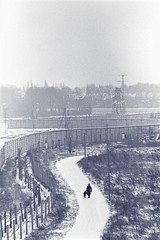 When I saw the footage of people hammering away at the Berlin Wall 20 years ago, I cried. I've never been there (the closest I came was Frankfurt Airport, three years earlier), but it's where my dad was born in 1939. Berlin has always loomed large in my family's history—through stories from him and my aunt, from my grandmother and step-grandfather, of the War, and the Blockade. And in the phone calls and letters to and from the city, where we still have relatives.
Berlin is where my grandfather Karl, my father's father, died in 1947. Thin and weakened in a Russian PoW camp, he returned to his family when the War ended, but never regained his full health. In the ravaged city, medical care wasn't quite good enough, or medicine available enough, to save him when he caught an infection—perhaps pleurisy, perhaps something else. With modern antibiotics and intensive care, he would probably have lived. And I would almost certainly never have been born.
My parents will be in Berlin again this week, able to cross back and forth across the city. The Wall is only shards now, the city and Germany itself now whole, if sometimes awkwardly. I visited Moscow and what was then Leningrad in 1985, while Russia was still fully Communist, though waning. Where today there are billboards, then the signs were only massive revolutionary slogans. To my children, the Cold War is history, long gone before they were born.
But it's not really gone. Current events emerge from what happened then. And my father told me that, a few years ago when he visited the village in the former East Germany to which he'd been evacuated late in the War, the buildings still had bullet holes in the walls.
Labels: anniversary, europe, family, history, war
25 January 2009
Faster than anybody expected
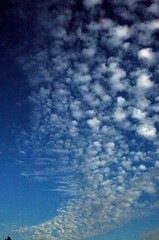 By the way, if you're in a mood to be scared, forget about Saw V or The Uninvited or The Unborn or My Bloody Valentine 3D. Listen to Climate Wars on CBC's always excellent radio show "Ideas."
In fact, listen to Gwynne Dyer's documentary anyway (it's on the podcast), whether you want to be scared or not. The key statement:
Everything that is expected to result from global climate change driven by greenhouse gases is not only happening, but it's happening faster than anybody expected.
Learn why, and how global warming and climate change, which should rationally be non-political, became a political and ideological issue anyway, and what might happen—including some potentially nasty wars. Ignore anything else I've been pointing you to. Really. Just listen.
11 November 2008
Soggy fields on a sombre day
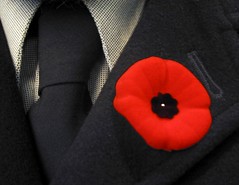 It's miserable, sloppy, rainy November day here in Vancouver. It often is on Remembrance Day, and that's appropriate. Soldiers die on all sorts of days—sunny, rainy, snowy, windy, or calm—but this weather fits the mood.
We used to know it as Armistice Day, to commemorate the end of World War I, which we used to know as the Great War. But the holiday has once more come to have greater meaning in recent years, as our soldiers die in distant wars again. It's no longer a remembrance of history alone—the veterans and their families are no longer exclusively old. Sure, I fight my own battle with cancer, and with death, but when I see the names and faces of Canadians killed in Afghanistan, and think of Afghans dying there too, I consider how young many of them are, just as their predecessors were overwhelmingly young.
Most are much younger than me, never having had a chance to age or get ill. Just gone early, from bullets or bombs, gas or grenades.
Today isn't a glorious day, but a sombre one. Our yards and cemeteries are puddled and muddy, like those battlefields so regularly were—and are. That helps me remember.
Labels: death, holiday, remembranceday, vancouver, war, weather
20 October 2008
Links of interest (2008-10-20):
- How to tell if the Iraq War has been won.
- Does the financial collapse mean the end of Libertarianism?
- Wonderful interviews with many legendary guitar players.
- Metallica's new album sounds better on vinyl.
Labels: guitar, linksofinterest, money, politics, war
19 October 2008
The shocking clarity of Colin Powell
In the upcoming American election, it's a pretty big deal to have former Secretary of State and general Colin Powell, a Republican, endorse Barack Obama, the Democratic nominee, for president:
Of course it's all over the news. But I'd like you to watch the video of his speech or, even better, read the transcript, then think about it a minute.
Notice how straightforward Powell's answers are. He doesn't dodge or prevaricate. He doesn't try to spin talking points or fire out sound bites, even about the Iraq War. When a reply needs detail, he provides it, and talks for some time, making an argument. When it needs simplicity, he offers it without extra padding. At the end, when a reporter asks if he's still a Republican, what is his answer—in its entirety? "Yes."
Such clarity in political speech is so rare that it is actually shocking. That people must be out of politics before they can really speak their minds this way is shameful. I'm sure many U.S. Democrats will applaud Powell for it, and many Republicans will excoriate him. But I'm glad he is self-secure and well respected enough that, to him, that obviously doesn't matter.
Labels: americas, language, politics, war
12 April 2008
Bomb days
A few days ago I wrote about the 50th anniversary of the Ripple Rock detonation, which sent me hunting around the Web for information. Inevitably, I came across lots of pictures of explosions of all sorts.
I think many people in a broad cohort around my age (38), who grew up during the Cold War, have a morbid fascination with photos of nuclear bomb tests. Some of them are chillingly, starkly, awfully beautiful, especially this set from the French Licorne ("Unicorn") test in the Pacific in 1970:
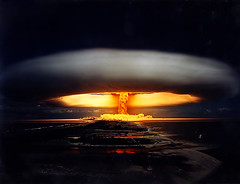
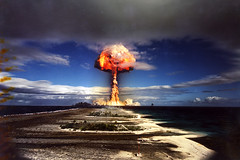
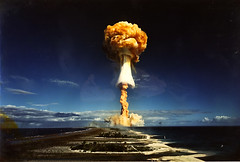
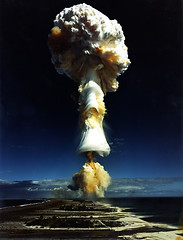
Reports say that the day of the Licorne detonation had "cloudy conditions but good visibility," but notice how the bomb's shockwave punches right through those clouds, sweeping them entirely away and leaving blue sky in the later pictures. Scary.
Of the hundreds of above-ground nuclear detonations by the U.S., the U.S.S.R., the U.K., France, and China between 1945 and 1980, no two seem to have looked the same. The photographs that freak me out the most are those where the surrounding landscape (and thus the scale) is clear. Or where soldiers walk towards a mushroom cloud in the Nevada desert.
China performed the last atmospheric test of a nuclear weapon almost 28 years ago—these sorts of photos are all, thankfully, now historical. But North Korea conducted what may have been a failed atomic explosion uderground as recently as 2006.
So those mushroom-cloud images don't worry me like they used to when I was a kid. But the worry isn't entirely gone either, is it?
Labels: age, americas, china, europe, history, korea, science, war
26 March 2008
The real stakes of a U.S. election
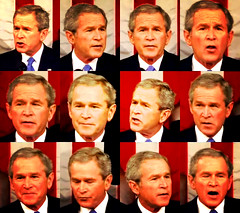 I've just finished watching the full online version of the first part of "Bush's War" (via Kottke), an extraordinary PBS Frontline documentary about the tactical battles and infighting within the U.S. federal administration between September 11, 2001 and the initial invasion of Iraq on March 20, 2003.
It is a multi-hour program, extraordinarily depressing, though not surprising. The sinking feeling I had back in 2002—as I slowly lost the belief that there were good intentions somewhere, anywhere in the call to war—comes seeping back as I watch it.
I recommend you watch "Bush's War." (I plan to check out the second part tomorrow.) It is election season in the U.S. again, and it's worth some time for all of us, inside and outside America, to remember what the real stakes of voting in that country are.
Labels: americas, controversy, politics, terrorism, war
07 February 2008
I think he'll take it
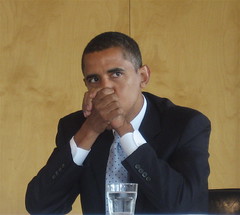 I'm Canadian, and can't vote in the upcoming U.S. elections. But they affect me, as they affect everyone on the world, so I have opinions.
I think—as most seem to—that John McCain or whoever wins the Republican nomination would have to work miracles to win the general election this time around. And I think that's a good thing. His party has damaged his country and its relations with the rest of us in the past seven years, and they do not deserve to keep running it. I hope its citizens agree.
On the Democrat side, there were a number of strong candidates, now down to Hillary Clinton and Barack Obama. As Larry Lessig notes in his video today, their policies do not differ especially radically (although Obama's policy document and website state without equivocation, "I will close Guantanamo," which is enough for me right there). I think either one would make a good president of their nation, and obviously make history doing it.
Where I agree with Lessig, and why I think Obama is a better choice, is that he is inspiring to watch and to listen to in the way no other presidential candidate is, from Clinton to Edwards to McCain and the rest. There is a danger with Obama, as Tom Negrino notes:
What bothers me the most about Obama is his core message, which boils down to "I'm magic, and I'll be able to bring everyone together to move America forward."
What I've seen of his policies seems more concrete to me, but it is true that many of his speeches are long on rhetoric and short on details.
Yet rhetoric is not evil if it not empty, if real action follows it. I think Obama can inspire a politics of "hope and common sense," rather than one of "fear and ideology," as he says. To lead the United States, he need not know the answer to every question—that's why presidents hire smart staffs—but he does need to listen, and to prompt action.
I think one reason he inspires so many already is that while he does give speeches crafted by a team of top-notch writers, he doesn't sound like a machine while he does it. He comes across as a human being. Clinton may be smarter, more knowledgeable, and more experienced, and I hope if Obama wins she can find a place to execute her ideas in his administration. (And if she wins, I certainly hope he can find one in hers.)
But she is not more inspiring. America and the rest of us need inspiration now. America's citizens need to say to us, and to themselves, "We have been on the wrong path, and we will choose a different and better way." To see and to listen to Barack Obama as president will demonstrate the beginning of that choice. If I'm right, I think he will win.
Labels: americas, government, war
30 December 2007
Torture
Several years ago, before the 2004 U.S. election, I wrote about Guantanamo Bay, still for me the key symbol of the failure of American foreign and legal policy after the 9/11 attacks, although I have been encouraged that the country's courts and media have at least done some chipping away at the edges of its black hole.
A big issue this year has been allegations of government-endorsed torture by U.S. government personnel at Guantanamo and elsewhere. I think P.Z. Myers's take on the subject today is cogent:
When the U.S. government announces [its] support for torture, they aren't talking about intelligence gathering: they are simply saying "Fear us." They are taking the first step on the road to tyranny.
The real problem is that fear isn't a good tool to use in a democratic society. [...] Anyone who supports torture is a traitor to the democratic form of government...
This upcoming year will give Americans a chance, once again, to decide what kind of country they want to become, and whether that will be a different one, with Guantanamo and torture as a sad past to remember, not a poisonous legacy for the future.
Iraq, well, that's more complicated, isn't it?
Labels: americas, government, terrorism, war
11 November 2007
Graves

10 November 2007
Worth remembering
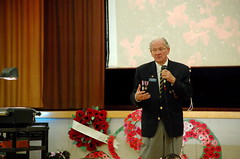 I went to St. George's School, a private boys' high school in Vancouver. It was founded in the early 1930s, so many of the school's first graduates fought in World War II. Quite a number of them died.
Each year on Remembrance Day, November 11 (even if it falls on a weekend, as it does tomorrow), the school holds a large service where the names of those dead former students are read out. It takes some time.
My daughters' public elementary school, Chaffey-Burke in Burnaby, also used to be my school, from kindergarten through grade seven. It held its Remembrance Day assembly yesterday, and I attended. The school was built in the late '60s, so none of its former students are veterans of the big wars, but the assembly was still a significant event. The staff work hard to make the remembrance something real, not a simple reciting of platitudes.
As part of the event, the school invited Mr. Tom Stewart, a local World War II veteran, to attend and speak. He brought a photo of himself as a boy in uniform, before he set out to fight, and reminded the students that kids like the one he was, teenagers not that much older than the pupils themselves, not only went off to Europe and the Pacific then, but are doing just as hard and dangerous a job in Afghanistan now. The military, he said, doesn't decide to fight—those are political choices—but youngsters are always the ones hired to do the work, to risk injury and death.
As they filed from the gym, each student shook his hand—many in a rush to get some lunch, but some with genuine appreciation.
Canada treats Remembrance Day pretty seriously, even though we haven't had a drastic war on our own soil. The carnage of World War I in Europe, which inspired the day, changed the demographics and politics and character of this country irrevocably. And Canadian coffins flown back regularly this year from Central Asia remind us that despite what we should have learned from all the horrors of the 20th century, peace is a long way off for many people in the world—ourselves included.
I've always treated Remembrance Day pretty seriously too, in part because of that list of names of my distant high-school colleagues. More so this year, as I face my own thoughts of death. Even a hardened cynic would find it pretty hard to hear 400 poppy-wearing little kids singing "Where Have All the Flowers Gone?" and not get a bit choked up. Especially when they start singing it again spontaneously at the end of the ceremony, long after they were supposed to be finished.
Labels: death, family, holiday, remembranceday, school, war