I've put together 14 high-quality original podsafe instrumental tunes from my Penmachine Podcast into a CD album you can buy. It also includes a bonus data DVD with a bunch of cool stuff that isn't on this website. Find out more...
Since words are what count, I don't care which web browser you use at this site. Okay, I do. I prefer you avoid Internet Explorer for Windows, but that's mostly for your own good. It works fine here.
This is "Penmachine.com: July 2005," a page that archives an entire month's entries from my online journal. The latest material for that month is at the top. For my newest entries, visit the home page.
Sunday, July 31, 2005 - newest items first # 10:51:00 PM:
Like Todd Cochrane, I don't quite have my head around the concept yet, despite seeing Dave's demo at Gnomedex, but I get the sense that it's the beginning of something important. Being able to edit an outline collaboratively over the network using OPML, which is an established standard format, and manually working with my RSS subscription file are certainly worthwhile, but I think there's more going on than that. I just don't know what it is so far.
That's life on the technology edge: having fun, but not knowing what the hell you're doing.
|
Saturday, July 30, 2005 - newest items first # 10:48:00 PM:
There are always conferences going on in the tech world, but certain ones have more buzz than others. Last month it was Gnomedex (or, as Steve Rubel called it, "Woodstock"), and this month it's BlogHer (which I'm not able to attend).
While not limited to women, today's conference focused on the experiences of women in blogging. And as you can see from the Flickr photos, the audience composition at BlogHer and Gnomedex was a bit different. But there were just as many laptops and other geek bling. And back in February, Northern Voice had a much more realistic mix of men and women, beginners and experts, locals and visitors.
Next week, some of my colleagues from work are heading to the Open Source Convention in Portland, which is less philosophical and high-level and more about actually writing code to do real things. I'll also be in Oregon, but not at a conference—like last year, my family and I are going to the beach.
Looking back on BlogHer now that it's over, Little Judy reports:
Another participant said she felt that people often don't go beyond their comfort zones and tend to only read blogs written by people just like them. She suggested everyone "find five blogs of people that don't look like you and learn something about them." Someone else suggested that everyone identify three people they know and help them create and learn how to use a blog.
Robert Scoble, who, like me, wasn't there, writes:
I'm really bummed I wasn't able to be there. But, actually, it's almost better than I'm not. As I read the blogs here I realize I'm part of the problem and need to just sit back, read, and hear what's being discussed there. [...] The ideas being discussed there are ones that we haven't yet discussed well in the blogosphere.
They're good ideas. And good ideas are what we need.
People sometimes ask me for advice about stuff. All sorts of stuff. Here are some of the things I recommend:
JaguarPC has been my web host since 2002. Initially, I signed up with Aletia Hosting (via Alistair), which Jaguar bought out—and that was good, because while Aletia was sometimes unreliable, Jaguar has been rock solid for me. Their pricing is insanely low: if you sign up for a year, you get 5 GB of storage and 75 GB a month of data transfers (no, those aren't typos) for under $100 USD per year, or less than $8 USD a month. Plus, on the rare occasions I've needed to contact them through their online support ticket system, I usually get a response within minutes, even at crazy late hours of the night. Sometimes it requires a bit of technical knowledge to do everything you want, but JaguarPC is reliable, has good service, and it's cheap. And no, I don't get a kickback if you sign up (at least I don't think so—but if they ask who referred you, mention penmachine.com!).
Jones Soda's Sugar Free Wild Black Cherry is the best diet pop I know of, although Diet Dr. Pepper and Diet Cherry Coke (not available in Canada!) tie for second.
If you have a Mac, install and use QuickSilver to launch applications and do other stuff. It's free. Every other computer will feel wrong once you get used to it. Look at the documentation to see how powerful it is.
Unless you have a specific reason for a particular, single usage in an individual place in a document—one which you can justify logically in writing to picky editors like me—use the serial comma ("pens, pencils, and erasers" rather than "pens, pencils and erasers"), and don't put two spaces after the ends of sentences when you type. No arguing. Just trust me.
I'm no style maven, but even I know that you have to be rather astoundingly hip to be able to pull off huge eyeglasses. If you have bad vision like me, they'll distort your face horribly, and you won't see any better, usually because large frames have to sit farther from your face, and so don't cover any more of your field of vision than tiny John Lennon specs that sit high up your nose. So even if you're old, get some smaller, more fashionable frames and you'll look better.
That's all for today.
|
Friday, July 29, 2005 - newest items first # 10:23:00 PM:
I wondered why this photo from Gnomedex suddenly became so popular, accounting for nearly half of all the views of any of my photos at Flickr. Well, after following the chain from Chris to Steve, now I know (click the "large number of Macs" link).
I also enjoyed the link to an old article in Wired by Dave Winer. What's interesting is that Bill Gates did turn the supertanker around—and now Dave hasn't been a Mac developer for years. Yet he also wasn't wrong 10 years ago. Despite its best efforts, Microsoft doesn't control the Internet. It managed to slow the change, and it may continue to ride the wave, but the company no longer defines where things are going.
If you're interested, the Voices for Change website has posted a copy of their settlement agreement (360 KB PDF) with Telus, which consists of several lawyerly exchanges, and that led to the block on their site being lifted.
If you prefer not to read the PDF, I've also set up a big honkin' image (190 KB GIF) of all 10 pages, which you may scroll through.
The phone tag is over. I finally spoke to the Executive Customer Relations Advisor at Telus just now, and while I'm not entirely encouraged, I'm at least a bit mollified. Some notes:
She's obviously extremely busy, but was willing to take a good 20 minutes to listen to me rant and rave (in a polite way) about Telus's blocking of the pro-union website. I'll excuse her calling me both "Dennis" and "David" a couple of times.
The best news is that Telus is no longer blocking the Voices for Change website. (I'm unsure of the status of other blocked sites, since I haven't checked what they are.) Instead, the company has talked to the site administrator, asking to have some of the more objectionable material removed—which is what they should have done in the first place. Discussion on the website about the matter is typically fiery.
Since I was never able to find the material Telus was complaining about, I don't know how bad (or not) it was, and I'm also not a lawyer. Apparently there were open threats to people crossing picket lines ("Do you know where your wife and children are?"), which could be illegal. There were also photos of those line-crossers—but since Telus security and others have also apparently been taking photos and video of union picketers and supporters (though not posting them on a website), that's more of a grey area. And the posting of confidential Telus documents (procedures for managers to avoid picket lines, for instance) is a breach of confidentiality agreements—whoever leaked those documents could be sued, fired, or whatever—but that's not criminal.
She told me that, "This [blocking sites] is not something that we do. But because of the position that we're in, this is something that we had to do," as an issue of employee safety. I countered that blocking the site, (a) didn't work, (b) was bad PR for Telus, and (c) might lose them customers. And she agreed without reservation. I also argued that there's no way for me as a customer to know, once this has happened once, that it won't happen again under some other pressure. Blocking sites is something Telus does, since the company just did it.
On the other hand, I do get the impression that Telus decision-makers may be learning something from the incident, because of the reactions of customers like me, bloggers worldwide, Slashdot, lawyers, and so on. But actions matter more than words, and we'll see.
Several times, my phone contact said that "the information shown [on the website] was illegal," but she never gave me a satisfactory explanation of how Telus, rather than the police or the courts, can decide that, and then mete out a penalty (even if the penalty didn't work). "I'm not in a position to determine whether it was legal or illegal," she said, but Telus's lawyers did look at the site before the block. But lawyers are neither police nor judges, and for good reason.
I also restated my argument that Telus was jeopardizing its previous positions (in court cases) that it is a common carrier, not responsible for the material carried over its networks. (That argument is why Telus and other ISPs didn't get sued over Napster or in other file-sharing cases, for instance.) I also noted that the site blocking contradicts item 37 of Telus's own Internet terms of service, which state:
You acknowledge that the TELUS Internet Services provide access to content, information and materials that are uncensored. You acknowledge that some of the content, information and material that is available through the TELUS Internet Services and the Internet may be inaccurate, offensive, harmful or in violation of applicable laws.
And again, she agreed that the company's recent actions contradict that part of the terms.
Ultimately, my argument was that, regardless of whether the material on the Voices for Change site (etc.) was illegal or otherwise objectionable—and irrespective of whether Telus thinks it has the legal or moral right to block the site—Telus customers like me (and other Internet users around the world) feel that we can't trust the company with our Internet anymore. Even people who didn't know about the labour dispute at all, people halfway around the globe, now think of Telus as the bad guy, which surely can't help. Like the governments of China and Singapore, this private company was trying to decide what it will let us see by blocking material it finds objectionable.
The site blocking is like a crack in the veneer, showing (accurately or inaccurately) the attitude of the company underneath. That makes me think about changing to another carrier. It already makes many others no longer consider Telus as a potential service provider. And, in the end, Telus needs customers, because that's what its business is about—helping people communicate. If we can't trust that we can communicate through Telus transparently, it will lose us.
I hope that's the message that got through. I hope it sinks in. Even when this labour dispute is over, Telus will have a lot of work to do to try to regain that trust. In the heat of a labour disruption, blocking a few websites seems like a small decision.
A couple of days ago I blogged and emailed about Telus, then one of the company's Executive Customer Relations Advisors phoned me, and I called back, and then the same person returned my call yesterday afternoon after 2:00 p.m., but I was at work, and I called back again later—and we still haven't managed to speak to one other directly.
Welcome to the modern world.
I've asked them to try my cell phone (also Telus) or maybe email. With any luck, I won't be biking my way downtown when they call.
|
Thursday, July 28, 2005 - newest items first # 1:52:00 PM:
So far I've heard nothing further from Telus, nor have I called them back. So, nothing to report. (I left a long comment at Darren Barefoot's site, though.)
Although I slagged (or "walloped," I guess) Microsoft's Wallop social networking experiment mercilessly a few weeks ago, if you're still interested in trying it out, I now have four free Wallop invitations to give you. Leave a comment or email me if you'd like an invite. Oh, and I found out that Wallop has been going since 2003—if their user interface is still so hopeless after nearly two years, I don't hold much hope for the project.
Following the appearance of some of my free instrumental tunes on some podcasts last week (Steve from the F1 Podcast said that reaction from his audience to my music was "very positive"), more shows have added me to their roster:
The Seattle and Beyond podcast played "Pirilloponzi" in episode 31, and featured three of my tracks in its next episode, number 32. Host Ken Clark even compared my guitar playing to Joe "Satch/St. Joe" Satriani's, which is tremendously flattering, but should give the genuine guitarists in my band a good laugh. (I'm a drummer in real life.)
Irreverent Experiments in Inconsistency also claims to have played one of my tracks, but the show site doesn't seem to have that episode's notes posted yet, so maybe it's for a future podcast.
Business hours are long over in Alberta, so I expect if I get another phone call from Telus about their blocking the pro-union website (actually, more than one), it will be tomorrow. I should say at this point that for the most part I have always been quite satisfied with my Internet, telephone, and cell phone service from Telus, and I was, until this week, not on one side or the other of the labour dispute.
Anyway, since I also sent email to Telus through their usual customer contact form, I received a reply from Technical Support (who likely don't know about the phone call from head office) as well. It's a form letter, which others have received too:
----- Forwarded message -----
Date: Wed, 27 Jul 2005 18:29:31 -0700 (PDT)
From: TELUS Internet Services Support
Subject: Re: Internet access inquiries
To: "Derek K. Miller"

Hello Derek,
TELUS has prevented access to voices-for-change.com from TELUS.com or
TELUS.net IP addresses.

This independent web site, which is hosted by a service provider outside
of TELUS, was blocked because it publishes confidential TELUS documents,
photos of TELUS team members who have chosen to continue to work, and
instructions on how to carry out harmful actions that impede TELUS?
ability to serve our customers.

While the web site remains operational, TELUS has blocked access to the
site to protect our employees, our assets, and reduce activities that
are clearly designed to limit our ability to provide the highest level
of customer service possible.

Access to the Telecommunications Works Union website
(https://www.twu-canada.ca) is not impacted by the above.

We apologize for the inconvenience.

Thank you for choosing TELUS as your Internet Service Provider.

TELUS Internet Services
Technical Support Help Desk
Alberta and BC: 1-877-310-TECH (8324)
Email: helpdesk@telus.net
Home Page: https://www.mytelus.com/internet/
"24 hours 365 days for you"
Here's my reply:
----- Forwarded message -----
Date: Wed, 27 Jul 2005 22:36:52 -0700
Subject: Re: Internet access inquiries
To: TELUS Internet Services Support

> This independent web site, which is hosted by a service provider outside
> of TELUS, was blocked because it publishes confidential TELUS documents,
> photos of TELUS team members who have chosen to continue to work, and
> instructions on how to carry out harmful actions that impede TELUS'
> ability to serve our customers.

Can you tell me:

(a) Whether you have contacted the website operator to see if the
material you object to can be removed, if you consider it illegal?

(b) If that has not worked, whether you have contacted the hosting
provider to ask them to remove any illegal material?

(c) Whether you have contact police or attempted to obtain a court order
for the material you consider illegal to be removed?

(d) What other sites you're blocking that you haven't told me or your
other customers about?

If the website is acting criminally or inciting criminal behaviour,
there are legal avenues available to Telus. If it is not, you may not
like it, but you shouldn't be blocking it -- especially because anyone
who wants to see it can use the available mirror sites, or another
Internet provider, and you're therefore not really preventing anyone
from viewing it. Not only that, but in your own terms of service you
write:

https://www.mytelus.com/internet/policies/TISAA.do

"37. You acknowledge that the TELUS Internet Services provide access to
content, information and materials that are uncensored. You acknowledge
that some of the content, information and material that is available
through the TELUS Internet Services and the Internet may be inaccurate,
offensive, harmful or in violation of applicable laws."

I understand that the rest of your terms of service and acceptable use
policy allow you to block this site. That doesn't mean you're right to
do so, or that you should, or that customers like me will tolerate it.

I work for a company that makes web-based software, and while I'm
representing my own personal views and not any of that company, your
actions here are telling me that, if an ISP such as Telus decides it
doesn't like what companies like my employer put on our websites or in
our software, then you might start blocking us from our paying
customers. I don't like that precedent, especially because Telus has
used the argument that you are a common carrier -- and therefore not
responsible for material people access over the Internet through you --
in legal proceedings in the past.

Now you're contradicting that. Should I believe what Telus has argued in
court (and which I believe to be correct), or what you have done when
push comes to shove (which I believe to be wrong)?

All you're doing here is giving yourself bad publicity, and making
people like me think of switching to other carriers for our
communications services. Over the rest of my lifetime, that's probably
something like $100,000 in revenue from my household alone that you're
looking at losing, never mind what decisions my children, family, and
friends make about telecom providers in the future.

Is that worth it?
How about that? Not three hours after I blogged about Telus's website blocking and sent them an email protest about it, I received this phone message while I was out of the house, from the Alberta 403 area code:
Hello, this message is for Derek K. Miller. It's [name withheld] calling from the executive office at Telus. If you could, please return my call at [toll free number]. Thank you!
This could be interesting. I'll let you know how it goes.
UPDATE: I reached voice mail only, so we'll see if they call back again. In case you're interested, here are Telus's Internet terms of service and the acceptable use policy. I should note that, according to those documents, Telus is fully within its rights to block the website in question. That doesn't make it right or something customers should tolerate, though.
B.C.'s major phone company, Telus, and its main union have been locked in fruitless contract negotiations for years, and last week that came to a head: the employees were in a strike position, and are now locked out. I'm not fond of the positions that either side has taken, but Telus lost much of any respect I held for them by blocking its Internet customers from viewing a specific website that strongly supports the union. (The company may also be cutting off employees' Internet access, but I can't verify that.)
Here's my problem with the site blocking:
Blocking websites is not what ISPs are supposed to do—if something is illegal or dangerous (which it doesn't look like this is), they need a court injunction or other legal remedy to remove offending content. Why is the company blocking this site, and not those that provide information on blowing stuff up, for instance?
The precise argument ISPs have made (to avoid being held liable for file sharing and illegal activities taking place over their networks) is that they are "common carriers," and not responsible for the content they transmit. Telus can't have it both ways. What other sites might the company prevent me from seeing? With this precedent, what would stop government or a lawsuit from making Telus block sites in the future? Will the company prevent union members from phoning one another too?
This only affects Telus customers (like me!), who may not be able to see the site at home, but who can easily access it through any other Internet service. So any argument that it protects people is bogus.
The Internet has (inevitably) routed around the problem by setting up a mirror site, so the block doesn't even work except as a bad PR move for Telus.
While there has been some vandalism of phone cables, quite possibly by disgruntled union members acting unofficially and illegally, this is different in that it is a formal position by the company.
So go visit vfc.proxy.pfak.org or www.voices-for-change.com, whichever works for you. And if you're a Telus customer, phone or Internet, then consider dumping Telus and switching carriers. After more than 20 years, I'm thinking about it.
|
Tuesday, July 26, 2005 - newest items first # 7:39:00 PM:
Microsoft's new MSN Virtual Earth is a pretty nice first try. It has some features that give Google Maps a run for its money, although some of MSN's space imagery is laughably out of date, and so far those photos only cover the United States anyway.
Here's one winner: you can zoom in a lot farther in some places with Virtual Earth than with Google Maps. Here, for example, is Virtual Earth's view of the Seattle's Bell Harbor Conference Center, home of the Gnomedex conference I attended last month. Here's as far as Google Maps goes.
Virtual Earth, like so many Microsoft products, looks cluttered, even at this early stage. But kudos to MSN for making their maps work in Safari on a Mac quite well—I wouldn't have expected that.
|
Sunday, July 24, 2005 - newest items first # 2:58:00 PM:
Well, okay, not everybody. But if you do, now you have it. Nothing like some slapback guitar for a Brylcreem-and-burgers hot summer night at the drive-in, I say, and "Meltdown Man" (3.9 MB MP3 file) is just that.
As usual, if you subscribe to the Penmachine Podcast, the song is probably already on your computer.
|
Saturday, July 23, 2005 - newest items first # 11:55:00 AM:
Okay, try to imagine the most Canadian photo you (or someone you know) have been in.
Being sworn in as a new citizen on Canada Day? Towing a maple leaf flag behind a dog team to deliver insulin to a group of moose hunters trapped in an igloo during a snowstorm? Paddling the Rideau Canal in a canoe while munching back bacon and drinking maple syrup? Arguing before a royal commission on health care with a view of Saskatchewan wheat fields in the background?
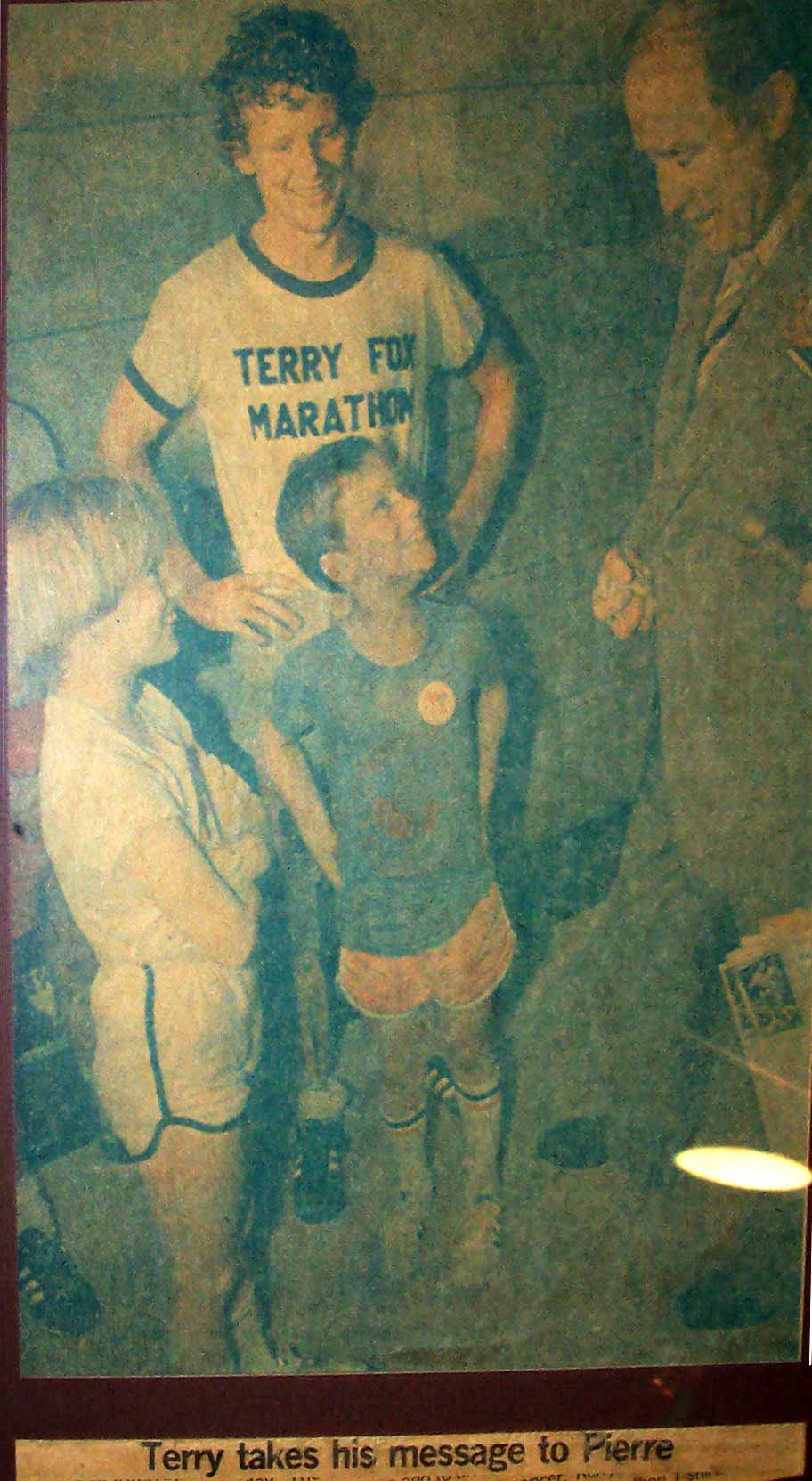
Sorry. Our friend KerryKLove has you all beat. I saw it, framed, on the wall of her father's home office at a party yesterday, and I stood staring at it for a few minutes before I had to sneak back in with my camera to get a copy.
She and her brother are kids. It's July 1, 1980 (Canada Day!), and they're helping to present a Marathon of Hope cancer research fundraising T-shirt...
...to Pierre Trudeau, while he was in his last term as prime minister...
The reason KerryKLove and her brother are in the picture is that their dad was the PR guy [not the camper driver, as I'd previously written - D.] for Fox during his run, and they were on the road with him for a good chunk of that summer. The encounter between the runner and the prime minister, which took place in Ottawa, was apparently awkward, because Fox had not yet garnered much publicity, and parliamentary staff had not properly briefed Trudeau, who didn't know about the run (rather Canadian in itself, I'd say). It would be their only meeting.
If you or someone you know is in a photo that's more Canadian, I'd like to hear about it here or at Flickr.
Anyone?
|
Friday, July 22, 2005 - newest items first # 8:23:00 PM:
Check out the new hybrid view on Google Maps. It gives you a satellite photo with major street names and routes overlaid on top—and as you zoom in, it gives you more detailed names and routes.
Now you can get street names and a sense of the foliage, buildings, and topography all at once. Nice job!
On a mailing list that Chris Pirillo runs, Vancouver blogger and conference organizer Darren Barefoot asked how to reduce the background noise he was getting when recording interviews with a setup that included nice unidirectional microphones and a compressor. Here's my response:
I'm writing here as a musician, not someone who records talk-show-style podcasts (I do have a podcast, but it's purely instrumental tunes for now—see below), but I've dealt with a lot of vocal recording, so this may still be informative.
One of the problems may be the compressor. Keep in mind that what a compressor does is reduce the dynamic range of your recording—it makes the loudest parts quieter, and the quieter parts louder. One of the quieter parts being background noise and hum. Depending on what you're doing with the compressor, that may be contributing to the noise level. See this page for some background on compressors and limiters (compressors that only lower the volume of the loud bits), and a little rant I did last year about how compression is overused these days (although it is certainly helpful when recording very peaky, dynamic stuff like speech).
A strongly unidirectional ("supercardioid" or "hypercardioid") mic with one of those foam windscreens will certainly help. You may already be using one of those, but the longtime standard is something like the Shure SM58, common on concert stages and podiums around the world. There are more expensive, more dedicated, highly directional microphones like those used by TV crews. Other options are lavalier (tie-clip) mics and headsets, which put the microphones closer to the speakers' mouths, and thus block out much more background noise.
Is the mixer powered, or is it running off the iBook's USB port or something? It would be better if it has its own power.
Consider a small power conditioner for when your laptop and recording gear is plugged in. Musicians use those in rack systems to reduce hum and noise from dirty power or bad power wires. Oh, and turn off your wireless Internet, cell phone, and other radio transceivers, as well as microwave ovens, fridges, and cordless phones (which you may need to unplug) nearby to try to reduce induced radio noise. That may be overkill, but every bit helps.
The room is important, more so than almost anything but the mic. There's a reason radio studios (including those portable trailer ones) have all that foam on the walls, and big thick doors and multi-paned windows. It's also why on-location radio shows (onstage at theatres, outdoors, at shows and in vehicles) sound so noisy, with everyone more prone to shouting, even when using the same high-end gear from the radio station. Lots of hard surfaces, fans, traffic, audience members, and so on will increase the noise level. So if you're recording a podcast on location, find the quietest, most carpeted room you can, and try sitting on soft chair away from big boardroom tables or other reflecting surfaces to reduce echoes.
Finally, get the mic as close as possible (but not too close—10 cm away is good) to the mouth of whoever's speaking at the time. If you can have two mics, one each for the interviewer and interviewee, or one for each member of a panel, that reduces the extra noise and awkwardness of flipping the mic head back and forth or having to pass it among the group.
With luck, you'll end up with audio that requires minimal post-processing.
And so, one of the ways you can ameliorate the noise is by using a mic processor that also includes an expander. This processes the sound in the complete inverse of a compressor - it exands the dynamic range, making loud sounds louder and soft sounds softer. You might think that the two cancel each other out, but they do not. In combination with a noise gate, which shuts the inputs off to the microphone when the sound level drops to an adjustable volume, these three processes can make the noisiest area a lot quieter.
I use several different mic processors, but the one that I usually come back to and specify for clients is the Symetrix 528E. EQ, compression, de-essing, expansion, phase correction - it's the box people want.
This is a bit dismaying if, like me, you're over 35:
Stanford neuroscientist Robert Sapolsky concluded that most people form their basic musical tastes by the age of 20. If a new genre is introduced after age 35, there is an astounding "95 percent chance that you will never choose to listen to it. The window has closed."
For me, I guess being in a retro-sixties band doesn't help matters. But it affirms that we'll have a decent market out there until people who grew up on that music pass on. And everyone, like me, who lived through the sixties revival about 20 years ago too.
|
Thursday, July 21, 2005 - newest items first # 11:55:00 PM:
Almost everything on this website is available under a Creative Commons license, which means that people can reuse my writing or music without having to ask permission, in most cases.
This week other websites have taken advantage of that:
Zaldor's World is a podcast from Detroit that features "Pocketbook" as the finale music for episode 38, which also includes some truly rude karaoke.
The F1 Podcast used several of my tunes as background music for show #5. The podcast covers F1 racing with a bit of humour, and its host Steve wrote that, "Guitar-based instrumentals are fairly rare on [the Podsafe Music Network] at the moment, so i was glad to hear your work as it was exactly what I was looking for. Keep up the good work." Thanks, Steve.
I think getting some of my work out there for people to enjoy or learn from is worth more than trying to keep it locked up on the off chance that I might someday make money from it. That's exactly what Creative Commons is trying to encourage. I don't see why some people find that so hard to understand.
|
Wednesday, July 20, 2005 - newest items first # 10:12:00 PM:
You could spend an entertaining afternoon simply setting the photos posted by Kris Krug on Flickr as a slideshow, then just watching the amazing images go by. (He has more than 4500.)
I'm trying to decide whether to set this one or this one as my desktop wallpaper.
Kris also provided some of the new photos of me on this site, although the home page one I took myself.
UPDATE: Kris now has a company. Go hire him (or Alastair, bien sûr) if you need a photographer.
It took long enough, but for the first time in almost 25 years, people bought more Apple personal computers than IBMs (how quaint of me, calling them "IBMs").
The IBM PC brand, however, is no longer owned by IBM, but by Chinese computer maker Lenovo, which has built most of IBM's machines for a number of years. And what used to be called "IBM compatible" PCs, now usually "Windows boxes," come mostly from Dell, Hewlett-Packard, and Gateway, who sell way more computers than Apple. And now way more than IBM/Lenovo too.
So my young geek self would have been overjoyed at Apple beating IBM. But for Apple users, IBM stopped being the enemy a long time ago.
Chris Pirillo and a number of others tried out Boeing's new Connexion in-air wireless Internet today. But it's not just in the air: Vancouver's Teekay Shipping, the world's largest independent oil tanker company, will be the first to deploy the same service (PDF file) to its fleet of ships, which will mean broadband Internet nearly anywhere in the world, air or sea.
And I tell you, that's going to make things a whole lot easier for Navarik, the company I work for. When you make web-based software, trying to get it to work on ships today, without a connection to the Web in mid-ocean, is tricky.
|
Tuesday, July 19, 2005 - newest items first # 11:24:00 PM:
Rockabilly, like some other musical styles (barbershop, big band, jump blues, and disco come to mind), is an anachronism. It arose 50 years ago, when thousands of musicians tried to sound like Elvis Presley, with the same hiccupy singing, train-chugging rhythms, and spanky, slapback-echo guitar that he, Bill Black, and Scotty Moore conjured up in Sun Studios in 1954. So any self-respecting neo-rockabilly band needs a hollowbody or semi-hollowbody guitar (preferably a Gretsch), a stand-up bass, crisp collared shirts, and pompadour hairstyles.
Still, rockabilly does rock. Paul Simonon of the Clash and his bandmates took it in some interesting directions with Havana 3AM as late as 1991. Around the same time, when I was trying to become a famous musician, contemporaries of mine in the Vancouver music scene were the Rattled Roosters, and while no one would have called them wildly original, their music—and especially their live performances—were a ton of fun. I've held a soft spot for rockabilly ever since.
Today I stumbled into the Rockabilly Guitar Page, which does a whole lot more than just talk about the style: guitarist Vince Gordon of the oddly-named, Denmark-based band The Jime describes in great detail what kind of gear you need to get a good rockabilly guitar sound, and then offers his $20 USD e-book How to Play Rockabilly Guitar and Get Good Fast!. From the sounds of the free download "Anyhow," he knows his Gene Vincents, if you get my drift.
So if you want to have a crack at rockabilly, you can start with a few free lyrics and chords from the band's albums. Don't forget your pompadour.
If you subscribe to my Penmachine Podcast, you probably already have another new song: "Stop Yield Go Merge." It's only two and a half minutes long, so go give it a listen.
You may have noticed a new picture of me at the top of the home page—the first official update in almost five years. With my hair so long (and with more grey), plus new glasses, it's about time.
|
Monday, July 18, 2005 - newest items first # 2:04:00 PM:
Something I've always wondered: What is the origin of the cliché when a leading character in a movie or TV show finds out some horrible secret ("I am your father"), and then screams to the sky "Noooooooooo!" (echoing), usually as the camera zooms upward away from him?
I've seen it parodied dozens of times, from The Simpsons to Toy Story 2. George Lucas even used it un-ironically in the last Star Wars movie (without the zoom), but when did it happen the first time?
|
Sunday, July 17, 2005 - newest items first # 10:50:00 AM:
If you're thinking of setting up a weblog for yourself and don't know what the best approach would be, here is a good overview of blogging tools from Online Journalism Review. It doesn't mention every possible tool, but it's a fine review of the market leaders and their relative merits.
On a related note, there continues to be much discussion about the new world of real-time blog-and-feed search, including Robert Scoble's post from early this morning about how some of the current search sites compare in number of results, for different types of search. If you're wondering what the fuss is about, it will give you an idea.
...takes you directly to my songs inside the iTunes Music Store, where they are (of course) completely free to get. Click Subscribe and you'll get the latest ones automatically whenever I update them.
I'll have to get a cool button for that.
UPDATE: Done!
|
Friday, July 15, 2005 - newest items first # 8:33:00 PM:
I've long wondered who on earth watches any of the seemingly unending series of supposedly funny and heartwarming movies where chimpanzees (or, on rare occasions, cute shaggy dogs) take part in sports like hockey, basketball, skiing, or skateboarding. No doubt the chimp (or dog) helps the underdog team win a plucky come-from-behind victory in each case.
There's one on TV right now—in which the pretty scenery and undisguised hockey arena of my hometown of Vancouver somehow stand in for nearby Seattle, with the use of occasional spliced-in shots of the Space Needle. (I'm in the other room, and even from here I can tell that the product placement in this movie is out of control.) My seven-year-old daughter said she'd prefer to watch the end rather than reading our usual bedtime book. "This is a great movie!" she said, and her five-year-old sister agrees.
Suddenly, I remembered that back in 1978, when I was about the same age, the first Clint Eastwood movie I ever saw was Every Which Way But Loose, in which he co-starred with an orangutan.
There's no trick to that: I just followed my own advice and wrote a well-structured article that tries to be useful and has lots of links in it. I pinged various notification services, found a spot in Wikipedia where I could make a valuable link to the article myself, and there it is.
|
Thursday, July 14, 2005 - newest items first # 9:13:00 AM:
Those of us who use computers made by Apple (and I've been one for 25 years now) tend to have a rosy picture of the company: as an innovative, artsy underdog, more interested in style and a good user experience than in raking in money, like big bad Microsoft, IBM, and Dell. Yeah, sometimes the company does dumb things, but we forgive it like a prodigy—after all, sometimes genius breeds eccentricity, right?
That is utter BS. While the company and its co-founder and leader Steve Jobs are style mavens (most of the time), that's because emphasizing style and usability helps them rake in the money, which is precisely what Apple is doing right now. People spent 150% more on Apple stuff this quarter than last year at at this time, and profits on those sales are up more than 500%. While sticking to their principles of good design (again, most of the time), Apple's team is also competing ruthlessly, using subterfuge and sometimes turning the company on a dime in order to sell more stuff, and keep competitors selling less stuff.
Two recent examples:
John Gruber's analysis shows why Apple rushed madly to include podcasting support in iTunes, bugs and all, even while it's still an infant technology, and small podcasting startup companies haven't even made it to market yet. (Most podcasters are still talking about podcasting, and interviewing other podcasters—always a sign of early days.) In short, it is a way to solidify Apple's lead in the MP3 player market. A big reason to do it right away was also to establish podcasting (based on iPod) as the word, so that when referring to audio subscriptions, everyone else who makes players either has to use the name of Apple's product or try to ignore the trend and hope it goes away. Take that!
In The Register, Andrew Orlowski points out that Apple's recent commitment to using Intel processors starting next year might not be based on technology alone, since IBM has some powerful stuff coming in the current PowerPC architecture. Instead, Jon Stokes at Ars Technica thinks that it may be more of an attempt from Apple to get good prices on silicon chips for Macs, iPods, and other devices. In other words, never mind pure technological elegance: it's about the business.
Does it work? Between buying my Power Mac G3 in 1998 and our eMac last year, I had hardly spent anything at all on new Apple products. Now, just since the beginning of this year, my family has two new iPod shuffles, several accessories for them (including an Apple-branded sport case), and, most recently, a brand new iBook. The last one was the biggest expenditure, and my wife made it. Unlike me, she is no Apple zealot—last year she had been thinking of buying a Windows laptop.
That's all money that didn't go to Dell or Creative or HP or Sony or Microsoft. I guess the ruthlessness pays off.
|
Wednesday, July 13, 2005 - newest items first # 2:59:00 PM:
Those who've been using the Web since its early days remember the search engine wars of the mid-1990s, when HotBot, Magellan, AltaVista, InfoSeek, Northern Light, Lycos, Yahoo!, and a host of others tried to outdo one another in indexing and processing web pages to yield search results. At first, they worked (sort of), then they got hijacked by keyword spammers, and then Google came along in 1998 with a different approach to the problem and ate them all for breakfast. Now there is a similar search war going on, but this time it's for blogs and news feeds, and the fallout is beginning too.
Despite many attempts, none of the hundreds of surviving search sites has managed to unseat Google. When it moved out of beta, it amazed everyone with how much it improved search results—because it harnesses the judgment of everyone who builds web pages, it uses the intelligence of millions of people instead of the brute-force calculations of computers of its predecessors. It has become so pervasive that it influences how people write for the Web.
It does not do especially well with real-time information, however—it often takes several days for news and blog posts to make their way into Google's index, and it is not designed to give particular weight to the increasing use of syndication using RSS (Really Simple Syndication) and similar XML-based feeds. In recent years, services such as Technorati, Daypop, Feedster, PubSub, Popdex, Furl, Bloglines, and del.icio.us have tried various approaches to indexing and searching material from blogs, news feeds, and other constantly-changing sites and data flows in and around the web. New sites such as IceRocket are trying too. • [READ MORE at Navarik's Windward...]
Right about here (I think), northeast of San Francisco, California, above the famous Napa Valley, lies the Monticello Dam, which has created Lake Berryessa. Instead of the usual sub-surface spillway, it has a massive concrete pipe sticking up out of the surface of the lake behind the dam.
When the water level gets high enough, it starts draining down the pipe, known as the Morning Glory Spillway or, less formally, the "Glory Hole." Then it becomes a disturbing image: a huge, sucking hole in the water.
As Barc, who pointed me to this, wrote, "Seriously, that's one freaky construction. We don't do anything nearly as cool with our dams up here [in Canada]."
|
Tuesday, July 12, 2005 - newest items first # 11:03:00 PM:
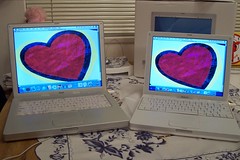
Today my lovely wife bought her first-ever computer. Aren't ours cute together? (Come on, all together now: Awwwwww.)
She's been using computers for ages, as you would expect—her teacher colleagues come to her each June when they need help getting their marks properly set up in the school's database. But up to now, she's always used a machine at work, or one of the many I've accumulated or we've bought together over the years.
Now she has her own. And I've got to learn to keep my mitts off it.
Incidentally, for those of you who are married to a geek, but aren't geeks yourselves: your geek spouse will not mind at all if you get up in the morning and ask to go shopping for a laptop. We'll probably be first to the car, in fact.
|
Monday, July 11, 2005 - newest items first # 11:45:00 PM:
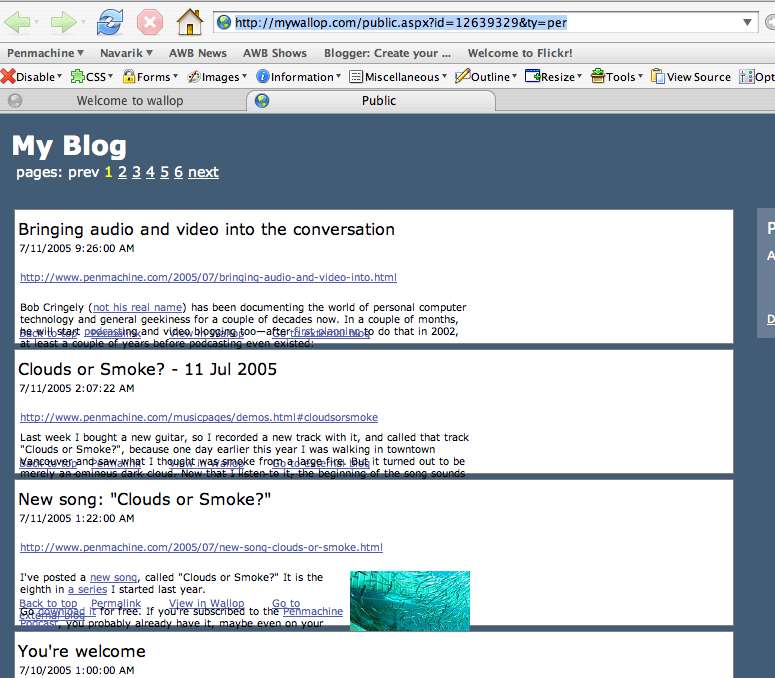
Microsoft, not surprisingly, has a research division, which has a Social Computing Group that tries to "research and develop software that contributes to compelling and effective social interactions, with a focus on user-centered design processes and rapid prototyping." One of their new projects is Wallop. Today I received an invitation from one of my work colleagues to try it out.
(Aside: The subject line in the invitation email was "an invitation to wallop," all lower case. I'm shocked that my spam filter didn't kill it, since if that doesn't look like a spam subject line, I don't know what does.)
What is Wallop?
It says, "in Wallop, you can share photos, blog, and interact with your friends. Wallop is a research project that explores how people share media and build conversations in the context of social networks." I do all those things alresady, using tools like Flickr, Blogger, email, instant messaging, comments, trackback, and such high-tech things as phone calls and personal conversations.
So, I thought, Microsoft must have something compelling going on here—a new way to consolidate those things that makes them more than they were before, perhaps. Or at least some clever ideas and usability innovations. Or, maybe they were just trying another tack on the whole social networking-blogging-photo sharing-syndication-music thing, to see if some network effects could emerge.
Fun with a sledgehammer
Wallop turned out to be fun to go through, but not in the way Microsoft expected, I think. It was fun in the same way watching stuff blow up in a disaster movie, or smashing up a derelict car with a sledgehammer, is fun. Wallop's online user interface is a mess, so much so that I gave up on it after 20 minutes (and only that because I'd resolved to document some of its problems) without figuring out what it was actually supposed to do.
Now, I use a Mac, so maybe some of this stuff works better using Internet Explorer and Windows XP. Maybe others have fun with Wallop, or find it helpful and useful. But, sad to say, I doubt it—certainly many of the problems I'll mention here appear to be design choices rather than technical limitations.
NOTE: If you're interested in checking out Wallop for yourself, I think I can invite you to join (though I haven't figured out how yet). Leave a comment or email me if you'd like an invite. Read the rest of this entry first, though, to make sure you want it.
My comments
Here's what I wrote to the Microsoft Social Computing team:
Why all the Flash? Most of the interface would work just as well or better using regular HTML, and maybe some Ajax. The Flash just makes it slow on my old iBook G3, and creates non-standard interface elements that make me think I'm using Windows XP -- yikes. All the red Xes and random "helpful" popup windows just cause OS-interface cognitive dissonance for me.
Flickr uses Flash creatively and well, but even they have been moving more toward standard HTML, CSS, and JavaScript over time.
Flash has its uses, but it's generally unnecessary, and wasteful, for building interfaces for web applications. Too often, Flash is just a way for UI teams to get all control-freaky about how things look or where they go. The web is about the client software interpreting the standards, and that means you can't rely on everything -- even in Flash. Go with the flow.
Speaking of interface elements, anytime something needs to have a "clickable..." tooltip when you hover over it, that's a sign that the graphical interface isn't doing its job. If it's clickable, it should look it, and if it needs a label saying that, it doesn't look right. Almost everything in Wallop says "clickable..." when you hover over it. No tooltip at all, and intuitive clickability, would be far preferable -- but if you insist on it, at least have the tooltip describe what I might be able to do. It's supposed to be a tip, right?
In both Firefox and Safari, the HTML blog looks awful. And why on earth, I wonder, would the public HTML blog be something separate from the blog in my Wallop home page? It's a blog! There need be only one!
Oh yeah, it's in Flash. That's why. Sigh.
I wanted to re-skin my page (something the first help tip told me I could do when I logged in) to get rid of all the extra UI frou-frou (background images etc.) and simplify it, but when I tried to do that, here's how it went:
Skinning Options
Give it a Name
"You Must Be Using This Skin First." What? How could I use a skin I haven't even created yet?
Click Proceed. Nothing happens.
I discovered how to remove the background image, but the rest of the skinnability remains a mystery. Oh, hang on, now I find I've created three skins without knowing it. And the background image keeps coming back. Agh! How about just including skins as a pane in my Preferences, or at least indicating what I can change and how? Right now I'm just clicking around seeing if I can change things, and I have no idea if any of the work I put into the changes will stick.
Many of the tabs and other elements, like the public HTML blog, have overlapping or otherwise gorped-up text, which means I just have to click randomly to figure out if they work and what they do.
The Wallop blog can automatically aggregate various RSS feeds, which is cool, so I added two of mine (my blog and my podcast), but the interface only displays the URL of the latest one in the sidebar's Preferences tab, which made me think that I could only have one, so I ended up adding my main feed twice. Has it been aggregated twice? I don't know, since instead of a nice single-page scroll for my blog, it's divided into awkward pages with buttons to go from one to the other, so it's too much of a hassle to check.
The Music (which should maybe be Audio) tab doesn't understand podcasts, which would be a simple way to get audio files into Wallop. And to add music, I can't point to a URL, but must upload from my local machine.
Try running it on a 1024x768 laptop screen. Things get lost at the edges, at least on a Mac.
When I first logged in, the top and left sidebars were disabled because I had to go through the tutorial/intro first. But nothing indicated that, so I thought my browsers just didn't work with Wallop. If you want people to go through the tutorial, just hide the other elements in the meantime, so we won't try using them to find out that we can't.
How do I make the music player go away? Oh, and if I click Surprise Me, why does it always Surprise Me with the same song?
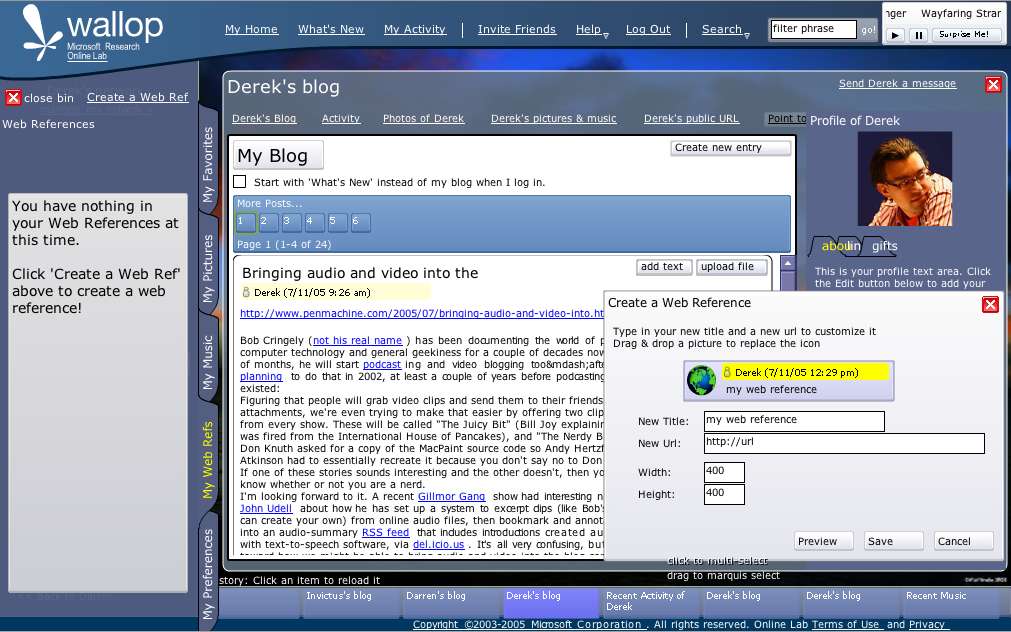
Oh look, another help popup! (You're doing a good job of turning my Mac into a Windows XP machine.) "We've just added a new object type for Wallop to encapsulate web references." Well, okay. I work for a developer of web-based applications, and I've been using personal computers since 1980, when I was 10 years old. I've had a website since 1997, and a blog since 2000. I've been invited to speak at conferences about this stuff, and I get paid to give seminars on using software and making websites. I'm the definition of the non-programming power user. I don't have a bloody clue what that little popup message means.
The left sidebar and "bin" (a sidebar that semi-translucently goes over the other sidebar) are confusing. When I had the tabbed bin on top, I didn't realize that the regular sidebar, with my contacts and stuff, wasn't part of the bin, but underneath it. I couldn't figure out how to get to it, but when I closed the bin (expecting it to slide away and make the main content pane bigger), it revealed the contact links underneath. Neat, but needlessly complicated and unintuitive.
Now I have a bunch of blobby tag-like things at the bottom of my Wallop window, three of which are called "Derek's blog." I wonder what they are? Oh, I clicked one, and it made another blob, as well as displaying the content. Hmm. I still don't know what it was or what I did. They have menus, one item of which is "open this query." Query? I didn't make any queries. Is this some sort of SQL thing?
So, overall, I haven't found out whether Wallop might be useful or fun or pleasant or cool, because the interface is so obscure, un-discoverable, slow, and buggy that I can't clear my head enough to see what's going on underneath.
Sure, I could run through the tutorials and all the help and stuff, but why? Right now I get the impression they wouldn't help me anyway, since the "elevator speech" blurb for when I signed up didn't actually tell me anything compelling about Wallop to start with, and I only followed through because the link came from one of my co-workers.
I don't have to use this for my job. I have blogs and photos and media and comments and cross-posts and stuff already through Blogger and Flickr and podcasts and other services I've been using for years. And I didn't have to read any help or tutorials just to understand what they were for when I got started either. So far it's given me a fun opportunity to rant about user interface, which I'm prone to do, but that's about it.
Right now, I still don't even know what Wallop is supposed to be or do. I know it's a research project, but so far my only impression is that it might be research to see how much time people like me will spend trying out a frustrating interface with no clear purpose before we give up.
</RANT>
P.S. Let me know if you've completely re-thought the Wallop interface and maybe built it with some leaner technologies. I'd be happy to try again.
After I sent that email, I thought that if Wallop is an example of "a focus on user-centered design processes and rapid prototyping," its developers had better get more rapid at prototyping, and talk to some more users. And before you go all medieval on me for being so critical of an unreleased, pie-in-the-sky research project, hold on.
Walltop is from a social computing group, trying to make software for people to interact. The biggest part of online interaction is having a useful, easy, fun interface. That's why Flickr and Blogger and MSN Spaces (from Microsoft!) and Google Maps and Amazon and eBay are so popular. They're easy. It's why the iPod is huge, even though there were MP3 players around for years first. If Wallop isn't easy, if it's actively unpleasant to use, it's stillborn.
Bob Cringely (not his real name) has been documenting the world of personal computer technology and general geekiness for a couple of decades now. In a couple of months, he will start podcasting and video blogging too—after first planning to do that in 2002, at least a couple of years before podcasting even existed:
Figuring that people will grab video clips and send them to their friends as e-mail attachments, we're even trying to make that easier by offering two clips of our own from every show. These will be called "The Juicy Bit" (Bill Joy explaining how he was fired from the International House of Pancakes), and "The Nerdy Bit" (how Don Knuth asked for a copy of the MacPaint source code so Andy Hertzfeld and Bill Atkinson had to essentially recreate it because you don't say no to Don Knuth).
If one of these stories sounds interesting and the other doesn't, then you already know whether or not you are a nerd.
I'm looking forward to it. A recent Gillmor Gang show had interesting notes from John Udell about how he has set up a system to excerpt clips (like Bob's, but you can create your own) from online audio files, then bookmark and annotate them into an audio-summary RSS feed that includes introductions created automatically with text-to-speech software, via del.icio.us. It's all very confusing, but points toward how we might be able to bring audio and video into the blog conversation, along with written text and images.
Chris and Ponzi of Gnomedex fame love Vancouver. There are reasons so many of us lifelong Vancouverites never leave, you know.
And sorry to say, while I like Tim Hortons coffee, it's not really that good, objectively. It's good, but not great. Tim's just put lots of cream in it, it's not over-roasted like Starbucks, you can get it anywhere in this country, and it's cheap. That's why so many Canadians like it, I think. So Chris is right not to think it anything special.
|
Saturday, July 09, 2005 - newest items first # 2:17:00 PM:
I recently bought a new guitar as a present to myself for my birthday. Looking for it took several days of trying out many instruments, which created new calluses on my fingers.
I still have to add a whole ton of links to the article—to manufacturers' websites and online reviews—but I have photos and discussion of over 20 different guitars there, so it's probably pretty useful already.
|
Friday, July 08, 2005 - newest items first # 12:55:00 PM:
My parents return from a month in Europe today. We've missed them—my oldest daughter has kept a photo of them by her bed the whole time.
Try to imagine how amazed someone 100 (or 1000) years ago would have been if they could understand this: My parents are taking only about 9 hours to return from Europe, flying a third of the way around the world in a metal tube in the sky. And, here in my kitchen, I can type a few letters on a keyboard and see, on a flat, electrical screen on my laptop (which, incidentally, has no wires connected to it at all), a map of where that metal tube is right now (over southern Greenland) and how long they have left to fly (about three and a half hours).
That last part would have been amazing 10 years ago, never mind 100.
|
Thursday, July 07, 2005 - newest items first # 11:23:00 AM:
Apparently, a 5000-year-old leather-and-straw shoe design is more comfortable and useful than nearly all modern footwear. Still, it looks like the person who left some prints in Mexican volcanic ash perhaps 40,000 years ago (about 30,000 years earlier than many scientists thought there were people in this hemisphere) walked barefoot, which is still a good option if you have tough soles.
Thanks to the Google Maps Pedometer (no good in Safari, but it works in Firefox on a Mac), I now know that my bike route to and from work is almost exactly six miles (or nearly 10 km) either way, which was about what I had guessed. Back in the day, when I used to cycle to university and back, I was traveling about 20 km each way.
And in 1991, when I was working at one university and going to school at another, there were occasions when on one day I would ride my bike close to 60 km in a single day's commute.
That summer I was about as in shape as I've ever been.
|
Monday, July 04, 2005 - newest items first # 11:57:00 PM:
My wife was secretly a bit glad that I had a fairly crappy birthday last Thursday, because she had been planning a surprise party for me on Saturday all along, and if it went well, it would be a nice contrast.
I can now officially say that it was a fabulous weekend, and a great party, and she is the very very best for putting it together for me. Not only for the party, but because I spent all day Saturday shopping for a new electric guitar, and finally found one (I'm writing an advisory article, similar to my digital piano piece from 2003), then had a pedicure at the spa (which I now realize was a way to keep me out of the house).
Even the surprise was extra-surprising. I came home earlier than expected because my spa treatment went quickly, but there was no outward sign of anything unusual at our house. I walked in the front door and heard people in the living room. At first I thought some friends had walked there to drop in for a visit, but within a second or two I realized there were too many voices. I figured out what was going on—and was completely surprised. But I had a few seconds to decide what to do.
I spotted my aunt walking to the living room at the top of the steps, so before she could say anything I rushed up to the edge of the living room and yelled, "SURPRISE!" at the top of my voice.
"AAAGH!" said everyone else, not expecting me for almost half an hour. So I got a surprise, and so did they. That's a surprise party.
Then the next day my wife and youngest daughter and I (our oldest is visiting grandparents in Maple Ridge, an hour east of Vancouver, for a few days) went to see my bandmate Adam Woodall play with his own band at the beach in West Vancouver on a beautiful warm summer night.
Much better indeed.
|
Friday, July 01, 2005 - newest items first # 1:35:00 PM:
Apple has now added my Penmachine Podcast—a free subscription to new songs I compose and publish here on my site—into its directory, so in addition to the drag-and-drop subscription method, you can now instead:
Click Podcasts in the Music Store's left-side menu.
Search for "penmachine" or "derek miller" in the search box at the top right of the iTunes window.
Click the Subscribe button.
Here's what it looks like:
There might be a way for me to construct a link directly to the podcast in the iTunes store (rather than just here on the website), but I don't know of it yet.
I forgot to mention one more thing that happened yesterday: After I carried the stitched-up one from the car into the house at 12:30 a.m., I forgot to close the car door, so it was yawning wide open all night. And it rained. And two huge moths decided to hang out inside, only revealing themselves when we drove the car around in the afternoon.
Yet in many ways this has been a good week. For example, more than five years after an initial controversial church wedding spurred action, and two years after proposing a bill, Canada's parliament passed a law permitting same-sex marriages across the country. While the debate seemed endless—there's no way I would call it "fast tracked"—as a social policy change, five years is pretty quick. As far as I know, none of my gay friends is planning to get married anytime all that soon, though.
Even more revolutionary, then, is that apparently you don't need to wait an hour after you eat before you go swimming. I know a lot of people planning to go swimming soon.


![[Creative
Commons License - You may reuse my original content from this site non-commercially, with attribution.]](https://www.penmachine.com/images/somerights.gif)

![[RSS syndication feed]](https://www.penmachine.com/images/rssfull.gif)
![[RSS comments feed]](https://www.penmachine.com/images/rss_comments.gif)
![[Penmachine Podcast]](https://www.penmachine.com/images/rsspodcast.gif)








![[Powered by Blogger]](https://www.penmachine.com/images/blogger_button.gif "Blogger powered")
![[Powered by BlogRolling]](https://www.penmachine.com/images/blogrolling_button.gif "Blogrolling makes the link list")


![[Layout with CSS and no tables]](https://www.penmachine.com/images/css_tableless.gif)
![[Viewable with any browser]](https://www.penmachine.com/images/allbrowsers_button.gif)
![[Meets U.S. Section 508a accessibility guidelines]](https://www.penmachine.com/images/sec508a.gif)
![[Weblog Commenting by HaloScan.com]](https://www.penmachine.com/images/haloscan.gif)
![[Video preview]](https://www.penmachine.com/images/planet_ed_preview.jpg)

 Now that there is a Mac version of Dave Winer's OPML Editor, I've downloaded it and started giving it a spin.








![[Subscribe in iTunes button]](https://www.penmachine.com/images/itunes.gif)
![[Godin LG oblique view]](/musicpages/musicimages/godin_lg_black-oblique.jpg)


![[Wallop encapsulates web references! Right on! (Huh?)]](https://www.penmachine.com/images/wallopwebrefs.jpg "Wallop encapsulates web references! Right on! (Huh?)") Microsoft, not surprisingly, has a
Microsoft, not surprisingly, has a 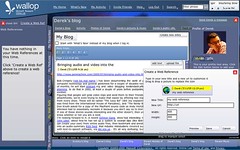



![[Evacuating a London tube tunnel]](https://newsimg.bbc.co.uk/nol/shared/spl/hi/pop_ups/05/in_pictures_enl_1120742501/img/1.jpg)

![[iTunes podcast screenshot]](https://www.penmachine.com/images/itunes_podcast_penmachine.gif)
![[Canada Day]](https://www.theneurotics.com/canday2002/Thumbs/0.jpg "Canada Day")