Penmachine
28 April 2010
Following the camper
My former co-worker Chris got married to Kerry recently, and they're posting travel photos from their camper-van U.S. honeymoon, which have been great fun to follow. What I especially like is that their wedding presents included sponsorships of various parts of their journey, and they include thank-you printouts in many of the pictures, like this and this.
It's all just terribly charming. I've traveled a lot in the western U.S.A. over the years, especially Oregon and California, so their photos bring back many fond memories. Oddly, I've never visited Yosemite National Park. Maybe someday, if my health improves. Maybe.
Labels: americas, blog, friends, navarik, photography, travel, wedding
01 February 2010
My 13 jobs
This month, February 2010, marks three fricking years since I first went on disability leave for cancer treatment. (And, incidentally, since we got our Nintendo Wii.) This got me thinking about all the jobs I've had in my life, starting back when I was still in high school.
It turns out that I've worked for 13 organizations, if you include my own company when I was freelancing. I did not enjoy every job, but each taught me something:
| Year(s) | Job | Lesson |
|---|---|---|
| 1985? | Graveyard-shift self-serve gas station attendant | Don't be a graveyard-shift self-serve gas station attendant. Also, burnt coffee smells really bad. |
| 1988 | Park naturalist | Science is fun, five-year-olds aren't patient, but summer jobs are a great place to meet your future wife. Also, avoid flipping your canoe. |
| 1989 | Science centre floor staff | Science is fun, but you'll spend most of your time telling people where the bathrooms are. |
| 1990 | Student handbook editor | Choose your fonts carefully, and people never get things in on deadline. |
| 1991 | Student society admin assistant | It's a long way to pick up your printouts across campus when you type them on a mainframe computer. |
| 1991 | English conversation coach | Japanese girls definitely interested in learning English; Japanese boys (who smoke like chimneys), not so much. |
| 1992–1994 | Student issues researcher | Creating your own job is great, but it sure would be nice to have an office with a window. |
| 1994–1995 | Full-time rock 'n' roll drummer | Playing live music onstage is often awesome. Everything offstage, however, usually sucks. |
| 1995–1996 | Magazine advertising assistant | No matter how nice your co-workers, a bad boss can ruin the whole experience. |
| 1996–2001 | Various software company jobs, from developers' assistant to webmaster | Even if you know almost nothing about how to do it, when someone asks you if you want to run a website, it's still worthwhile to say "sure!" |
| 2001–2003 | Freelance technical writer and editor | The paperwork to run your own business is immensely boring. |
| 2001–2003 | Semi–full-time rock 'n' roll drummer | Rock is more fun when you mostly stay in town and get paid better. |
| 2003–2007 | Communications Manager, Navarik | Working with friends can be a good thing, especially when they have good ideas. Oh, and a decent extended-health plan is really, really important. |
In the late '80s, I also helped my friend Chris install alarm systems in people's homes and businesses, but while I got some money from it, it wasn't quite a job in the same way. It was more like when I helped him repair cars and resell them around the same time. Though in those cases, I did learn that I dislike crawling around in fibreglass-filled attics running wires, and that I'm not too fond of all the grease, gunk, and rust involved in auto work either.
Labels: anniversary, band, cancer, editing, ego, memories, navarik, neurotics, nintendo, wii, work, writing
30 August 2009
Old man, look at my life
 I've come to realize something in the last few days. My cancer treatment drags on, keeping me alive but not really getting me better. I continue to manage my diabetes and live with an artificial IV port in my chest. I take lots of pills and shots, get medical tests, and see doctors all the time. I can't safely travel very far.
More to the point, I hurt, and I'm tired. Many parts of my body simply don't work the way they're supposed to. Most of the time, I'm nothing close to genuinely well. I may never return to my great job. I've been like this in some form or another for more than two and a half years.
So here's what I realized. I'm a 40-year-old man whose body has become much older. I'm a youngish guy in an oldish container. There are plenty of people three decades beyond my age—including my own parents—who feel better than I do, and can do more. And the hard part (for all of us) is knowing there's a good chance they'll live longer than me too.
For the vast majority of human history, living to age 40 was an achievement in itself. Even a hundred years ago, Type 1 diabetes like I have was a death sentence too—I would have died in my early 20s, before I had a chance to marry my wonderful wife or have two great children. I'm glad I've had those chances.
If I were (for instance) 75 years old now, it would be easier to accept what cancer has done to me, and to acknowledge that living (for example) another five years would be a pretty good achievement. I'm trying to think more like that—not to be fatalistic, but to be pragmatic, to know that while I'll keep fighting, without radical new treatments or some very good luck, it's probably a losing battle. But that's not a failure.
I'm sitting on the back porch in the sun, drinking a coffee. In a few minutes I'll help my kids make some cake. It's a good life.
Labels: age, cancer, death, diabetes, family, navarik, pain
06 December 2008
My friends at work know me well
While my cancer treatment means I haven't been able to work for my employer, Navarik, for close to two years, I still make time to attend a few company events, including the Christmas party last night in downtown Vancouver:


This year my colleague Nathan and his wife had an excellent idea for our traditional employee gift exchange: instead of getting each other trinkets, we were to imagine what our assigned recipients would have liked when they were children. They would get to open the wrapping in front of everyone at the party, then say whether the choice would have worked for their childhood selves. Now that the unwrapping is over, Navarik will donate all the presents to a children's charity for Christmas. Perfect!
Even more perfect? Whoever was matched with me gave my childhood self a matching set of a toy camera with a toy microphone. How about that?
Labels: friends, holiday, insidehomerecording, navarik, photography, recording, vancouver
29 September 2008
New site design for Navarik
I've worked for Navarik, a company started by some of my university colleagues, since 2003. But I was involved with the the organization almost from the beginning in 2000, doing freelance writing and editing work and helping out with the website. That site has been through numerous incarnations over the past eight years, including a new version that just launched this week. Here's a comparison of what the home page has looked like over the past three generations (2004, 2006, and now 2008):
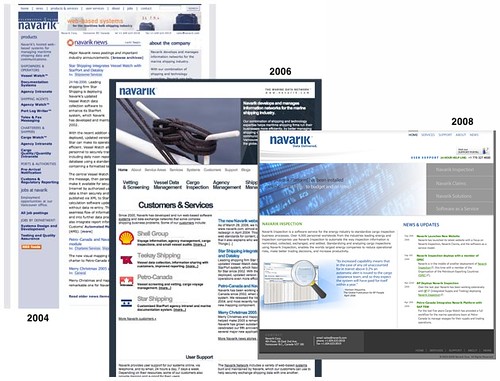
The overall feel of the site hasn't changed too radically: the blue-and-white colour scheme has been there all along. The logo, designed by Ryan in 2001, is also much the same. But the company itself has shifted its focus, so that it now describes itself as "a software service provider to the petroleum supply and trading industry." It began back in 2000 as a developer of web applications for small marine shipping agencies and shipbrokers, but now our customers include some of the largest companies in the world, such as Shell and BP.
The fine new site is much more straightforward and reflects what the company does far better than the previous one. Yet it does make me a little melancholy. I've been off work for more than a year and a half because of my cancer treatment, which means that I had nothing at all to do with this redesign, whereas I was in charge of the previous two. This relaunch is the first time I've been uninvolved for many years.
Labels: design, navarik, oil, web
11 March 2008
Why I'm itching to get back to work eventually
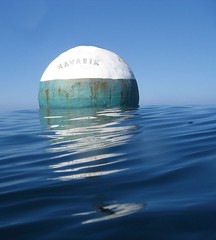 It's been fascinating, if frustrating, to watch from the sidelines as the company I work for, Navarik, has done some amazing stuff over the past year. Most recently, they launched a new version of Navarik Inspection, our web-based application that helps petroleum companies keep a handle on the oil they're moving around the world.
That sounds like a pretty big deal for a small Vancouver company. It is. When people ask me what Navarik does, I use part of Navarik Inspection as an example. Here are the basics:
- When an oil tanker pulls up to a terminal to load, the company shipping the oil wants to know, (a) how much oil gets pumped in, and (b) what the qualities of that oil are.
- To confirm that, they hire a third-party cargo inspector who works near that terminal to check the various pumping measurements, and to take samples of the oil and analyze its properties, such as sulphur content, etc.—as well as to assess the state of the ship's tank, including (for instance) how much accumulated sludge is at the bottom.
- Another inspector performs similar measurements and analyses several weeks later at the discharge port, where the oil is unloaded.
- The information reported by the inspectors goes back not only to the shipper of the oil, but also potentially to a whole mess of other companies and people, often including the terminals, the ship's crew, the ship owner and operating company (which can be different), both the buyer and seller of the oil, various others involved in the transaction, and possibly government and regulatory agencies as well.
- Each company receiving that information might do a bunch of stuff with it, such as passing it among various departments and through a bunch of computer systems for accounting, payment, analysis, and so on.
- Especially with oil at record high prices, having that quantity and quality information be accurate is pretty important.
- Until rather recently, a lot of the inspection reporting involved somewhat ad hoc systems of fax transmissions, emails, phone calls, courier shipments, and typing of the same information several times over into different computers at different places by different people—which risks delays and errors.
So, again, when people ask what Navarik does, I can go through the rigamarole above, and then explain how we've built a web-based software program that inspectors can sign into securely from any web browser on any computer (just like an online bank, or Gmail, or Amazon) and find out what shipments they've been hired to inspect. Then they can head down to the terminal, do their work, and come back and use that same computer (or a totally different one) to enter the reporting information, which goes directly over the Internet to the people who need to use it.
There's a lot more to it than that, obviously—mechanisms for other people to put together the lists of tests to be performed, procedures for nominating and contacting inspectors, information about ports and terminals around the world, thresholds for alerting people when inspection results are out of spec, and so on—but the overall result is that the whole cargo inspection process can go more smoothly. Information moves more efficiently and is more accurate, and people get paid quicker. And we have other web software solving similar problems for other companies too.
What I'm talking about here is a real web business—not one with a high profile and a shiny 3D glistening logo and a gazillion page views for a beta application with a questionable revenue model. Instead, Navarik is an under-the-radar company turning eight this year, with a few dozen very talented employees in a nondescript light industrial Vancouver building, adding a little bit of extra efficiency to the energy industry that keeps the modern world functioning.
For a business, that's a pretty good place to be. Navarik's founder, my friend Bill Dobie, will be speaking at the eLiberatica open-source conference in Romania this spring about it, and about how we use open technologies and standards that were built over the past decade for the Internet to make it happen.
I'm also hoping to be well enough again sometime later this year to help move it all along.
Labels: cancer, friends, money, navarik, web
18 February 2008
Learning to say no
 Sometimes I forget how sick I am. Not often, but on a day like today when the sun is shining and I have a week off from chemotherapy, when I can take the car in for service, then buy some groceries and take the bus home, make dinner, clean up, help get the kids to bed, and record a podcast, there are times when I forget the cancer.
At times like this, I have to remember what I've learned in the past year, which is to say no.
When I was healthier, I'd often get roped into (or rope myself into) projects that might be fun, or might benefit me or other people, or might even make me some money—but that turned out to be way more work than I expected. Or I'd end up saying yes to many little things that, individually, wouldn't take much effort, but collectively sucked up way too much of my time.
I can't do that now, and it has been a good lesson. During the rollercoaster of surgeries and radiation and chemo and weight loss and weight regain and wild swings in blood glucose and mood and physical ability since the beginning of 2007, I've simply dropped quite a number of things, sometimes with no warning. The world kept spinning, and the people who had to pick up the pieces did a good job, or made do without my contributions.
Seeing that, I've made myself a rule. When I get offered some freelance work or come across a volunteer project or a hobby activity that I might want to do—the kind of thing I'd have reflexively said yes to previously—I ask myself a question: if I'm well enough to do this kind of work, shouldn't I be ready to go back to my day job? If not (and so far, my answer has always been no, I'm nowhere near healthy enough), then I shouldn't take on anything big and new either. I shouldn't, and can't, juggle what I used to.
It's refreshing. I do smaller things here and there, and have managed to keep doing some activities I really enjoy, such as podcasting, playing with my band on occasion, and writing this blog. I do some chores around the house, hack around with computers, watch a bit of Discovery Channel, hang out with my kids and make sure they get to school in the morning, and spend time with my wife so I can look into her amazing blue eyes.
For now, in between all my medical appointments and such, that's plenty. And that's what I say yes to.
Labels: cancer, chemotherapy, family, fatigue, love, navarik, podcast
08 December 2007
Startup no more
Last night was the Christmas party for Navarik, the company I've worked for since 2003, and for which I had the occasional contract in the three years before that. Several of my college colleagues founded it in 2000—a web software company started just as the web software bubble collapsed. It's about the same age as my younger daughter, or this blog.
Early on Navarik was the leanest of self-funded startup companies, with a tiny office where people were nearly stepping over each other and everyone could go for lunch around one table. Last night I looked around and realized that it is no longer a startup at all. The many employees who have been there nearly from the beginning are now seasoned veterans (with far more experience than, say, the folks who run Facebook; Navarik itself is several years older than Flickr and WordPress). We've brought in more seasoned veterans over the years to help run the place.
Pointedly, Navarik has hired more new people since I went on medical leave in February (and thus with whom I've never worked directly) than formed the entire company when I started. Some of them I'd never met until last night. Back in 2003 only a couple of us in the office had children; in the past two years there has been a substantial baby boom, enough that we're having another Christmas party next week, just for all the kids.
The business we do is not flashy or high-profile, though it requires considerable skill and intellectual effort. We help some very big companies move important, money-making information around. Our website needs updating to reflect what that means in 2007 (that's one thing that's not getting done while I'm away), but it is fundamentally the same vision that Bill, the company's founder, had while working in the marine bulk shipping industry in the late 1990s.
I'm itching to get well again and return to helping make that vision real. I joined Navarik more than four years ago not simply because my friends started it. Rather, I saw a company built on new technologies and ideas, created for the Internet, that could show important worldwide industries how to do better than the clumsier old world of traditional information technology.
That's not Web 2.0 hype, but a real business. And a strong one, I think.
Labels: cancer, holiday, navarik, software, web
19 November 2007
Warming the cockles of geeks' hearts
UPDATE: See my review of the iPod Touch.
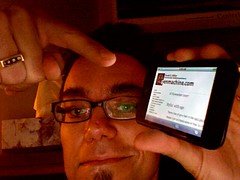 The company I work for, Navarik, has been amazingly supportive during my medical leave for cancer treatment. It has always been a great place to work, even in the darkest depths of the dot-com bust in which the company started in 2000 (I did freelance editing work for them back then, and started as a proper employee in 2003). That's because the company's founders—university colleagues of mine—created a culture where people are important. It's the main reason I wanted to work there originally, because in the technology industry, you can't necessarily predict what kind of work you'll be doing in the future—but you can judge the culture of your employer pretty easily.
While I've been here at home recovering from surgery and pumping my body full of chemotherapy poisons, everyone else at Navarik has been working incredibly hard on some fascinating and powerful software that will help many people in the maritime shipping industry and elsewhere around the world do their jobs better.
This afternoon my daughters and I dropped by the office for the first time in some months. Coincidentally, it was the same day that the management team presented each employee with a Navarik-personalized iPod Touch (what's the plural of that? iPod Touches? iPods Touch?) as thanks for that effort. Amazingly, I received one too. The accompanying handwritten note from our CEO brought me (and my wife, when she read it) pretty close to tears.
This is not a new thing, nor a token attempt at recognizing the great people who work for the company. I'll write about my impressions of the iPod Touch tomorrow, but my impression of Navarik has only been reinforced: it would be hard to find a better place to work.
Labels: apple, cancer, friends, gadgets, ipod, navarik