Penmachine
29 April 2010
Ready to move
On Saturday, I'll be switching this blog from the Blogger publishing system, which I've used for almost ten years, over to Movable Type. I've been preparing for the move for a few weeks, and everything is pretty much ready.
What will change?
For you as a reader, not much:
- If you read my posts on my website at penmachine.com, you'll see a few minor alterations to the site layout, but overall things will be familiar. Similarly, if you read them as Notes on Facebook, everything will continue as normal.
- If you subscribe to my blog feed at penmachine.com/index.xml, some recent entries might appear twice, but new ones will only be there once, so it will soon settle back to normal. If you're using one of my older feed addresses (something like penmachine.com/rss.xml or penmachine.com/rss/rss.xml), things should redirect automatically. But if you don't see any updates in the first two days of May, then please re-subscribe using the proper address.
- My Penmachine Podcast feed remains at penmachine.com/podcast/index.xml. Nothing has changed there, and I haven't updated it since July 2009, so don't expect anything new for the moment.
- There will be a new subscription feed for comments on my blog, at penmachine.com/comments.xml, but as of today (April 29), that's not active yet.
Speaking of comments, perhaps the biggest change (which has happened already) is that you can no longer post new comments on any of my archived posts from October 2000 to April 2010, including this very entry. That's not the way I'd prefer it, but in starting fresh with Movable Type, it's just easier to lock down all the old stuff and move on.
You'll be able to post comments on new entries I publish from May 2010 onward. How you do that will look a little bit different than it used to, but will work essentially the same way as before, with a bit more flexibility for you.
Smooth, real smooth
I'm hoping that what is a fairly major technical transition for me is a smooth and barely noticeable change for you many kind folks who read this blog. What should matter to you (at least a little) is what I write, not how I publish it. There will likely be a few minor bumps and anomalies in the first week or so, but I hope to iron those out quickly.
Then I can get on with the next ten years of stuff.
Labels: blog, geekery, history, software, web, writing
28 April 2010
Following the camper
My former co-worker Chris got married to Kerry recently, and they're posting travel photos from their camper-van U.S. honeymoon, which have been great fun to follow. What I especially like is that their wedding presents included sponsorships of various parts of their journey, and they include thank-you printouts in many of the pictures, like this and this.
It's all just terribly charming. I've traveled a lot in the western U.S.A. over the years, especially Oregon and California, so their photos bring back many fond memories. Oddly, I've never visited Yosemite National Park. Maybe someday, if my health improves. Maybe.
Labels: americas, blog, friends, navarik, photography, travel, wedding
14 April 2010
Movable Type vs. WordPress, Round 2
A bit more blogging platform geekiness, but much shorter this time.
Contrary to my first impressions a couple of days ago, I'm warming to the way Movable Type works. It's taken only a little effort to customize it, roughly to match my existing page design and typography here—easier than I've experienced with WordPress.
So, two days later, it looks light I might end up using Movable Type 5 after all. But we'll see if my further experiments blow it up in some nasty way.
Labels: blog, geekery, linkbait, software, web, writing
12 April 2010
Replacing Blogger: Movable Type vs. WordPress
This is a big long nerd brain dump about behind-the scenes software stuff on this website. Even if you're not a web geek, there's a possibility you might find some of it interesting. But if not, you've been warned.
UPDATE: A couple of days later, I may have changed my mind about my apparent decision below. Find out more.
Gotta move
Since Blogger announced the shutdown of its venerable FTP publishing system a couple of months ago, I've been working to figure out what new system I'm going to use to publish my writing here. (I'm glad Blogger postponed the shutdown for an extra month, but of course that meant I simply procrastinated about it until now.)
I have about three weeks to make the change, and I've boiled it down to two options, neither of which is ideal, but both of which are serviceable:
- WordPress (currently at version 2.92), a PHP-based system, with the Really Static plugin.
- Movable Type, written largely in the Perl programming language (currently at version 5.01).
They are two of the most popular and long-running blogging platforms on the Web. There are other possibilities, but I don't need all the complexity of Drupal, and don't find other options like ExpressionEngine all that compelling. Movable Type has always used the static files publishing model I prefer, while WordPress requires a plugin like Really Static to hack it into doing what I want.
Movable Type in the sunset?
However, Movable Type's day in the sun may be past. While some high-profile sites of people I know—such as John Gruber and Dave Shea—use it, its popularity seems to have been in general decline since the licensing controversies of version 3, way back in 2004. The current version 5 (MT5) is brand new, and an open source project, but I don't sense the same community vibrancy and wealth of third-party extensions WordPress has. Six Apart, the company that created Movable Type, also seems to have been focused on its other hosted blogging tools, TypePad and Vox, for years.
There's a fork of Movable Type called Melody too, which is cool. But forks like that tend to arise when the originating platform is losing air. Yes, I know there are lots of people who love it, but I just get the sense that general enthusiasm for Movable Type has faded—even in the vibe I feel after installing and playing around with MT5 last night. The basic software is great, mature, and solid. But when I want to muck around and extend it, the available resources are a little sparse and often out of date.
WordPress on a tear
Just when Movable Type stumbled in 2004, Matt Mullenweg's WordPress—itself a fork of the awkwardly-named b2/cafelog blogging platform—was hitting its stride. I know Matt a bit, and have been using WordPress on other websites (most notably Inside Home Recording and Lip Gloss and Laptops) since 2006. I like it and recommend it to friends, despite its sometimes-sprawling nature, and its reliance on a dynamic, on-the-fly, database-driven publishing approach that I find somewhat brittle.
Indeed, that dynamic approach really was the only thing keeping me from switching to WordPress right away. I understand WordPress and how to tweak it, I like the wide range of themes and plugins available for it, most of my geek friends use it in some form or another, and the community is second to none. Recent versions are also very easy to upgrade in place, which is a big improvement over the way most installable blog platforms (WordPress and Movable Type included) have usually worked.
So when Matt Mullenweg's colleague, Victoria-based Lloyd Budd, pointed out the Really Static plugin to me, it looked like a perfect solution. It takes a regular WordPress blog and generates plain-old text files which otherwise continue to look and work pretty much just like the original WordPress pages. Nice.
The showdown
Therefore, last night, after all that procrastinating and evaluating, I installed both WordPress 2.9.2 (with Really Static) and Movable Type 5.01 into test directories on my server. The WordPress install went smoothly, since I've done it before. Movable Type took a couple of tries, but I got it working without too much trouble. Disabling either software installation seems to leave the resulting static blog pages essentially intact, which, after all, is my key criterion in this whole production.
As I said above, I found Movable Type underwhelming. I really, really wanted to like it, because it would be interesting for me to learn how to work with and tweak a new publishing system. The default appearance theme is certainly nicer than WordPress's, and its more modular system of templates and styles is also a bit more elegant. Though not a key feature for me, it's much easier to publish multiple blogs with a single Movable Type installation (at least for now). Some tech-head friends I respect a lot think its Perl-based CGI architecture is inherently better than WordPress's collage of PHP scripts.
All that may be true, but MT5 looks, to me, like it's catching up to features and polish that WordPress has offered for at least two or three years. Searching for some alternative themes and styles, as well as fairly simple plugins (displaying my recent Twitter posts on my home page, for instance), didn't yield very many options, and most of the results I did get seemed to be talking about MT installs a version or two old.
Not that the WordPress option is perfect. The forest of PHP files that WP uses can make heavy customizing kind of a chore ("which of those 250 files was I supposed to edit again?"). The Really Static plugin remains a hack, though an effective one, so making it do what I want requires some duplication of template files, some advance planning of how I want to structure my blog and archives, careful pruning of HTML pages on the server if I choose to delete something, and the awareness that when WordPress releases a new version (like the upcoming 3.0, or even a service update like 2.9.3), I might have to wait to make sure Really Static plays nice with it.
So right now, I'm leaning heavily toward the WordPress/Really Static approach [but wait! see my April 14 post to find out if I changed my mind]. Any Movable Type advocates (or people with different suggestions) who want to convince me otherwise can email me or leave a comment here—at least until I disable comments on this post at the end of the month (see below).
Other housekeeping
One annoying thing about moving away from Blogger as my publishing system is that I'm going to have to lock down my blog archives. What I mean is, I'm not planning to import all my nearly 10 years of existing blog posts into the new system and republish them. Indeed, one of the advantages of the static-files approach I'm choosing is that I can just leave my old posts exactly as they are, whether from 2001 or 2009.
But since I'll no longer be able to update the pages from Blogger, that also means that no one will be able to post new comments to those posts—or, more accurately, if I leave things as they are, people can write comments, but they'll never show up on this website. So my plan, over the course of the next three weeks, is to disable new comments on my old posts, and gradually disable them on newer and newer ones until FTP publishing stops working at the end of the month. Then, if I time things right, I can seal off comments on my latest entries, tie up the old blog in a bow, fire up the by-then-ready new system, and be done.
I've already started. Want to comment on one of my posts from April 2007 or earlier? Sorry, you can't. Same for entries for my occasional Penmachine Podcast from last year or before. They were never much for comments either.
Yeah, it's a bit of an awkward transition, but after a decade of largely smooth sailing with Blogger, I can hardly expect anything else. I'll miss the simplicity and familiar orange-and-blue colour scheme of writing in Blogger, but I won't miss its bizarre system of labels, its strange way of handling podcast enclosures, and of course the consistent unreliability of FTP publishing in the first place. Besides, for the geek in me, making the change is sort of fun.
As long as I don't screw anything up too badly over the next few weeks, anyway.
Labels: blog, geekery, linkbait, software, web, writing
18 March 2010
I know, I know
People who put pictures of their pets on their blogs are a Web stereotype. I know. But come on...

...what am I supposed to do? Not post that?
Labels: blog, pets, photography
14 March 2010
The privacy transition
 A few weeks ago, my daughter Marina, who's 12, asked me to start mentioning her by name on this website, and when I link to her blog, photos of her on Flickr, the new blog she just set up with her sister, and so on.
Until now, I've been pretty careful about just calling her "M" or "Miss M," because while I'm personally comfortable putting my own name and information on the Web, that's not a decision I should have been making for my kids, especially before they were able to understand what its implications are. (For similar reasons, here on the blog I generally refer to my wife by her nickname Air, at her request.)
But Marina has started to find that annoying, because when she searches for "Marina Miller," she nearly always finds other people instead. She's starting to build herself an online profile—and the first component of that is establishing her online existence.
I was online around that age too, but at the turn of the 1980s it was a very different thing. In fact, no one expected to be themselves: we all used pseudonyms, like CB radio handles. And it was a much smaller, geekier community—or rather, communities. I had no Internet access until the decade was over, so connections were local, and each bulletin board system (BBS) was its own island, accessed by dialup modem, often by one person at a time. The Web hadn't been invented, and the concept of a search engine or a perpetual index of my online life was incomprehensible.
On a recent episode of CBC Radio's "Spark," Danah Boyd, who researches these things, noted that today's adults often look at our online exposure in terms of what can go wrong, while our younger compatriots and children look at it in terms of its benefits, or what can go right. It's not that they don't care about privacy, but that they understand it differently.
Marina is now closer to adulthood than toddlerhood, and her younger sister, at 10, is not far behind. I think that's a bit hard for any parent to accept, but in the next few years both our daughters have to (and will want to) learn to negotiate the world, online and offline, on their own terms. Overprotective helicopter parenting is a temptation—or today, even an expectation—but it's counterproductive. Just like we all need to learn to walk to school by ourselves, we all need to learn how to live our lives and assess risks eventually. I'd rather not wait until my kids are 18 or 19 and only then let them sink or swim on their own.
I think I share the more optimistic view about being myself on the Web because, unlike many people over 40 today, I have been online since even before my teens, and I've seen both the benefits and the risks of being public there. I hope my experience can help Marina and her sister L (who hasn't yet asked me to go beyond her initial) negotiate that landscape in the next few years.
That is, if they continue to want my help!
Labels: blog, controversy, family, geekery, probability, web
02 February 2010
So long, Blogger.com: I need a new blogging platform to publish static files
 For close to a decade, since October 2000, I've published this home page using Blogger, the online publishing platform now owned by Google. That entire time, I've used the original hacky kludge created by Blogger's founders back in 1999, where I write my posts at the blogger.com website, but it then sends the resulting text files over the Internet to a web server I rent, using the venerable FTP (File Transfer Protocol) standard—which was itself last formally updated in 1985. This is known as Blogger FTP publishing.
While often unreliable for various technical reasons, Blogger FTP works effectively for me, with my 13 years of accumulated stuff on this website. But I am in a small, small minority of Blogger users (under 0.5%, says Google). Almost everyone now:
- Uses Blogger's own servers for their sites.
- Or another hosted service that takes care of everything for them.
- Or if they want to publish on their own servers, another tool like Movable Type, WordPress, or ExpressionEngine, which you install on your server and publish from there.
So, as I've been expecting for years, Blogger is now permanently turning off FTP publishing, as of late March 2010. And, in my particular case, that means I need to find a new blog publishing tool within the next month or so.
This has been coming for a long time
Blogger has all sorts of clever solutions and resources for people using FTP publishing who want to migrate to Google's more modern server infrastructure, but they don't fit for me. I have specific and very personal needs and weird proclivities about how I want to run this website, and putting my blog on Google's servers simply doesn't meet them.
That's sad, and a little frustrating, but I'm not angry about it—and I think it's misguided that many people commenting on this topic seem to be. I realize that I have been getting an amazing, easy publishing service for free for almost a quarter of my life from Blogger. It has enriched my interactions with thousands of people. Again, for free. (Actually, I did pay for Blogger Pro back in the day before the 2003 Google acquisition, but that was brief. And as thanks, Google sent me a free Blogger hoodie afterwards—I still wear that.)
The vast, vast, vast majority of users find the newer ways of publishing with Blogger meet their needs. And any of us who has used FTP publishing for years knows it's flaky and convoluted and something of a pain in the butt, and always has been since Ev and his team cobbled it together. I've been happily surprised that Blogger has supported it for so long—again, free.
Yes, it was a distinguishing feature of Blogger that you could use a fully hosted editing and publishing system to post to a web server where you don't have to install anything yourself. Very nice, but I think there are good technical reasons that no other service, free or paid—whether WordPress.com, TypePad, SquareSpace, or anything else—ever offered something similar.
I applaud the Blogger team for trying to do the best they can for us oddballs. And it serves as a reminder: Blogger FTP can go away. Gmail could go away. Facebook could go away. Flickr could go away. Twitter could go away. WordPress.com could go away. If you're building your life or business around free online tools, you need some sort of Plan B.
I've had this possibility on my mind at least since the Google takeover, seven years ago. Now I have to act on it. But I'm thankful for a decade of generally great and reliable free service from Blogger. I haven't had ten free years of anything like it from any other company (online or in the real world), as far as I know.
Getting nothing but static
One other thing I've always liked about Blogger's FTP publishing is that it creates static files: plain-text files (with file extensions like .html or .php or .css, or even no extensions at all). It generates those files from a database on Google's servers, but once they're published to my website, they're just text, which web browsers interpret as HTML (Hypertext Markup Language) to create the formatting and colours as such.
Most other blogging tools, including Blogger's hosted services, generate their web pages on the fly from a database. That's often more convenient for a whole bunch of reasons, and I'm happy to run other sites, such as Inside Home Recording and Lip Gloss and Laptops, with a database-dependent tool such as WordPress.
But this site is my personal one—the archive of most of my writing over the past 25% of my life. And I'm a writer and editor by trade. This website is my thing, and I've worked fairly hard to keep it alive and functional, without breaking incoming links from other sites, for well over a decade now. I've always wanted to keep it running with static files, which is one reason I didn't migrate from Blogger to WordPress four or five years ago. Over on Facebook, Gillian asked me why I'm so hardheaded about it. (She's a database administrator by trade.)
I'll be blunt about the most extreme case: I have cancer. I may not live that long. But I'd like my website to stay, even if only so my kids can look at it later. If necessary, if I'm dead, I want someone to be able to zip up the directory structure of my blog, move it to a new server, unzip it, and there it is, live on the Web. I don't want to have to plan for future database administration in my will.
In that worst case I won't need to update my site anymore, but I think static files on a generic web server are more reliable in the long run. To make a bulk change, a simple search-and-replace can update the text files, for example, to note that it's not worth emailing me, since, being dead, I'll be unable to answer.
On other blogging and content management systems I've worked with, I've had MySQL databases die or get corrupted. Restoring from MySQL backups is a pain for non-techies, or even for me. I've blown up a WordPress site by mis-editing one part of one file, and I've been able to fix it—but I don't want someone else to have to do that.
Right now, if Blogger died entirely, my site would still work exactly as-is. If my web host went belly-up, anyone with a teeny bit of web savvy and access to my passwords and one of my computers could redirect penmachine.com to a new server, upload the contents of one of my backup directories to it by FTP, and (other than visitors being able to post new comments) it would be up and live just like it was within a day or two.
In addition, tools like WordPress are brittle. I like using them, but there are security updates all the time, so the software goes out of date. That's fine if you're maintaining your site all the time, but if not, it becomes vulnerable to hacks. So if a database-driven site choogles on without updates, it's liable to get compromised, and be defaced or destroyed. That's less likely with a bunch of HTML files in directories—or at least I think so.
Betting on text
Plain text has been the language of computer interchange for decades. If the Web ever stops supporting plain text files containing HTML, we'll all have big problems. But I don't think that will happen. The first web page ever made still works, and I hope and expect it will continue to. My oldest pages here are mild derivatives from pages that are only five years younger than that one. They still work, and I hope and expect that they will continue to.
At worst, even a relatively non-technical person can take a directory dump backup of my current website and open the pages in a text editor. I can do that with files I've had since before the Web existed—I still have copies on my hard drive of nonsensical stories from BBSes I posted to in the '80s (here's an HTML conversion I made of one of them). I wrote those stories with my friends, some of whom are now dead, but I can still read what we wrote together.
Those old text files, copies of words I wrote before some of the readers of this blog were born, still work, and I hope and expect they will continue to. Yeah, maybe a SQL backup would be wise, but I'll still place my bets on plain text. Okay, I'm weird, but there you go.
Suggestions
Okay, so I need a new blogging platform. Probably one I can install on my server, but definitely one that generates static files that don't depend on a live database. Movable Type does that. ExpressionEngine might. More obscure options, like Bloxsom and nanoc, do so in slightly more obscure ways.
If you know of others I should look at, please email me or leave a comment. However long I'm around, I'll remain nostalgic about and thankful to Blogger. It's been a good run.
Labels: blog, death, geekery, history, linkbait, memories, software, web, writing
17 December 2009
The Lip Gloss and Laptops podcast shuts down
 Yesterday my wife Air and her co-host KA posted their 150th and final regular episode of Lip Gloss and Laptops, the podcast they started way back in 2006. The blog will continue, with frequent updates about the cosmetics and beauty industry, but the podcast had become too much work.
As for the vast majority of podcasters, the LGL show was a hobby, not any kind of paying job, and so was only worth continuing while it was fun. When KA left as regular co-host earlier this year (she started grad school), the podcast became a lot more work for Air, even with other guest hosts in the interim.
And then my latest new cancer growths dropped our family into a yet more intense pit of chemotherapy and medical treatments and side effects and general hell, so that not only takes more of Air's time, but also makes it more difficult technically, since I've been the engineer and producer of the show since the beginning.
Nearly four years and 150 episodes is a pretty long run for a podcast. Lots of people will miss Lip Gloss and Laptops, me included, but it was a good time while it was going. And you never know—some one-off special episodes might yet appear from time to time.
Labels: blog, family, lipglossandlaptops, podcast
15 October 2009
Sinking feeling
 Today, as part of Blog Action Day, I've agreed to write about the environment and climate change. I've done that here many times before, generally in a positive way, or at least a frustrated one. But not today.

Maybe I'm just in a pessimistic mood, but honestly, I'm starting to think we're screwed. There are honest moves afoot, especially in Europe, to change patterns of human energy consumption and reduce carbon emissions. But here in North America, where we use more energy per person than all but a few very small countries, we're doing essentially nothing.
I first became aware of increasing human effects on the Earth's climate around Earth Day in 1990, almost 20 years ago, which was a pretty high-profile event. For awhile after that, there were lots of recycled products in the grocery stores, and talk of converting away from oil, gas, and coal to heat our houses, generate our electricity, and power our vehicles.
And then things slid back roughly to where they were before. Paper towels and toilet paper went from recycled brown to bleached white again. As the economy boomed, people who never went off-road or hauled lumber bought huge Hummers and pickup trucks. Politicians, businesspeople, activists, and others expended a lot of words about the problem of climate change. Yet here in Canada, while we've improved the efficiency of what we do, our overall emissions keep going up, despite our promises.

In the United States and Canada, we're distracted by economic crises and healthcare reform and celebrity scandals and cable reality shows. The developing world is growing too fast not to increase their own emissions. Europe and other countries making efforts aren't enough. By the time sea levels start rising in earnest and the social and political disruptions start, we probably won't be able to keep climates from changing all around the world.
So in all likelihood, we'll wait too long, and we'll have to adapt as our environment alters wildly around us. That will be expensive, disruptive, and probably bloody in all sorts of ways.
I'm not saying we should give up and do nothing, but right now it seems that, collectively, we (and I'm fully including myself here) are very nearly doing nothing by default. Since I have cancer, I don't know if I'll be around to see what happens in a few decades. But my kids will. They will most probably, as the curse goes, live in interesting times.
Labels: americas, blog, canada, environment, linkbait, news, politics
11 October 2009
The slow history of Vancouver
Vancouver historian Chuck Davis has been writing a series of posts for re:place magazine about the city, summarizing a single year of the city's history each time. The series is called "A Year in Five Minutes," though I think you'd have to read pretty fast to get through each entry in that little time.
He's just reached 1938 and 1939, the years my mother (here in Vancouver) and father (in Berlin) were born, respectively. You can visit the Year in Five Minutes category regularly, or subscribe to the RSS feed for those stories. I'm finding them an enjoyable read. Fellow Vancouverites, former residents, or other B.C. history buffs might too.
Labels: blog, history, vancouver, web
14 September 2009
Book Review: Say Everything
 It's a bit weird reading Say Everything, Scott Rosenberg's book about the history of blogging. I've read lots of tech books, but this one involves many people I know, directly or indirectly, and an industry I've been part of since its relatively early days. I've corresponded with many of the book's characters, linked back and forth with them, even met a few in person from time to time. And I directly experienced and participated in many of the changes Rosenberg writes about.
The history the book tells, mostly in the first couple of hundred pages, feels right. He doesn't try to find The First Blogger, but he outlines how the threads came together to create the first blogs, and where things went after that. Then Rosenberg turns to analysis and commentary, which is also good. I never found myself thinking, Hey, that's not right! or You forgot the most important part!—and according to Rosenberg, that was the feeling about mainstream reporting that got people like Dave Winer blogging to begin with.
Rosenberg's last book came out only last year, in 2008, so much of what's in Say Everything is remarkably current. He covers why blogging is likely to survive newer phenomena like Facebook and Twitter. And he doesn't hold back in his scorn for the largely old-fashioned thinking of his former newspaper colleagues (he used to work at the San Francisco Examiner before helping found Salon).
But then I hit page 317, where he writes:
...bloggers attend to philosophical discourse as well as pop-cultural ephemera; they document private traumas as well as public controversies. They have sought faith and spurned it, chronicled awful illnesses and mourned unimaginable losses. [My emphasis - D.]
That caused a bit of a pang. After all, that's what I've been doing here for the past few years. It hit close to home. Next, page 357:
For some wide population of bloggers, there is ample reason to keep writing about a troubled marriage or a cancer diagnosis or a death in the family, regardless of how many ethical dilemmas must be traversed, or how trivial or amateurish their labours are judged. [Again, my emphasis - D.]
Okay, sure, there are lots of cancer bloggers out there. I'm just projecting my own experience onto Rosenberg's writing, right? Except, several hundred pages earlier, Rosenberg had written about an infamous blogger dustup between Jason Calacanis and Dave Winer at the Gnomedex 2007 conference in Seattle.
The same conference where, via video link, I gave a presentation, about which Rosenberg wrote on his blog:
Derek K. Miller is a longtime Canadian blogger [who'd] been slated to give a talk at Gnomedex, but he’s still recovering from an operation, so making the trip to Seattle wasn’t in the cards. Instead, he spoke to the conference from his bed via a video link, and talked about what it’s been like to tell the story of his cancer experience in public and in real time. Despite the usual video-conferencing hiccups (a few stuttering images and such), it was an electrifying talk.
Later that month, he mentioned me in an article in the U.K.'s Guardian newspaper. When he refers to people blogging about a cancer diagnosis, he doesn't just mean people like me, he means me. Thus I don't think I can be objective about this book. I think it's a good one. I think it tells an honest and comprehensive story about where blogging came from and why it's important. Yet I'm too close to the story—even if not by name, I'm in the story—to evaluate it dispassionately.
Then again, as Rosenberg writes, one of blogging's strengths is in not being objective. In declaring your interests and conflicts and forging ahead with your opinion and analysis anyway, and interacting online with other people who have other opinions.
So, then: Say Everything is a good book. You should read it—after all, not only does it talk about a lot of people I know, I'm in it too!
Labels: blog, books, cancer, gnomedex, history, review, web
08 September 2009
My lazy personal response to the latest WordPress hack
A few days ago, many people running slightly out-of-date versions of WordPress blogging software on their servers had it hacked in very nasty ways. Understandably, that's caused a lot of consternation, including suggestions (via John Gruber) that you shouldn't run that kind of software on a public server yourself. Indeed, perhaps you should use crazy complicated workarounds involving Unix terminal commands and such instead. (As if doing so is less complicated than keeping WordPress up to date, but anyway...)
Now, to be clear, I do run several sites using WordPress, and was lucky enough to have all of them up to date so that they weren't bitten by this hack. But this site, my personal blog, has always used Blogger, the original easy blogging application. Not only that, but I use it in its original configuration, which provides the benefits of the weird Unix approach above, but without the hassle.
I didn't come to this approach because I'm especially security conscious. Mostly, it's just inertia and laziness. I started publishing this blog using Blogger almost nine years ago, in October 2000. It works, so I just kept publishing it that way, through several redesigns and a couple of hosting moves. In other words, I got lucky. On to the details.
John wrote:
[Creating blog posts on a local, non-public computer] is how a lot of early blogging software worked. The software generated static files and uploaded them to the publicly available server, which meant the software was not publicly available. This is very secure, especially if you’re using SFTP, but the downside is that you can't post from multiple machines.
...and Maciej Ceglowski said:
Either host your blog with a competent centralized site (like LiveJournal or Blogger) that takes the burden of upgrading, backing up and patching off your hands, or use whatever personal publishing software you like (WordPress, Movable Type, and so on), but keep it on a local machine.
I wrote to John that:
There is a third way. Blogger still allows you to use its original, intermediate model: access the blogging software on Blogger's server, but publish via FTP or SFTP to your own server (i.e. the files travel from Blogger's server to your web server). That's the way I've run penmachine.com since 2000, and it has the advantages of:
- publishing static files that don't require Blogger or a database to stay alive.
- having Blogger maintain upgrades, backups, and databases.
- working from any computer with a web browser.
Many people don't know this option still exists, and many of the more newfangled features of Blogger's newer templates, widgets, and so on don't work with it, but since I create my own templates and don't want the extra stuff, that's not an issue for me.
I should note that my approach permits comments via Blogger or a third-party service, as well as other plug-ins and whatever else you want to do via regular HTML, CSS, JavaScript, PHP, and so on. The approach is slightly more technical than using a hosted service like Blogspot, TypePad, WordPress.com, Squarespace, or whatever—but it's a lot less tricky than installing WordPress (five minutes? yeah right)—or, for that matter, installing Movable Type, or Expression Engine, or Drupal—on your own server in the first place.
Oh, and publishing via Blogger and FTP or SFTP is not perfectly secure, of course. Someone could still hack my Google/Blogger account, or compromise my server, or (more unlikely) both. But I can regenerate my blog via Blogger's database (if the server is hacked), via my server (if Blogger is hacked), via my hosting provider's backups, or from my own local copies of my blog. So I'm in a better position than someone running everything on the server without proper backups.
Then again, anyone who has backups is in a better position than someone who doesn't, always.
Labels: blog, geekery, security, software, web
28 July 2009
Making stories, showing off (for Raul's Blogathon)
This is a re-post of the guest entry I wrote for Raul's Blogathon on Saturday.
 Here's a story. Two years ago this week, I weighed 145 pounds, about 70 pounds less than I do now. I looked like I'd been in a PoW camp, pale and skeletal. I'd just left St. Paul's Hospital, where I'd been for close to a month after major cancer surgery and an intestinal blockage.
By October I'd gained back 30 of those pounds. Within a year I'd taken a bunch more chemotherapy, lost my hair and grown it back, and had terrible chemo-induced acne. A year after that, the cancer is still here, but I'm fighting it, and I feel pretty good. End of story, for now.
We all grow up making stories—when we're kids, we call it playing, whether it's using an infant mobile or a video camera. And our stories are best when we make them for others, or with them. Unfortunately, many of us become unused to playing, thinking it childish. We grow up terrified of giving speeches, or we write our thoughts only in diaries instead of for reading. We become shy.
For whatever reason, that didn't happen to me. I've been passionate about many things in my 40 years—computers, photography, public speaking, music, making websites, writing and language, science and space, commuting by bicycle, building a life with my wife and family—but when I took at them all, each one is really about making stories for others. Or, as my wife succinctly pointed out, about showing off. I'll admit to that.
Some examples, in no real order:
- Helping put together a school newspaper in sixth grade (or high school, or university).
- Donning a smoking jacket and hand prosthetic to play Captain Hook on the elementary school stage.
- Setting my daughters up with blogs and email addresses before they each turned ten.
- Posting photographs to MacDesktops in the late '90s and photo.net a few years later.
- Playing in a band in crappy bars or luxury New York hotels.
- Editing my high school yearbook (with others) and the UBC student handbook (by myself).
- Teaching courses about Microsoft Word.
- Talking about my cancer on the radio.
- Talking about geeky stuff on TV.
- Recording songs and giving them away for free.
- Helping my wife Air put together her podcast.
- Uploading thousands of pictures and videos to Flickr.
- Crafting obscure technical documents to make them understandable.
- And of course blogging and blogging and blogging for close to nine years.
I've done many of these things for no money (and some for lots of money), but for almost all of them, I wanted other people to know.
Okay, yes, I wanted to show off. Is that healthy?
For me, on balance, I think so. Whether for my jobs or my hobbies, being a ham and wanting others to see and appreciate what I do prods me to make those stories good, and useful. Humans are natural tellers of stories, and we enjoy anything presented in a story-like way. So I've tried to make all of those things in the form of a story. Whether a discussion of evolutionary biology, a fun rockabilly instrumental, a bunch of rants about PowerPoint, or a pretty photograph (or yes, even the instruction manual to install a wireless cellular modem in a police car), I want it to generate a story in your mind.
Stories don't always have an obvious structure. They don't necessarily go in predictable directions, or have a moral or meaning. I certainly didn't see it coming when all this cancer stuff from the past two and a half years happened. But I've been able to make it a story that other people can read, understand, and maybe find helpful. So too with my other passions.
So whatever you're trying to do, whatever hobby or job or habit you have, if you want to share it with others, try to craft it like a story—short or long, visual or auditory, but something that flows. Show it off. That, it seems, is what I like to do.
Derek K. Miller is a writer, editor, web guy, drummer, photographer, and dad. Not in that order. He's been blogging at penmachine.com since 2000, and has been on medical leave from his position as Communications Manager at Navarik Corp. since 2007. His wife and two daughters have put up with his show-offishness way longer than that.
Labels: band, blog, cancer, charity, editing, friends, music, photography, vancouver, writing
25 July 2009
Blogathon
UPDATE 11:50 p.m.: Guest posts for Blogathon on Raul's site by my wife and by me are now online. The Blogathoners have a little over six hours left. Go go go!
 Words change. Marathon was originally (and still is) a plain in Greece, but after a battle there between Athenians and Persians in 490 BC, legend says that messenger Pheidippides ran a little over 26 miles to relay the result, and died from heat and exhaustion. More than two thousand years later, his distance was established for races at the Olympics and elsewhere, now called marathons. Deaths, fortunately, are now rare.
Over time, marathon also came to mean anything that took a long time and a lot of effort. After the invention of television, we got the telethon: fundraisers broadcast on TV over many hours or days, focused on a particular charity or cause. Many of us raised in the 1970s don't think of Jerry Lewis as a movie star, but as the guy who ran the telethon.
Now we have blogathon, where numerous bloggers (close to 200 this year from across North America and beyond) post something every half hour for 24 hours. This year's event began at 6 a.m. today, and runs till the same time tomorrow morning. Each participant can choose his or own charity, so there are lots of options. Here in Vancouver, we have quite a few friends doing the blogathon:
- Raul is blogging for the B.C. Cancer Foundation (donate here), and will be publishing guest posts both from my wife and from me later today.
- Rebecca, Jen, Lorraine, Duane, and Beth are also in on the action.
- Numerous others in town, listed on Rebecca's page, are blogathoning today too.
Many of the blogathoners are at Workspace in Gastown today, and I plan to drop in with my kids sometime this afternoon to cheer them on for a bit. Visit their blogs and choose a worthy cause for a donation, why don't you?
Labels: blog, charity, friends, vancouver
14 July 2009
Links of interest 2006-07-05 to 2006-07-13
Yup, still on a blog break. So, more of my selected Twitter posts, newest first:
- Vancouver to Whistler in one minute (okay, I cheated):
- We're in the mountains, but in a civilized way. Pool/hot tub, grocery store across the street, Wi-Fi. But, uh, there is mountain weather.
- Super-duper stop-motion movie with 60,000 photo prints (ad for Olympus, via Lisa Bettany and Photojojo). Chris Atherton points out that this follows Wolf and Pig.
- Okay camera nerds, here's some rangefinder pr0n for you.
- The stereotypically blingtastic (and boobtastic) video diminishes Karl Wolf's tolerable version of Toto's "Africa." (And I'm no Toto fan.) It's like a live-action Hot Chicks with Douchebags. Yes, the choirboy harmonies are actually kind of charming, but he's going P-Diddy on it in the end.
- In the storage closet, my kids found something of mine from 1976 that is EVEN GEEKIER than my U.S.S. Enterprise belt buckle:

Red shirts were available back then, as well as the blue Mr. Spock style, but I chose Kirk. Of course. - The only sounds I can hear right now: the dishwasher, the fan in the hallway, and the birds in the trees outside the window.
- During my biology degree, Platyhelminthes was a favourite organism name. Now there's a plush toy! (With 2 heads!!)
- When I used to busk with the band, our biggest victories were scaring away the holy rollers across the street (we got applause).
- Neat. When a ship is built, here are the differences between milestones: keel laying, christening, commissioning, etc.
- AutoTune the News #6. Even more awesome.
- Picked up kids from Aldergrove camp. Sadly, there was a terrible accident on the Port Mann Bridge. We took a long Langley/Surrey/New Westminster detour.
- Google's changing culture. Point: Google now has more employees than Microsoft did at launch of Windows 95.
- Time lapse: 8 hours from my front window in about 1 min 30 sec, made with my new Nikon D90 and free Sofortbild capture software (and iMovie):
Something like John Biehler's Nikon Coolpix P6000 is better for timelapse long term; the D90's mechanical shutter, which is rated for 100,000 uses, would wear out in less than 6 months if used for time lapse every day. P.S. Andy Gagliano pointed to a useful Macworld podcast about making time-lapse movies. - Depressing: most Internet Explorer 6 users use it at work, because they're not allowed to use another browser.
- These Christopher Walken impressions are way funnier than I expected.
- The way monkeys peel a banana shows us we've all been doing it the needlessly hard way all these years.
- Um... hot!
- Most appropriate Flash cartoon ever?
- Drinking whisky and Diet Dr. Pepper, watching MythBusters. Pretty mellow.
- A good photo is "not about the details or the subject. It's what your subconscious pulls out of it all without thinking."
- Just picked up another month's supply of horrible, nasty, vile, wonderful, beautiful, lifesaving anti-cancer pills. Thanks, Big Pharma Man.
- My wife tells me she's discovered a sure-fire tip for a gal to attract quality guys in public: carry a huge SLR camera over your shoulder.
- "For the great majority [...] blogging is a social activity, not an aspiration to mass-media stardom."
- Just talked to younger daughter (9) for first time after three days at summer camp. She's a little homesick, but having fun.
- I took a flight over a remote landscape:
- The 50 worst cars of all time (e.g. "The Yugo had the distinct feeling of something assembled at gunpoint").
- I haven't seen either Transformers movie, but that's okay, I saw this.
- Dan Savage: cheating on your spouse should now be known as "hiking the Appalachian Trail." Good point in the article too.
- You can still buy a station wagon with fake wood paneling!
- Train vs. tornado. It does not end well. Watch without fast-forward/scrubbing for maximum tension.
- Just lucked into a parking spot on Granville Island. Time for some lunch.
- Sent the kids off for a week of horse-riding camp today. Wife Air and I had sparkling wine in the garden. Vewwy vewwy quiet around here.
- Just sorted a bunch of CDs. Still several discs missing cases, and cases missing discs. I feel like a total '90s throwback.
- Rules of photography (via Alastair Bird).
- When did the standard Booth Babe uniform become cropped T-shirt and too-short schoolgirl kilt?
- Listening to "Kind of Blue." It's been awhile.
- "A two-year old is kind of like having a blender, but you don't have a top for it." - Jerry Seinfeld (via Ryan).
Labels: audio, biology, blog, cancer, chemotherapy, family, flickr, geekery, google, microsoft, movie, music, oceans, photography, sex, startrek, transportation, video, whistler
13 June 2009
Blog break
 Except for the occasional vacation or trip to the hospital, I've written on this blog most days since October 27, 2000 (and more intermittently for three and a half years before that, before it was a blog). Including this post, that's 3446 entries in 3152 days, or an average of 1.09 posts per day, through raising our kids and work and travel and illnesses and treatments galore.
For most of my life I've written compulsively. In the words of Tim Bray and Mark Pilgrim, I write this blog because I "can't not write." Or at least I did. But today it feels forced, an annoyance, something it should not be.
I need a break. So I'm taking one. I don't know how long.
I'll probably still post to Twitter and Facebook, but not as much. I'll be on email too, though I plan to unsubscribe from a lot of lists and notifications that clutter up my inbox, and maybe try to pare down the 1800 messages sitting there. There will be photos on Flickr. Maybe I'll find a way to bring some of that material over here automatically. We'll see.
Other things also won't change. I plan to continue co-hosting with Dave Chick the Inside Home Recording podcast once a month or so. I won't be offline or off the grid. If you subscribe to my RSS feed you'll see when something new appears here, whenever that might be. I'll let you know if there's any big news.
In the meantime, it's almost summer. Go outside. Be with your friends and family. Talk. Love. I plan to.
Labels: blog, facebook, fatigue, flickr, twitter, web
30 March 2009
Juno night
 Last night my wife and I went to the Juno Awards (Canada's English-language music industry awards, like the Grammys) at the GM Place hockey arena here in Vancouver. We were waaaay up in the rafters, but still had a decent view. However, one of the ushers told me the lens on my SLR camera was "too big"—you know what they say about the size of man's lens—so I had to be surreptitous about it, and thus didn't get too many photos.
There was lots of music, as you would expect. But the acts I liked best surprised me. Dallas Green's City and Colour (with guest Gord Downie of the Tragically Hip) topped my list, even though I'd never heard of Green before. I'm a musical oldster, you see. Bryan Adams and Kathleen Edwards were also remarkable, singing without a backing band and turning out a marvelously affecting acoustic performance of "Walk On By," with strong harmonies. 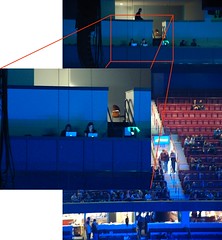 And Divine Brown again showed the amazing voice I'd heard a few nights before—she needs to get out from the overdone dance production on her album, I think.
We also spotted our live-blogging pals Miss604 and Arieanna (who had an awesome announcement the next day) in the rafters across from us. I snapped a picture before I got busted by the usher.
Since it was broadcast live across the country, the Juno ceremony started early (5 p.m.), and was over promptly at 7. We were home before the sun even went down, which is often just as well for us these days.
P.S. Yes, Nickelback started the show with a song called "Something in Your Mouth." And pyro effects coming from stage props designed to look like giant chrome exhaust pipes.
P.P.S. Does anyone know who buys all those Nickelback albums?
Labels: band, blog, music, television, vancouver
20 March 2009
Dead dead trees
It's been all over the web this week, but Clay Shirky's article on the death of newspapers is still a worthwhile read:
When reality is labeled unthinkable, it creates a kind of sickness in an industry. Leadership becomes faith-based, while employees who have the temerity to suggest that what seems to be happening is in fact happening are [...] ignored en masse.
It makes increasingly less sense even to talk about a publishing industry, because the core problem publishing solves—the incredible difficulty, complexity, and expense of making something available to the public—has stopped being a problem.
That is what real revolutions are like. The old stuff gets broken faster than the new stuff is put in its place. [...] When someone demands to know how we are going to replace newspapers, they [...] are demanding to be lied to.
The expense of printing created an environment where Wal-Mart [through its advertising dollars] was willing to subsidize [a newspaper's] Baghdad bureau. [But] they’d never really signed up to fund the Baghdad bureau anyway.
So who covers all that news if some significant fraction of the currently employed newspaper people lose their jobs? I don’t know. Nobody knows. We’re collectively living through 1500 [when the printing press was introduced], when it’s easier to see what’s broken than what will replace it.
When I was in university, I helped found a couple of student newspapers, and I imagined myself working for a big newspaper one day. I never did, though I did get jobs at a couple of magazines over the years. If I were graduating today, a couple of decades later, I'd still want to write, but I don't think I'd have those ambitions anymore.
Labels: blog, geekery, news, web
21 February 2009
Northern Voice 2009, day 2
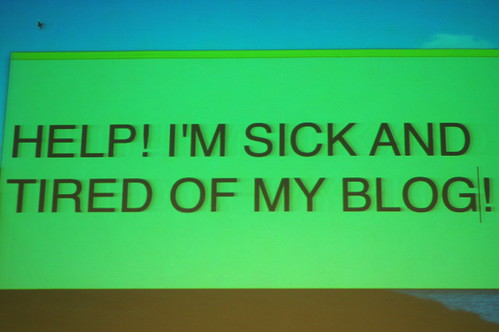
More photos in my Flickr set and from others.
Labels: blog, conferences, friends, geekery, northernvoice, photography, podcast, vancouver, web
20 February 2009
Northern Voice 2009, day 1
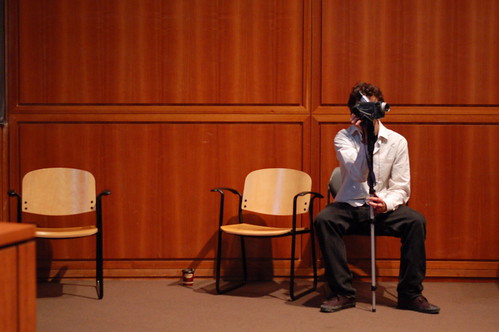
More photos in my Flickr set and from others.
Labels: blog, conferences, friends, geekery, northernvoice, photography, podcast, vancouver, web
09 February 2009
Shine your own shoes
Just slightly over a year ago, I tried to answer a question realistically, not for myself, but for numerous people who ask me. The question was: can you make money from blogging and podcasting? I've been blogging a long time, so some people think I might have an insight there. Who knows, really?
I answered anyway. My answer, in short, was that yes, blogging and podcasting can be your job, just like being a musician can be a job. But for most people, "making money" has to mean making a modest living, working hard (sometimes to the point of burnout), having some luck, and treating it as a small business like any other.
If you expect sudden riches, that's like expecting your garage band to become Coldplay, or your basketball skills to take you to the NBA. Yeah, a miniscule few manage that sort of thing, but it's not wise to bet on being one of them. Even Dan Lyons, who ran the immensely popular (and stingingly funny) Fake Steve Jobs blog for a couple of years, acknowledges that: "I never made enough to quit my day job."
Jason Kottke has a good response to that:
As businesses go, blogging is a lot like shining shoes. There are going to be very few folks who own chains of shoe shining places which make a lot of money and a bunch of other people who can (maybe) make a living at it if they bust their ass 24/7/365. But for many, shining shoes is something that will be done at home for themselves because it feels good to walk around with a shiny pair of shoes.
That's regardless of whether the economy is good or bad. Oddly enough, before I even read that, I shined up a pair of my shoes today. Personally, I have no plans to start a shoe-shining business.
UPDATE: Dave Winer makes an interesting point on this topic.
Labels: blog, money, podcast, web
02 February 2009
Ten worst best cars
Via Ken Rockwell, here's the kind of list you don't see very often: Car and Driver admitting to a list of 10 Most Embarrassing Award Winners in Automotive History, including many of their own choices. The Renault Alliance and Chevy's Vega and Citation were all award-winners at one point. That is embarrassing.
One of the reason car aficionados love BBC's Top Gear is that they rarely make such mistakes. They even have a category of "WTF? Car" for particularly egregious examples of bad or misguided motor vehicle design. Scroll down the Foreman Blog home page for a fun list of them.
Labels: blog, humour, magazines, transportation
02 January 2009
Favourite posts of 2008
In which I revisit what I wrote here in 2008 and pick out some highlights:
- Less who we were, about my dead friend Martin
- The looking glass, about the parallel world of homelessness and addiction in Vancouver
- Subprime mortgages were always insane
- Ten and twenty, about my wife and our children
- A billion years, or 600 million, about natural selection
- Chevron's gas pumps piss me off
- Bomb days, about nuclear weapons
- Not always buying from China, about purchasing decisions
- Another fun night, about one of several hospitalizations I had in late May and early June
- Derek and the amazing technicolor vomit, about the rest of what happened
- My review of the book Twinkie, Deconstructed, with kudos to me from the book's author, Steve Ettlinger
- Buying your first serious digital SLR camera
- The best brainless, fun, hard-rockin' songs, a top-10 list
- Rock from on high, about the centenary of the Tunguska Event, and also Yngwie Malmsteen
- State of the digital SLR market, as of June 2008
- East Van, East Side, East End, West Van, West Side, West End?, about Vancouver's insane neighbourhood naming
- My Camera Works series, which tells you stuff you probably don't know about how still cameras operate
- Indian Arm, about our forbidding local fjord
- How left-wing Canada elects a right-wing government
- To fight, or to live and The living part, about my ongoing cancer treatment
- Farewell, Mr. PJ, about my high school math teacher
- Violence and sex, on why we're more willing to let our kids see one than the other
- Wasted megapixels, more ranting about the megapixel myth in digital photography
Labels: blog, ego, memories, web
09 December 2008
Photo advice, awards plug, music of Odds
1.  Ever wonder how great photographers capture amazing images? How do they happen to be there at the decisive moment? Scott Bourne's post at This Week in Photography about his recent photo "Cranes in the Fire Mist" tells you. There is some luck, yes, but much of it is long preparation and experience. Decades' worth, in Scott's case.
2. Today is the last day of voting for the Vancouver-area Best of 604 web awards put together by Rebecca Bollwitt, a.k.a. Miss604. The awards reception is tomorrow night. While of course I suggest that you vote for your favourites in every category, if you need a hint or two, my wife's podcast Lip Gloss and Laptops is nominated in the video blog/podcast category, and her personal site Talking to Air appears in the heavily competitive personal blog list. (Yeah, I got nominated for some stuff too, but why split the vote?)
3. If you listened to Canadian rock music in the '90s, you know the Vancouver band Odds. Well, they're back! After a hiatus of 12 years, earlier in 2008 they released a new album, "Cheerleader," under the name The New Odds. Recently they managed to get the rights to their original name Odds back, so (follow me here) Odds became The New Odds, and are now back to Odds again. Bass player Doug Elliott is a friend of mine, and also plays occasionally with my retro act The Neurotics, and appears on a track on my podcast. If you're on Facebook, join up as a fan on their new Facebook page.
Labels: band, blog, family, photography, podcast, vancouver, web
01 December 2008
Sixth-photo meme
Beth is propagating a meme. If you use Flickr, go to the sixth page of your photostream and pick the sixth picture there, then post it to your blog. Here's mine:

The next people I'll tag for this meme? I'm supposed to pick six: Arieanna and Ianiv, John, Mark, Gillian, Dave, and Tony.
But hey, don't let that restrict you. If you want to join in, then have at it!
Labels: blog, flickr, meme, photography
27 October 2008
Happy eighth birthday, blog
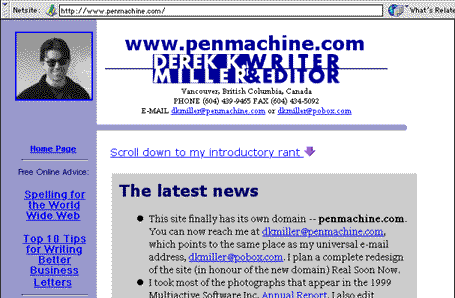 Today marks eight years since this site first became a blog, back on October 27, 2000. That's the day I started using Blogger—long before Google bought it—to publish updates here, instead of doing them manually in a text editor. (I did so on the recommendation of my friend Alistair—who was also standing next to me in the photo I cropped down as my portrait at the time.) Believe it or not, I'm still using Blogger to run the site, although I don't host it on Blogger's servers, and I make my own templates.

That day back in 2000 was also a little over seven months after I first registered the penmachine.com domain—in the three years before that, I'd been publishing at various obscure URLs owned by my ISP and others. However, the alias www.pobox.com/~dkmiller will still get you here, as it always has. So, courtesy of the Wayback Machine, here are some looks back:
- Take a look at this site in September 2000, before I blogified it. I also have a screenshot of an even earlier version, plus a preserved HTML archive from 1998.
- You can also examine roughly how it looked in 2001, 2002, 2003, 2004, 2005, 2006, 2007, and 2008. You know, this blog hasn't changed as much as I might have thought.
- As far as I can tell, the most popular thing I've ever written here is my 2005 article about buying a cheap guitar, which remains my most-viewed page more than three years after I published it, and more than two years after I last made any updates to it. If you post stuff on the web, that shows you why you should avoid breaking links.
- To reinforce that, this month 30 people took at look at my earliest blog archive, and 140 people (!) read my spelling article, which was pretty much the first thing I ever published on the Web, back in 1997. Earlier this year, an editor colleague of mine finally spotted a typo in the piece—even though it had been online and widely read for 11 years. So I fixed it.
- In the past eight years, I'm not sure if I've had visitors from every country in the world, but I have had at least one each (and probably more, given that many people's browsers don't reveal their location) from Namibia, Greenland, Tajikistan, Vanuatu, and Nicaragua, among others.
- My biggest traffic spikes have come via Jason Kottke and John Gruber, which is little surprise if you know their sites.
Given how things are going, I have no idea whether I'll still be writing here in another eight years. But it's been fun so far.
Labels: anniversary, birthday, blog, friends, linkbait, web
18 October 2008
Getting podPress to work with WordPress 2.6
NOTE: This post is a pure podcasting nerd-fest. If that's not your thing, feel free to move on.
I help run two podcasts published using the fine open-source blogging software WordPress. A few months ago, when the latest version of WordPress, 2.6, came out, I immediately upgraded one of the sites, Inside Home Recording (IHR). Whoops. Mistake. The new version broke the key podcasting plugin we use, podPress.
So I held off upgrading the other podcast, Lip Gloss and Laptops, keeping it at WordPress 2.5 to maintain compatibility while waiting for a podPress upgrade. Over at IHR, where it was too late, I instead installed the new Blubrry Powerpress podcasting plugin as a substitute.
UPDATE 21 Oct 2008: For those of you using the Blubrry Powerpress plugin, there is a new update that fixes the problem I talk about below, which Angelo discusses in the comments. His summary: "We've just made a new version (0.4.0) which now displays an image in place of loading quicktime files. We use a simple blubrry play icon as the default play image, but you can provide your own play image by adding a custom define to your wp-config.php that includes the URL where your custom play image is located. This new option is documented at the bottom of the Advanced Tweaks page for the Blubrry Powerpress plugin." Kudos to the Blubrry team.
Now, Powerpress is fine. It does the job, and recognizes most of the detailed settings from podPress, but it doesn't offer as fine-grained control, and has one major problem: for non-MP3 podcasts, such as the Enhanced AAC files we use at IHR, it puts up a little movie player (as does podPress), but in doing so (unlike podPress) it also starts loading the podcast file whenever someone visits the web page. For pages with a lot of podcast episodes on them (like our AAC episode index, or even our home page), that really slows down page load times, wastes bandwidth, and throws off audience statistics.
So I wanted podPress back, but for various reasons the developer has been very busy, had his site forums hacked by spammers, and has otherwise been unable to update his free plugin to work with WordPress 2.6 for several months now. I couldn't wait any longer.
But it turns out the fix is a simple one. The new WordPress feature that seems to be interfering with podPress is post revisions, which track changes to posts. Cool, but I don't use it. The No Revisions plugin turns off that feature, and voila!, podPress works again too.
So I installed No Revisions at both the IHR and Lipgloss sites, deactivated Powerpress at IHR, upgraded to the latest WordPress at Lipgloss (using the great WordPress Automatic Upgrade plugin), and everything seems to be working fine. Page load times have speeded up, simple players are available for all podcast files, and I'm back where I want to be.
If you're a podcaster with similar problems or have been postponing your WordPress upgrade, this solution might work for you too.
Labels: blog, geekery, linkbait, podcast, software, web
18 September 2008
For better or for worse
There's no good reason to try to determine which has been the worst year of your life, but I do consider it from time to time. It could have been last year, when I found out I had cancer, went through painful simultaneous chemotherapy and radiation, had four different surgical procedures (one of which kept me in hospital for almost a month), lost 60 pounds, and ended off with yet more chemo and no end in sight for treatment, even though I was feeling better.
It could be that. But it could also have been 2004, when I nearly lost my wife Air to clinical depression. I alluded to what happened that year, but never wrote about it it any detail, to maintain her privacy.
Now, almost five years later, she has written a four-part series on surviving major depression, as guest blogger at Mental Health Notes. She covers her initial post-partum depression back in 2000, the catastrophic breakdown in 2004 that took her to our local hospital's mental health ward for two weeks, her subsequent intensive outpatient treatment program at the hospital and gradual return to work, and the silver linings she has learned about in the years since, and now that she's had to take care of me through all my health problems.
In that weighty year, the worst moment for me was one day, after bringing our daughters to visit Air in the hospital. We had played cards with her in the patient lounge, on the ward where nothing is sharp, and there is nothing mounted to the wall or ceiling that will hold a person's weight. I brought the kids back to the car and buckled them into their seats, then I slumped on the outside of the door, and I cried and cried, not even caring what the girls thought, or whether some stranger might see me there, weeping against the station wagon in the hospital parking lot. At that moment I didn't know if my wife would ever leave that ward, or if she did, what would happen. I feared our life together would change permanently.
And it did. But, in many ways, for the better. When you get married, there's a reason you pledge to stay together for better or for worse, and part of it is that the worse forges something in your marriage that the better never could.
I look at her writing this way: I don't have to be brave to admit I have cancer. It brings almost nothing but sympathy from everyone who hears. I wish it were so for depression and other mental illness, but it isn't. As someone who's never been clinically depressed, I regret terribly that I really didn't understand what Air was suffering at all until it had gotten very, very bad in late 2003 and early 2004. I didn't have a fucking clue. And most of the rest of us don't either. Many people who have no experience with it remain judgmental about mental illness, so for her to write about it candidly now, when she doesn't have to—well, that's brave.
Her treatments have worked extraordinarily well over the past four years, but as with my cancer, as long as she is alive her battle is never over. I hope I am a better help in her fight now than I was in my previous ignorance. As my love and the person who cares for me, she is certainly the best reason to try my hardest to stick around.
Labels: blog, cancer, depression, family, love, web
06 September 2008
Two looks ten years back
It's weird to think that my website here is older than Google.
And valued a tad less on the markets, too.
Labels: anniversary, birthday, blog, google, web