Penmachine
14 April 2010
Movable Type vs. WordPress, Round 2
A bit more blogging platform geekiness, but much shorter this time.
Contrary to my first impressions a couple of days ago, I'm warming to the way Movable Type works. It's taken only a little effort to customize it, roughly to match my existing page design and typography here—easier than I've experienced with WordPress.
So, two days later, it looks light I might end up using Movable Type 5 after all. But we'll see if my further experiments blow it up in some nasty way.
Labels: blog, geekery, linkbait, software, web, writing
12 April 2010
Replacing Blogger: Movable Type vs. WordPress
This is a big long nerd brain dump about behind-the scenes software stuff on this website. Even if you're not a web geek, there's a possibility you might find some of it interesting. But if not, you've been warned.
UPDATE: A couple of days later, I may have changed my mind about my apparent decision below. Find out more.
Gotta move
Since Blogger announced the shutdown of its venerable FTP publishing system a couple of months ago, I've been working to figure out what new system I'm going to use to publish my writing here. (I'm glad Blogger postponed the shutdown for an extra month, but of course that meant I simply procrastinated about it until now.)
I have about three weeks to make the change, and I've boiled it down to two options, neither of which is ideal, but both of which are serviceable:
- WordPress (currently at version 2.92), a PHP-based system, with the Really Static plugin.
- Movable Type, written largely in the Perl programming language (currently at version 5.01).
They are two of the most popular and long-running blogging platforms on the Web. There are other possibilities, but I don't need all the complexity of Drupal, and don't find other options like ExpressionEngine all that compelling. Movable Type has always used the static files publishing model I prefer, while WordPress requires a plugin like Really Static to hack it into doing what I want.
Movable Type in the sunset?
However, Movable Type's day in the sun may be past. While some high-profile sites of people I know—such as John Gruber and Dave Shea—use it, its popularity seems to have been in general decline since the licensing controversies of version 3, way back in 2004. The current version 5 (MT5) is brand new, and an open source project, but I don't sense the same community vibrancy and wealth of third-party extensions WordPress has. Six Apart, the company that created Movable Type, also seems to have been focused on its other hosted blogging tools, TypePad and Vox, for years.
There's a fork of Movable Type called Melody too, which is cool. But forks like that tend to arise when the originating platform is losing air. Yes, I know there are lots of people who love it, but I just get the sense that general enthusiasm for Movable Type has faded—even in the vibe I feel after installing and playing around with MT5 last night. The basic software is great, mature, and solid. But when I want to muck around and extend it, the available resources are a little sparse and often out of date.
WordPress on a tear
Just when Movable Type stumbled in 2004, Matt Mullenweg's WordPress—itself a fork of the awkwardly-named b2/cafelog blogging platform—was hitting its stride. I know Matt a bit, and have been using WordPress on other websites (most notably Inside Home Recording and Lip Gloss and Laptops) since 2006. I like it and recommend it to friends, despite its sometimes-sprawling nature, and its reliance on a dynamic, on-the-fly, database-driven publishing approach that I find somewhat brittle.
Indeed, that dynamic approach really was the only thing keeping me from switching to WordPress right away. I understand WordPress and how to tweak it, I like the wide range of themes and plugins available for it, most of my geek friends use it in some form or another, and the community is second to none. Recent versions are also very easy to upgrade in place, which is a big improvement over the way most installable blog platforms (WordPress and Movable Type included) have usually worked.
So when Matt Mullenweg's colleague, Victoria-based Lloyd Budd, pointed out the Really Static plugin to me, it looked like a perfect solution. It takes a regular WordPress blog and generates plain-old text files which otherwise continue to look and work pretty much just like the original WordPress pages. Nice.
The showdown
Therefore, last night, after all that procrastinating and evaluating, I installed both WordPress 2.9.2 (with Really Static) and Movable Type 5.01 into test directories on my server. The WordPress install went smoothly, since I've done it before. Movable Type took a couple of tries, but I got it working without too much trouble. Disabling either software installation seems to leave the resulting static blog pages essentially intact, which, after all, is my key criterion in this whole production.
As I said above, I found Movable Type underwhelming. I really, really wanted to like it, because it would be interesting for me to learn how to work with and tweak a new publishing system. The default appearance theme is certainly nicer than WordPress's, and its more modular system of templates and styles is also a bit more elegant. Though not a key feature for me, it's much easier to publish multiple blogs with a single Movable Type installation (at least for now). Some tech-head friends I respect a lot think its Perl-based CGI architecture is inherently better than WordPress's collage of PHP scripts.
All that may be true, but MT5 looks, to me, like it's catching up to features and polish that WordPress has offered for at least two or three years. Searching for some alternative themes and styles, as well as fairly simple plugins (displaying my recent Twitter posts on my home page, for instance), didn't yield very many options, and most of the results I did get seemed to be talking about MT installs a version or two old.
Not that the WordPress option is perfect. The forest of PHP files that WP uses can make heavy customizing kind of a chore ("which of those 250 files was I supposed to edit again?"). The Really Static plugin remains a hack, though an effective one, so making it do what I want requires some duplication of template files, some advance planning of how I want to structure my blog and archives, careful pruning of HTML pages on the server if I choose to delete something, and the awareness that when WordPress releases a new version (like the upcoming 3.0, or even a service update like 2.9.3), I might have to wait to make sure Really Static plays nice with it.
So right now, I'm leaning heavily toward the WordPress/Really Static approach [but wait! see my April 14 post to find out if I changed my mind]. Any Movable Type advocates (or people with different suggestions) who want to convince me otherwise can email me or leave a comment here—at least until I disable comments on this post at the end of the month (see below).
Other housekeeping
One annoying thing about moving away from Blogger as my publishing system is that I'm going to have to lock down my blog archives. What I mean is, I'm not planning to import all my nearly 10 years of existing blog posts into the new system and republish them. Indeed, one of the advantages of the static-files approach I'm choosing is that I can just leave my old posts exactly as they are, whether from 2001 or 2009.
But since I'll no longer be able to update the pages from Blogger, that also means that no one will be able to post new comments to those posts—or, more accurately, if I leave things as they are, people can write comments, but they'll never show up on this website. So my plan, over the course of the next three weeks, is to disable new comments on my old posts, and gradually disable them on newer and newer ones until FTP publishing stops working at the end of the month. Then, if I time things right, I can seal off comments on my latest entries, tie up the old blog in a bow, fire up the by-then-ready new system, and be done.
I've already started. Want to comment on one of my posts from April 2007 or earlier? Sorry, you can't. Same for entries for my occasional Penmachine Podcast from last year or before. They were never much for comments either.
Yeah, it's a bit of an awkward transition, but after a decade of largely smooth sailing with Blogger, I can hardly expect anything else. I'll miss the simplicity and familiar orange-and-blue colour scheme of writing in Blogger, but I won't miss its bizarre system of labels, its strange way of handling podcast enclosures, and of course the consistent unreliability of FTP publishing in the first place. Besides, for the geek in me, making the change is sort of fun.
As long as I don't screw anything up too badly over the next few weeks, anyway.
Labels: blog, geekery, linkbait, software, web, writing
30 March 2010
Crime, sin, and authority
I've tried to figure out why the escalating sex abuse scandal in the Catholic Church is making me so angry. I mean, there's the obvious stuff: some priests and other Church officials have been getting away with the rape and beating of children for decades. And much of the Church hierarchy and bureaucracy, including the man who is now Pope, has been working hard to cover it all up, often with the tacit assistance of governments and other civil authorities.
A few of my friends and acquaintances are Catholics, but as far as I know none of them have been victims of these monsters—which is a relief. And I'm not only not Catholic, I'm not Christian or religious at all, but a happy atheist. However, I'm not gloating about the Catholic scandals, in some sort of twisted "I told you so" way. I'm sad and viscerally infuriated, in a way I hope many Catholics are, and quite a few do seem to be. Occasionally, learning new details makes me want to vomit. (Then again, that's not hard to do in general these days.)
I think my fury is it's because it's been going on for so bloody long: not just the physical and sexual abuse, but public knowledge of it and Church inaction about it. More than 20 years ago, following the Mt. Cashel Orphanage sex-abuse scandal in Newfoundland, a friend of mine and his girlfriend (who weren't afraid of being a bit tasteless) came to a Halloween party dressed as a priest and an altar boy, respectively. Even in the 1980s, the concept of a molesting priest was so widespread that everyone at the party got the reference.
It's also been 12 years since the Canadian federal government began attempts to apologize for sexual and physical abuse of native students at residential schools run by the Anglican, United, and Roman Catholic churches across the country until the 1960s, and to compensate the victims financially. And that's just here in Canada.
There are, unfortunately, small proportions of sexual predators and sadists in positions of authority inside some institutions that care for children, including schools, hospitals, foster homes, summer camps, and so on—and also including churches and religious organizations outside Catholicism. And sometimes there are coverups. But once exposed, those coverups can, should, and usually do result in shame, dismissals, apologies, and criminal charges. Even decades after the events.
Many groups and individuals within the Roman Catholic Church have had integrity, trying to get the molesters fired, charged, and punished. Yet men of authority within the institution, throughout its hierarchy—from priests and bishops to archbishops, cardinals, and apparently right up to the Pope—have used its power, influence, and worldwide reach to deny, deflect, hide, obfuscate, and in many cases abet those of its members who abuse children.
Their priority seems to have been to protect their Church, and the pedophiles within it, at the expense of their victims, the most vulnerable and innocent of its billion members. When pressed by incontrovertible evidence and public pressure, those same authorities have released half-hearted and defensive apologies. The situation is abominable, and the scandal deserves to be global front-page news, as it has become in recent months.
The Catholic Church claims to be the highest possible moral authority on Earth. Of course, personally, I think that's ridiculous. The horrifying enormity of child abuse and coverup within the Church over decades—more likely centuries, if we're honest with ourselves—only reinforces my conviction.
Indeed, it's hard to think of crimes more vile. If the beating and rape of children—as well as covering up those acts and enabling them to continue—are not sins worthy of excommunication, and presumably hellfire in the afterlife, I don't understand what could be. So if Catholics intend to continue taking claims of moral authority seriously, they must demand some large-scale changes in their Church, and the Pope and his underlings must listen to and act on those demands.
Given the glacial pace of change in Rome, and the stupefying weight of dogma and doctrine and history, I'm not optimistic. But I also genuinely hope that I am wrong.
Labels: controversy, linkbait, news, politics, religion, sex
02 February 2010
So long, Blogger.com: I need a new blogging platform to publish static files
 For close to a decade, since October 2000, I've published this home page using Blogger, the online publishing platform now owned by Google. That entire time, I've used the original hacky kludge created by Blogger's founders back in 1999, where I write my posts at the blogger.com website, but it then sends the resulting text files over the Internet to a web server I rent, using the venerable FTP (File Transfer Protocol) standard—which was itself last formally updated in 1985. This is known as Blogger FTP publishing.
While often unreliable for various technical reasons, Blogger FTP works effectively for me, with my 13 years of accumulated stuff on this website. But I am in a small, small minority of Blogger users (under 0.5%, says Google). Almost everyone now:
- Uses Blogger's own servers for their sites.
- Or another hosted service that takes care of everything for them.
- Or if they want to publish on their own servers, another tool like Movable Type, WordPress, or ExpressionEngine, which you install on your server and publish from there.
So, as I've been expecting for years, Blogger is now permanently turning off FTP publishing, as of late March 2010. And, in my particular case, that means I need to find a new blog publishing tool within the next month or so.
This has been coming for a long time
Blogger has all sorts of clever solutions and resources for people using FTP publishing who want to migrate to Google's more modern server infrastructure, but they don't fit for me. I have specific and very personal needs and weird proclivities about how I want to run this website, and putting my blog on Google's servers simply doesn't meet them.
That's sad, and a little frustrating, but I'm not angry about it—and I think it's misguided that many people commenting on this topic seem to be. I realize that I have been getting an amazing, easy publishing service for free for almost a quarter of my life from Blogger. It has enriched my interactions with thousands of people. Again, for free. (Actually, I did pay for Blogger Pro back in the day before the 2003 Google acquisition, but that was brief. And as thanks, Google sent me a free Blogger hoodie afterwards—I still wear that.)
The vast, vast, vast majority of users find the newer ways of publishing with Blogger meet their needs. And any of us who has used FTP publishing for years knows it's flaky and convoluted and something of a pain in the butt, and always has been since Ev and his team cobbled it together. I've been happily surprised that Blogger has supported it for so long—again, free.
Yes, it was a distinguishing feature of Blogger that you could use a fully hosted editing and publishing system to post to a web server where you don't have to install anything yourself. Very nice, but I think there are good technical reasons that no other service, free or paid—whether WordPress.com, TypePad, SquareSpace, or anything else—ever offered something similar.
I applaud the Blogger team for trying to do the best they can for us oddballs. And it serves as a reminder: Blogger FTP can go away. Gmail could go away. Facebook could go away. Flickr could go away. Twitter could go away. WordPress.com could go away. If you're building your life or business around free online tools, you need some sort of Plan B.
I've had this possibility on my mind at least since the Google takeover, seven years ago. Now I have to act on it. But I'm thankful for a decade of generally great and reliable free service from Blogger. I haven't had ten free years of anything like it from any other company (online or in the real world), as far as I know.
Getting nothing but static
One other thing I've always liked about Blogger's FTP publishing is that it creates static files: plain-text files (with file extensions like .html or .php or .css, or even no extensions at all). It generates those files from a database on Google's servers, but once they're published to my website, they're just text, which web browsers interpret as HTML (Hypertext Markup Language) to create the formatting and colours as such.
Most other blogging tools, including Blogger's hosted services, generate their web pages on the fly from a database. That's often more convenient for a whole bunch of reasons, and I'm happy to run other sites, such as Inside Home Recording and Lip Gloss and Laptops, with a database-dependent tool such as WordPress.
But this site is my personal one—the archive of most of my writing over the past 25% of my life. And I'm a writer and editor by trade. This website is my thing, and I've worked fairly hard to keep it alive and functional, without breaking incoming links from other sites, for well over a decade now. I've always wanted to keep it running with static files, which is one reason I didn't migrate from Blogger to WordPress four or five years ago. Over on Facebook, Gillian asked me why I'm so hardheaded about it. (She's a database administrator by trade.)
I'll be blunt about the most extreme case: I have cancer. I may not live that long. But I'd like my website to stay, even if only so my kids can look at it later. If necessary, if I'm dead, I want someone to be able to zip up the directory structure of my blog, move it to a new server, unzip it, and there it is, live on the Web. I don't want to have to plan for future database administration in my will.
In that worst case I won't need to update my site anymore, but I think static files on a generic web server are more reliable in the long run. To make a bulk change, a simple search-and-replace can update the text files, for example, to note that it's not worth emailing me, since, being dead, I'll be unable to answer.
On other blogging and content management systems I've worked with, I've had MySQL databases die or get corrupted. Restoring from MySQL backups is a pain for non-techies, or even for me. I've blown up a WordPress site by mis-editing one part of one file, and I've been able to fix it—but I don't want someone else to have to do that.
Right now, if Blogger died entirely, my site would still work exactly as-is. If my web host went belly-up, anyone with a teeny bit of web savvy and access to my passwords and one of my computers could redirect penmachine.com to a new server, upload the contents of one of my backup directories to it by FTP, and (other than visitors being able to post new comments) it would be up and live just like it was within a day or two.
In addition, tools like WordPress are brittle. I like using them, but there are security updates all the time, so the software goes out of date. That's fine if you're maintaining your site all the time, but if not, it becomes vulnerable to hacks. So if a database-driven site choogles on without updates, it's liable to get compromised, and be defaced or destroyed. That's less likely with a bunch of HTML files in directories—or at least I think so.
Betting on text
Plain text has been the language of computer interchange for decades. If the Web ever stops supporting plain text files containing HTML, we'll all have big problems. But I don't think that will happen. The first web page ever made still works, and I hope and expect it will continue to. My oldest pages here are mild derivatives from pages that are only five years younger than that one. They still work, and I hope and expect that they will continue to.
At worst, even a relatively non-technical person can take a directory dump backup of my current website and open the pages in a text editor. I can do that with files I've had since before the Web existed—I still have copies on my hard drive of nonsensical stories from BBSes I posted to in the '80s (here's an HTML conversion I made of one of them). I wrote those stories with my friends, some of whom are now dead, but I can still read what we wrote together.
Those old text files, copies of words I wrote before some of the readers of this blog were born, still work, and I hope and expect they will continue to. Yeah, maybe a SQL backup would be wise, but I'll still place my bets on plain text. Okay, I'm weird, but there you go.
Suggestions
Okay, so I need a new blogging platform. Probably one I can install on my server, but definitely one that generates static files that don't depend on a live database. Movable Type does that. ExpressionEngine might. More obscure options, like Bloxsom and nanoc, do so in slightly more obscure ways.
If you know of others I should look at, please email me or leave a comment. However long I'm around, I'll remain nostalgic about and thankful to Blogger. It's been a good run.
Labels: blog, death, geekery, history, linkbait, memories, software, web, writing
09 December 2009
The top riff
 British music site Musicradar recently published one of those visitor-voted lists of the 50 greatest guitar riffs (not solos, or rock songs) of all time. It's pretty much what you'd expect: heavy on the '70s, with plenty of Zeppelin, AC/DC, Metallica, Black Sabbath, and (being British) Radiohead, Muse, and such thrown in.
But I have to say that the top 10 is an interesting result, climbing from "Satisfaction" (number 10?!) through "Day Tripper," "Enter Sandman," "Back in Black," "Layla," "Smoke on the Water" (number 4?!), and "Whole Lotta Love" to "Sweet Child o' Mine" at number 2. Not a surprising list of candidates, though I wouldn't have predicted that order.
Number one, though, I would never have forecast in the top 10, never mind at the peak, even though I personally agree it's the right choice: Jimi Hendrix's "Voodoo Child (Slight Return)," from 1968. Here, watch the full psychedelicness:
Hendrix and his band basically jammed the song out in the studio while creating footage for a visiting film crew. The song as a piece is like a whole weather system, and it's hard to know exactly what Musicradar's users were voting for—is it Jimi's slinky, ominous solo wah-wah raindrops at the beginning, or the full booming open-string thunderstorm once the full band comes in?
It doesn't really matter. I think either one wins. Stevie Ray Vaughan, my favourite guitarist, used to play "Voodoo Child (Slight Return)" all the time, but even the best he could do was basically replicate Jimi nearly note-for-note.
Many music fans might know the song, but the riff certainly isn't among those people hum to themselves, like "Killing in the Name," "Sunshine of Your Love" or "Ticket to Ride." Certainly no beginning guitarist would attempt it, as they would "Satisfaction" or "Smoke on the Water" or "You Really Got Me," which is on the Musicradar list, but shamefully not in the top 10. I can't play a lick of it.
Yet "Voodoo Child" stands apart. (Joe Satriani called it "the greatest piece of electric guitar work ever recorded.") That main thundering riff is both separate from and weaved throughout the song—you never know when Jimi will drag it back out from the maelstrom. It's scary and beautiful and bluesy and futuristic—like Jimi himself in a few notes.
I think I'll go listen to it again.
P.S. Of course I have quibbles with the list too. Three riffs mysteriously missing are the Violent Femmes' "Blister in the Sun," Van Morrison's "Brown Eyed Girl," and of course Lynyrd Skynyrd's "Sweet Home Alabama." How did people miss that one?
Labels: controversy, guitar, history, linkbait, lists, music
24 November 2009
Mama? Mama?
This video might just possibly be the best thing ever (via Alex):
It will be horribly overexposed any minute now, but I don't care, because it is so awesome.
Labels: humour, linkbait, muppets, video, youtube
17 November 2009
Help me win a People's Choice Podcast Award
 The podcast I've co-hosted since 2006, Inside Home Recording, has been nominated for a 2009 Podcast Award, in the Education category. We're up against some heavy hitters, such as Grammar Girl and The Skeptics' Guide to the Universe, so to have a chance of winning, I'm asking for your help.
Simply go to PodcastAwards.com and choose Inside Home Recording in the Education category. (Feel free to pick any other shows in other categories too.) Then put your name and email address at the bottom and confirm your vote when it reaches your email box. Finally, if you can, please do it again tomorrow, and each day until voting ends on November 30. Each person can apparently vote once per day.
I'm not sure how good a shot we have, and the prizes aren't huge, but it would be fun to win. Thanks!
Labels: insidehomerecording, linkbait, podcast
15 October 2009
Sinking feeling
 Today, as part of Blog Action Day, I've agreed to write about the environment and climate change. I've done that here many times before, generally in a positive way, or at least a frustrated one. But not today.

Maybe I'm just in a pessimistic mood, but honestly, I'm starting to think we're screwed. There are honest moves afoot, especially in Europe, to change patterns of human energy consumption and reduce carbon emissions. But here in North America, where we use more energy per person than all but a few very small countries, we're doing essentially nothing.
I first became aware of increasing human effects on the Earth's climate around Earth Day in 1990, almost 20 years ago, which was a pretty high-profile event. For awhile after that, there were lots of recycled products in the grocery stores, and talk of converting away from oil, gas, and coal to heat our houses, generate our electricity, and power our vehicles.
And then things slid back roughly to where they were before. Paper towels and toilet paper went from recycled brown to bleached white again. As the economy boomed, people who never went off-road or hauled lumber bought huge Hummers and pickup trucks. Politicians, businesspeople, activists, and others expended a lot of words about the problem of climate change. Yet here in Canada, while we've improved the efficiency of what we do, our overall emissions keep going up, despite our promises.

In the United States and Canada, we're distracted by economic crises and healthcare reform and celebrity scandals and cable reality shows. The developing world is growing too fast not to increase their own emissions. Europe and other countries making efforts aren't enough. By the time sea levels start rising in earnest and the social and political disruptions start, we probably won't be able to keep climates from changing all around the world.
So in all likelihood, we'll wait too long, and we'll have to adapt as our environment alters wildly around us. That will be expensive, disruptive, and probably bloody in all sorts of ways.
I'm not saying we should give up and do nothing, but right now it seems that, collectively, we (and I'm fully including myself here) are very nearly doing nothing by default. Since I have cancer, I don't know if I'll be around to see what happens in a few decades. But my kids will. They will most probably, as the curse goes, live in interesting times.
Labels: americas, blog, canada, environment, linkbait, news, politics
05 October 2009
Nominate our shows for the Podcast Awards?
 I'm the co-host of Inside Home Recording and engineer for Lip Gloss and Laptops, my wife's podcast. We're trying the usual social-media methods of garnering nominations for the annual Podcast Awards, which have been running for a few years now and are organized by Todd Cochrane of Geek News Central.
If you'd like to help out, here's what I'd ask you to do by the deadline of October 18, 2009:
- Please go to PodcastAwards.com.
- In the People's Choice and Health/Fitness categories, fill in Lip Gloss and Laptops and its URL, www.lipglossandlaptops.com.
- In the Best Produced and Education categories, fill in Inside Home Recording and its URL, www.insidehomerecording.com.
- Do not nominate either show for any other categories. Each show is only allowed two nominations (one of the top categories, and one regular one), and we don't want to be disqualified or to dilute the vote. (Inside Home Recording, for instance, is more likely to get a nomination in Education, because Technology is crowded with popular podcasts.)
- Feel free to fill in any other podcasts you like in other categories. But do it all at once, because you can only submit the ballot once per person.
- Add your name and email address to the bottom of the form (Todd has tremendous integrity—he's not going to sell or reuse your info).
- Check your form over, and submit it.
- Maybe tell your friends.
Remember, the deadline is October 18. I'll let you know when the actual voting begins after that, especially if either of our podcasts get in. And of course, please subscribe to the shows if you don't already!
Labels: insidehomerecording, linkbait, lipglossandlaptops, podcast
30 September 2009
Blasphemy: funny if it weren't often so dangerous
 Today is International Blasphemy Day (of course there are a Facebook page and group). The event is held on the anniversary of the 2005 publication in Denmark of those infamous cartoons of the Prophet Muhammad. Subversive cartoonist Robert Crumb is coincidentally in on the action this year too, with his illustrated version of the Book of Genesis.
Blasphemy Day isn't aimed merely at Islam or Christianity, but at all and any religions and sects that include the concepts of blasphemy, apostasy, desecration, sacrilege, and the like. "Ideas don't need rights," goes the tagline, "people do."
While my grandfather was a church musician, and my parents had me baptized and took me to services for a short while as a youngster, I've never been religious, so no doubt I blaspheme regularly without even thinking about it. I've written plenty about religion on this blog in the past few years, often blasphemously in someone's opinion, I'm sure. In 2007 I wrote my preferred summary of my attitude:
The beauty of a globular cluster or a diatom, the jagged height of a mountain or the depth of geological time—to me, these are natural miracles, not supernatural ones.
In that same post, I also wrote tangentially about blasphemy:
...given the scope of this universe, and any others that might exist, why would any god or gods be so insecure as to require regulated tributes from us in order to be satisifed with their accomplishments?
If the consequences—imposed by humans against each other, by the way—weren't so serious in so many places, the idea of blasphemy would be very funny. Even if there were a creator (or creators) of the Universe, how could anything so insignificant as a person, or even the whole population of a miniscule planet, possibly insult it?
We're talking about the frickin' Universe here. (Sorry, should be properly blasphemous: the goddamned Universe.) You know, 13.7 billion years old? Billions of galaxies, with billions of stars each? That one? Anything happening here on Earth is, on that scale, entirely irrelevant.
To my mind, there are no deities anyway. But if you believe there are, please consider this: it's silly to think that a god or gods could be emotionally fragile enough to be affected by our thoughts and behaviours, and even sillier to believe that people could or should have any role in enforcing godly rules. Silliest yet is that believers in a particular set of godly rules should enforce those rules on people who don't share the same belief.
Being a good person is worth doing for its own sake, and for the sake of our fellow creatures. Sometimes being good, or even simply being accurate, may require being blasphemous by someone else's standards. Today is a day to remember that.
Labels: controversy, linkbait, politics, religion, science
23 May 2009
Ida the fossil primate isn't a missing link, but she's become a PR stunt
 If you watched the news or read the paper last week, or surfed around the Web, you probably came across one or two or ten breathless news stories about Darwinius masillae (nicknamed "Ida"), a 47 million-year-old fossil primate that was described, over and over again, as a "missing link" in human evolution. It even showed up in the ever-changing Google home page graphic.
But something in the coverage—many things, really—set off my bullshit detectors. That's because, in years of watching science news, and getting a biology degree, I've learned that the sudden appearance of a story like this (whether a medical miracle cure, a high-energy physics experiment, or a paleontological discovery) indicates that something else is pushing the hype. Most often, there's solid science in there, but the meaning of the study is probably being overplayed, obscured, or misrepresented. And sure enough, that's the case here:
- First of all, it is a wonderful fossil. A very old, essentially complete preserved skeleton and body impression of a juvenile lemur-like primate, which may or may not actually belong to the group of primates that later would include hominids, like us humans. That is super-cool. The fossil also apparently has an interesting history: it was first found over 25 years ago, and kicked around various private collections and museums in more than one piece until quite recently. Only in the past year has it been fully reassembled and analyzed, with the results published this week. That's news.
But, but, but, BUT...
- Darwinius obviously name-checks Charles Darwin. That's grandiose to start with: scientists naming a fossil after Darwin obviously think it's pretty important, and are hyping it up even before anyone else has a chance to evaluate that claim. Yet for precisely that reason, the name feels like a PR stunt to me. Actually, it makes me think of the Disney division that calls its toys Baby Einstein.
- The whole "missing link" business is a crock, whether the publishing scientists actually claim it or not. Evolutionary biology is 150 years old this year—old enough that there aren't any missing links. What I mean is, sure, scientists find new links in the relationships between living organisms all the time. They've been doing that since before Darwin and Wallace first figured out the mechanisms of natural selection.
But the term missing implies that we're still waiting for evidence that organisms evolve, that science still needs something convincing—when we've had overwhelming evidence since Darwin's Origin of Species in 1859 (and before!), while more keeps accumulating all the time. Even aside from all that, there's no indication that Darwinius is a human ancestor. It may be a link to something, and from something, but it's probably not a link from even older primates to us, which is what the news reports are saying. - The first paper about a fossil touted as such a very important, even revolutionary discovery should appear in one of the major global journals, such as Science or Nature, or maybe the Journal of Paleontology or another high-profile publication in the field. Instead, Darwinius is first appearing in PLoS ONE, an interesting but somewhat experimental online journal from the excellent Public Library of Science.
I'm not knocking it, because PLoS ONE is legitimate, and peer-reviewed—indeed, it's doing what many scientists have argued for since the dawn of the Web in the '90s, which is make quality original scientific research available online without the insane subscription fees of traditional journals. But it's also less than three years old. If the Darwinius paper were otherwise unimpeachable, publishing it in PLoS ONE would be a great example of bringing important, leading-edge science into the 21st century of publishing. However, it felt to me instead that it appeared there because it was a fast way to get the paper out for a looming deadline. - Ah, the press conference. It's always suspicious when a scientific discovery is announced at a press conference. When the media event happens simultaneously with, or even before, publication of the formal paper. When experienced science journalists and fellow researchers get no chance to dig into the details before the story goes live to the wires. When there's obviously some other motive keeping the research secret until the Big Reveal.
And that's what it comes down to. It turns out that the U.S. History Channel paid what is surely a lot of money for exclusive access to the research team for a couple of years now, and that the TV special about Darwinius premieres this coming week. What's it called?
Yup, it's called The Link:
Missing link found! An incredible 95 percent complete fossil of a 47-million-year-old human ancestor has been discovered and, after two years of secret study, an international team of scientists has revealed it to the world. The fossil’s remarkable state of preservation allows an unprecedented glimpse into early human evolution.
That entire summary paragraph is crazy hyperbole, or, to put it bluntly, mostly wrong. By contrast, here's what the authors say in their conclusion to the paper itself:
We do not interpret Darwinius as anthropoid, but the adapoid primates it represents deserve more careful comparison with higher primates than they have received in the past.
Translated, that sentence means "we're not saying this fossil belongs to the big group of Old World primates that includes humans, but it's worth looking to see if the group it does belong to might be more closely related to other such primates than everyone previously thought." It's a good, and typically highly qualified, scientific statement. Yet the History Channel page takes the researchers' conclusion (not a human ancestor) and completely mangles it to claim the very opposite (yes a human ancestor)!
It seems that what happened here is that the research team, while (initially at least) working hard to produce a decent paper about an amazing and justifiably important fossil, got sucked into a TV production, rushed their publication to meet a deadline a week before the show is to air, and then let themselves get swept into a media frenzy that has seriously distorted, misrepresented, and even lied about what the fossil really means.

In short, a cool fossil find has turned into a PR stunt for an educationally questionable cable TV special.
Labels: controversy, evolution, linkbait, science, television
03 May 2009
Children are safe, and should be outside
 Lenore Skenazy's Free-Range Kids sounds like a fascinating book (she has an accompanying blog too). Her argument, essentially, is that the crime rate today is equal to what it was back in 1970, and kids should go outside alone, as they always did in human history. "If you try to prevent every possible danger or difficulty in your child's everyday life," she says, "that child never gets a chance to grow up."
Our daughters have been walking to school by themselves for awhile now, but they're not wandering the neighbourhood all day as I used to 30 years ago. They probably should, but I don't think the idea has even occurred to them. That despite the likelihood that today's environment has probably made our kids safer than any kids have ever been, particularly when you take disease prevention into account.
In Vancouver, though, we can blame this new parental paranoia on Clifford Olson, and it has spread across much of the Western world. I think Skenazy's instinct to let her nine-year-old son explore New York City alone last April—with a transit pass and some quarters for a pay phone if he needed them (he didn't)—is a good one. He wanted to try, and he was ready.
"We become so bent out of shape over something as simple as letting your children out of sight on the playground that it starts seeming on par with letting them play on the railroad tracks at night. In the rain. In dark non-reflective coats," writes Skenazy. "The problem with this everything-is-dangerous outlook is that over-protectiveness is a danger in and of itself. A child who thinks he can't do anything on his own eventually can't."
Our experience bears this out, in an odd way. The only injuries my daughters have ever suffered that required hospital visits happened, (a) stepping out of our bathtub, (b) bouncing on a bed, (c) being rear-ended in a crash in our car, and (d) scraping a chin at a swimming pool. In all cases, we were right there, and we didn't make them any safer. There are dangers in all of our lives, but they're not generally the ones we fear.
Labels: controversy, family, linkbait, news, newyork, probability
01 May 2009
Canada's asbestos problem
 Mine is a pretty sensible country, just like our stereotype, but not always. A key example is our bizarre asbestos industry.
Asbestos is nasty shit: "All forms of asbestos," says Leslie Stayner, director of epidemiology and biostatistics at the University of Illinois School of Public Health, "cause both mesothelioma and lung cancer." Anytime asbestos is discovered in old construction here in Canada, the location is shut down for thorough removal of the mineral. Numerous countries around the world have banned use of the substance outright.
Yet in a few Quebec towns, asbestos mining continues, supporting about 500 jobs and bringing in about $100 million a year. (My wife visited one of those towns, Thetford Mines, on a French exchange when she was a kid and the industry was larger.) Since it's illegal to use here, our asbestos gets shipped overseas, to India, Indonesia, Thailand, and elsewhere where it's still permitted. There, it presumably kills people by giving them cancer.
The puzzling thing is that the Canadian government acts like it's still the 1940s, arguing that the form of asbestos we mine and sell, called chrysotile, can be handled and used safely. Perhaps it can, though it seems unlikely—plus I highly doubt construction projects in developing countries do so anyway.
Even our erudite new Leader of the Opposition, Michael Ignatieff, seems to have been cowed by the asbestos lobby, moving from a strong anti-asbestos position a couple of months ago to a "we need more research" stance. Yet we've known for decades that the stuff is a substantial, carcinogenic health hazard in all its forms.
It's sad to say, but if Canada's asbestos industry were anywhere other than Quebec, it probably would have shut down years ago, especially since it is now such a small part of our economy. Continued support from our two major federal parties, the Liberals and the Conservatives, seems to me a cynical political move, to avoid offending Quebec nationalists and the chrysotile lobby based in that province.
So one of our long-simmering domestic political quagmires keeps us selling a toxic mineral to the developing world. Not very sensible.
Labels: canada, cancer, controversy, environment, linkbait, politics
21 April 2009
Derek the fanboy
My daughter M and I just calculated that over my computer-using lifetime, I've owned 35 out of the 114 or so models of computers, iPods, and input devices that Apple has released since 1976 that appear in this collage image (via TidBITS). It doesn't list printers and some other accessories, and there are a few missing (I don't see the Apple ][ Plus, Power Mac 7100, or Power Mac G3 desktop, for instance) so I've actually had a few more in my house since 1982.
I guess I fall into the fanboy camp, right? Especially because I could pick out the missing items off the top of my head.
Labels: apple, geekery, linkbait, memories
07 January 2009
Are there perhaps too many digital SLRs on the market?
One way to get lots of people to see a photo of yours on the image sharing site Flickr is to take a good picture. That requires talent, skill, and dedication. A few of my pictures have become popular simply because they're good photographs—at least I think so.
But my most popular pictures on Flickr aren't like that at all. They're nerdy: pictures of wacky guitars or geek conferences, of old computers or Linux running on a Mac.
And what do you do to attract huge numbers of viewers and comments and favourites? Simple, go full nerd: just make a picture of a whole bunch of cameras and encourage people to argue about them. More than 38,000 views in six months, 208 favourite votes, and dozens and dozens of comments:
Old image of almost 25 cameras
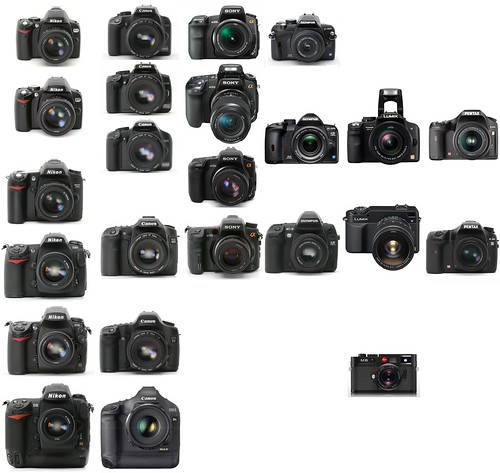
State of the DSLR market - June 2008 (old)
An earlier attempt of mine at the same thing even had commenters threatening to kill each other about the kind of camera they like! But my favourite comment was from Axl Van Goks: "I like the black one with the buttons and stuff."
Since the digital camera market changes like crazy, my big collage from June 2008 was out of date within weeks. I waited for all the pre-Christmas camera introductions to shake out, and now I've made a new version that includes all the current digital SLR cameras I could find (almost 40) from Nikon, Canon, Sony, Olympus, Pentax, Panasonic, Leica, Samsung, Sigma, and Fujifilm:
New image of almost 40 cameras
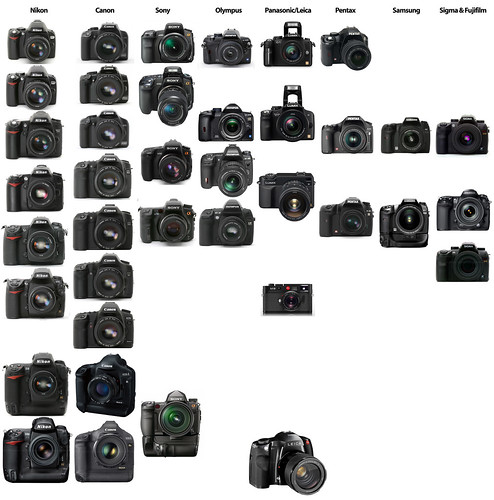
State of the DSLR market - January 2009 (new)
I expect the arguing to begin soon in the comments. The picture has 139 views and 4 favourites since I posted it three and a half hours ago. And yes, yes, I know, I know: they're not all strictly SLRs, but I think they're all of interest to SLR buyers.
Ah, art. Have at it.
UPDATE: My thesis appears to be correct. As a rule of thumb, the more cameras you put in a picture on Flickr, the more popular it is:
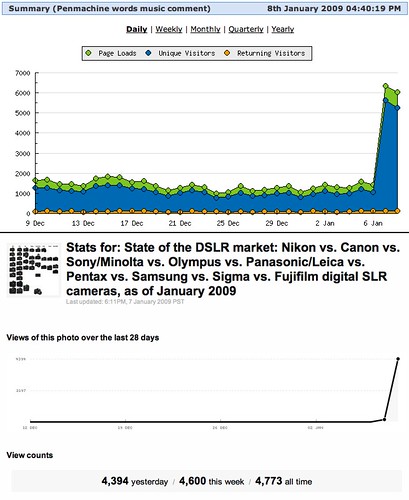
Links from John Gruber and 37signals didn't hurt either.
Labels: canon, controversy, flickr, geekery, leica, linkbait, nikon, olympus, panasonic, pentax, photography, sony
27 October 2008
Happy eighth birthday, blog
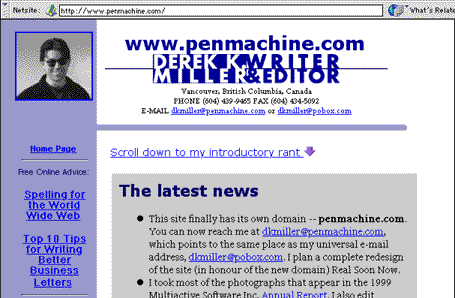 Today marks eight years since this site first became a blog, back on October 27, 2000. That's the day I started using Blogger—long before Google bought it—to publish updates here, instead of doing them manually in a text editor. (I did so on the recommendation of my friend Alistair—who was also standing next to me in the photo I cropped down as my portrait at the time.) Believe it or not, I'm still using Blogger to run the site, although I don't host it on Blogger's servers, and I make my own templates.

That day back in 2000 was also a little over seven months after I first registered the penmachine.com domain—in the three years before that, I'd been publishing at various obscure URLs owned by my ISP and others. However, the alias www.pobox.com/~dkmiller will still get you here, as it always has. So, courtesy of the Wayback Machine, here are some looks back:
- Take a look at this site in September 2000, before I blogified it. I also have a screenshot of an even earlier version, plus a preserved HTML archive from 1998.
- You can also examine roughly how it looked in 2001, 2002, 2003, 2004, 2005, 2006, 2007, and 2008. You know, this blog hasn't changed as much as I might have thought.
- As far as I can tell, the most popular thing I've ever written here is my 2005 article about buying a cheap guitar, which remains my most-viewed page more than three years after I published it, and more than two years after I last made any updates to it. If you post stuff on the web, that shows you why you should avoid breaking links.
- To reinforce that, this month 30 people took at look at my earliest blog archive, and 140 people (!) read my spelling article, which was pretty much the first thing I ever published on the Web, back in 1997. Earlier this year, an editor colleague of mine finally spotted a typo in the piece—even though it had been online and widely read for 11 years. So I fixed it.
- In the past eight years, I'm not sure if I've had visitors from every country in the world, but I have had at least one each (and probably more, given that many people's browsers don't reveal their location) from Namibia, Greenland, Tajikistan, Vanuatu, and Nicaragua, among others.
- My biggest traffic spikes have come via Jason Kottke and John Gruber, which is little surprise if you know their sites.
Given how things are going, I have no idea whether I'll still be writing here in another eight years. But it's been fun so far.
Labels: anniversary, birthday, blog, friends, linkbait, web
18 October 2008
Getting podPress to work with WordPress 2.6
NOTE: This post is a pure podcasting nerd-fest. If that's not your thing, feel free to move on.
I help run two podcasts published using the fine open-source blogging software WordPress. A few months ago, when the latest version of WordPress, 2.6, came out, I immediately upgraded one of the sites, Inside Home Recording (IHR). Whoops. Mistake. The new version broke the key podcasting plugin we use, podPress.
So I held off upgrading the other podcast, Lip Gloss and Laptops, keeping it at WordPress 2.5 to maintain compatibility while waiting for a podPress upgrade. Over at IHR, where it was too late, I instead installed the new Blubrry Powerpress podcasting plugin as a substitute.
UPDATE 21 Oct 2008: For those of you using the Blubrry Powerpress plugin, there is a new update that fixes the problem I talk about below, which Angelo discusses in the comments. His summary: "We've just made a new version (0.4.0) which now displays an image in place of loading quicktime files. We use a simple blubrry play icon as the default play image, but you can provide your own play image by adding a custom define to your wp-config.php that includes the URL where your custom play image is located. This new option is documented at the bottom of the Advanced Tweaks page for the Blubrry Powerpress plugin." Kudos to the Blubrry team.
Now, Powerpress is fine. It does the job, and recognizes most of the detailed settings from podPress, but it doesn't offer as fine-grained control, and has one major problem: for non-MP3 podcasts, such as the Enhanced AAC files we use at IHR, it puts up a little movie player (as does podPress), but in doing so (unlike podPress) it also starts loading the podcast file whenever someone visits the web page. For pages with a lot of podcast episodes on them (like our AAC episode index, or even our home page), that really slows down page load times, wastes bandwidth, and throws off audience statistics.
So I wanted podPress back, but for various reasons the developer has been very busy, had his site forums hacked by spammers, and has otherwise been unable to update his free plugin to work with WordPress 2.6 for several months now. I couldn't wait any longer.
But it turns out the fix is a simple one. The new WordPress feature that seems to be interfering with podPress is post revisions, which track changes to posts. Cool, but I don't use it. The No Revisions plugin turns off that feature, and voila!, podPress works again too.
So I installed No Revisions at both the IHR and Lipgloss sites, deactivated Powerpress at IHR, upgraded to the latest WordPress at Lipgloss (using the great WordPress Automatic Upgrade plugin), and everything seems to be working fine. Page load times have speeded up, simple players are available for all podcast files, and I'm back where I want to be.
If you're a podcaster with similar problems or have been postponing your WordPress upgrade, this solution might work for you too.
Labels: blog, geekery, linkbait, podcast, software, web
10 August 2008
When did dark become bleak?
Remember when the Michael Keaton Batman was considered "dark and edgy?" Today, I couldn't even write that without the ironic quotation marks, and without laughing, a bit like the Joker. Because The Dark Knight, that's dark.
These must be dark times, at least for some of us, because even the dark movies are darker. Or not that, really. They are dark, but also bleak. Look at No Country for Old Men, or some earlier films of the same ilk. Alien3 and Leaving Las Vegas come to mind. I left them as I left The Dark Knight, impressed but a bit deflated. I needed a recharge after each one. Which characters don't lose in those movies?
That's not to say there wasn't much to like about The Dark Knight. Heath Ledger, as everyone's been saying, made the definitive Joker. Minutes into his performance, you know that every other version, whether in the comic books or in the hands of Jack Nicholson, only hinted at what the character was really about, and they're all forgotten. Insane and focused, yet unhinged and random, Ledger's is the real fearsome face we'd all dread if he haunted our city.
His Joker is one of the greatest of all movie villains, and yes, I'd still say that if the actor were alive. Right up there with Dracula, Hannibal Lecter, Darth Vader, HAL, Norman Bates, and Nurse Ratched.
But his Joker also dismantles the universe that the other characters live in. Batman included. Right and wrong, good choices and bad—no one knows what's what anymore. And not just inside the movie, but for me in the audience too. This Joker is so dastardly, so industrious, so fiendish, so insidious, that everything the good guys try near the end is fruitless, even when they "win." Again, Batman included. And you know, I'm not sure that's what I go to superhero movies for.
There was another extraordinary performance in a comic book movie this year: Robert Downey Jr. in Iron Man. Downey made that movie, and owned it, and it was fun. I wanted more, right away. In The Dark Knight, Ledger owns the movie too, as he deserves to, because his Joker steals it. How appropriate. But somehow, he steals it from us in the audience as well. Then he unmakes it.
Would I have watched more of Ledger's Joker if he had lived to play him in another Batman sequel? Yes, I think I would. He was mesmerizing. But that won't happen, and the Batman he and director Christopher Nolan have left behind is so hollowed out I'm not sure I want to see more of him. I wonder whether that feeling will linger in a few years when the next sequel arrives, Jokerless.
Labels: film, linkbait, movie, review
18 July 2008
Zune arrives, not working yet
Yeah, I got the Zune today, but no, despite efforts all fricking day long, I have not actually managed to play any audio or video on it yet. So here are some photos:


Labels: audio, linkbait, microsoft, zune
17 July 2008
My Zune may be about to arrive
It looks like a few people are getting those free Zunes from Matchstick I mentioned recently. Mine would have arrived yesterday, but I was off at the clinic, and again today, so FedEx Ground is dropping by again tomorrow.
Honestly, other than the Zune itself, I'm most interested in the "premium headphones" this promotional one seems to come with. I've always found Apple's stock iPod headphone earbuds remarkably lame. On the other hand, these premium earbuds don't come stock with the Zune either.
Labels: audio, headphones, ipod, linkbait, microsoft, zune
27 June 2008
An author chimes in
Steve Ettlinger, author of Twinkie, Deconstructed, which I wrote about recently, left a comment saying that my blog post was his favorite review of the book.
In part that must be because I liked it, but it also seems that most other reviewers missed the winking irony in his use of Registered Trademark Symbols® throughout, which reminded me of Douglas Coupland's early-'90s novel Shampoo Planet. In that previous case the brands were made up, but the effect is similar: as a reader you feel a bit uncomfortable being hyper-aware of them.
I like that Ettlinger is keeping track of online reviews, in addition to those in traditional publications and media.
Labels: books, food, linkbait, writing
22 June 2008
The best brainless, fun, hard-rockin' songs, according to Derek
 There's a certain type of rock-n-roll song that bypasses your intellect and goes straight for the gut—or a bit lower. One that makes you want to shake your ass, or your head, and sing along, even if you don't know the words, because the words don't matter all that much. They're dumb and sophomoric, anyway, or at least unintelligible—probably about sex or cars or girls or something.
Such a song features guitars, bass, drums, and singing, but probably no keyboards and definitely no strings, horns, or children's choirs. It probably has about three chords, or sounds like it does. The guitars are distorted and loud, and there's almost certainly a guitar solo too, but a short one. You want to turn it up. You know what I'm talking about.
Here is my top 10 list of such songs. Yeah, they're all very mainstream, and you may disagree with me, but I don't care—go ahead and leave a comment if you have further suggestions. I'll include some of my own runners up in a later post. It's a stupid list of stupid songs, which is the reason they're great to begin with:
The Breeders, on the other hand, say, "Koo koo," or, more thoroughly, "Hey now, hey now/Want you, koo koo/Cannonball." Their song is built on a monster bass riff, vocals laid down as if sung through telephones and bullhorns, squeals of feedback, and thick, chunky guitar chords. Plus a drum fill that launches into the chorus like a machine gun, not a cannonball.
Joey Ramone is hiccuping like an amphetamine-fueled Buddy Holly about kids piling in the back seat and losing their minds, Johnny is buzz-sawing his barre chords, and Dee Dee and Tommy pummel away in the background. Despite the disappointing charts and record sales, I'm sorry, "Blitzkrieg Bop" is way better than Steely Dan or the Doobie Brothers.
Yet he was also taking a dig at the very kids who joined in singing, "Our little group has always been/And always will until the end." Yeah sure, teenagers always think so: oh well, whatever, nevermind. The guitar solo exactly duplicates the verse melody too, so it's sort of an anti-solo. Yet you don't need to know any of that, and I'm not sure Nirvana really wanted to you think about it very much, since the song rocks out no matter what.
That's the same reason Van Halen (see below) released a version as their first single in 1978. And while the Beatles may have sung "oh yeah!" a little earlier, no one has ever snarled it with more conviction than Ray Davies. Sure, the Rolling Stones might have seemed a tad dangerous back in '64, but I'm sure whenever kids put "You Really Got Me" on the turntable, it's what really scared the parents.
It wasn't as big a hit as "You Shook Me All Night Long," but that doesn't matter either—because there's more power and good-time boogie in the first chord of "Back in Black" than most bands put out in their entire careers. The clincher is the sing-along chorus: "Ba-a-a-a-ack! Ba-a-a-a-ack! Back in black, yes I'm back! In! Black!" Put away your schoolboy short pants. You're done.
Eddie's lithe little guitar solo is neck-snappingly brief, but still manages to tell a whole story. It starts off with a stereotypical string-bending riff any guitarist could play, then skyrockets off into impossibly fast finger-tapping, whammy-bar–wrangling madness before settling down into the gritty, slinky background of the spoken-word bridge, in which Roth intones the immortal words, "We're runnin' a little bit hot tonite/I can barely see the road from the heat comin' off it/Ah, you reach down/Between my legs/Ease the seat back..." In the background we hear the revving engine of Eddie Van Halen's Lamborghini, which was apparently backed into the recording studio (!) for the purpose.
Then we're into a building, building, building setup that climaxes with spot-on a capella harmonies from the whole band singing, "Ain't no stoppin' now!" What is the sing-along chorus? One word, over and over: "Panama! Panama-uh!" Who can forget the video too, which is like a compendium of pop petal clichés, including Dave riding through the streets of Los Angeles on his motorbike, mane of hair flowing in the wind?
And we're still done in under four minutes. I bow before you, Van Halen. If there is a more perfect song for a hot drunk summer night, I can't think of it.
After much discussion in the comments to this post, I must also add an honourable mention for Sweet's "The Ballroom Blitz" (I can't figure out which other tune to replace with it), from 1973. Brian Connolly's singing is so off-the-hook frenzied, so Rocky Horror Picture Show over the top that it's almost yodeling, and as Bob noted in the comments here, it's hard to beat an intro like, "Are you ready Steve? Andy? Mick? All right fellas, let's GOOOOOOOOOOOOOO!"
Labels: band, linkbait, lists, music, radio, video