Penmachine
17 March 2010
The Nikon FM3A
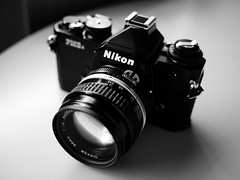 Camera nerds have strange obsessions. Among film cameras, the Leica M series of small rangefinder devices is probably top among photo fetishists, who might argue about whether the original 1950s M3 or the current M7 or MP is the optimum design.
But to me, the manual-focus, precision-built electromechanical Nikon FM3A SLR is the real star of these old-school cameras. It was an oddity when Nikon introduced it in 2001—by which time ergonomically-shaped, plastic-bodied autofocus cameras were what almost everyone used, and digital was poised to take over from film almost entirely. (Even the FA of 1983, or the intro-level FG I owned around the same time, had more modern features in many respects.)
But Nikon was intentionally building a modernized retro camera for those fetishists. It offers basic but powerful light-metering, manual focus assistance, fill-flash compatibility, and aperture-priority automation if you want it. But it is also a fully-mechanical machine that will operate perfectly (except for the light meter) without any batteries. All the power to run it can come from energy stored in springs when you ratchet the film advance lever with your thumb, something that's hard to comprehend for anyone who's used to today's battery-sucking digital beasts, or even my 1988 autofocus Nikon F4.
Nikon only made the FM3A for five years, and manufactures nothing at all like it today. (Indeed, almost no one besides Leica makes fully mechanical cameras anymore.) If you can find one, it sells for pretty close to the $800 the model fetched when new, which is still a fraction the cost of a Leica or a top-of-the-line digital Nikon SLR. And it will use most Nikon-mount lenses made between 1977 and quite recently, when the company stopped including aperture rings on their SLR lenses.
I'd compare this rugged Nikon with modern versions of the Fender Stratocaster guitar, or a brand-new fountain pen: the FM3A looks superficially like something created decades earlier, and works pretty much that way too, but it has some clever modern enhancements that smooth the way for enthusiasts or professionals to use it elegantly. It's neat that Nikon ever decided to create it, and like the still-manufactured Nikon F6 film SLR, it's probably among the last of its kind.
Labels: film, geekery, history, nikon, photography
07 March 2010
Get the T.A.M.I. Show on DVD
Any musician or music geek worth his or her salt knows about The T.A.M.I. Show, a one-off 1964 TV special/theatrical movie. It capitalized on that year's Beatlemania with an astonishing evening of concert performances by hitmakers from the U.S. and the U.K. in Santa Monica near the end of October of that year:
The film is now available for purchase for the first time (yes, the first time in 46 years). Like The Beatles' Yellow Submarine, The T.A.M.I. Show has been mired in copyright and ownership disputes for decades—bootlegs have abounded, but even those lacked footage of The Beach Boys, who had their part removed after the initial theatrical release in '64.
The T.A.M.I. Show is best known for the explosive performance (and amazing hairdo) of James Brown, then nearing the peak of his powers as a singer, dancer, bandleader, and musical innovator. (He would basically invent funk the next year, with "Papa's Got a Brand New Bag.") If you were among those who thought The Beatles were strange and radical in 1964, then this footage of James Brown and the Famous Flames would have simply exploded your head.
But check out the rest of the lineup too: The Barbarians, Marvin Gaye, Gerry and The Pacemakers, Lesley Gore, Jan and Dean (who hosted), The Supremes, Billy J. Kramer and The Dakotas, and Smokey Robinson and The Miracles. Plus a few other acts you might have heard of: Chuck Berry, The Beach Boys, and The Rolling Stones. All on one concert stage.
It's a shame the movie has been essentially underground since before I was born, but now it will be easy to find starting March 23. I made sure to pre-order a copy, and I'd like to thank Tim Bray for telling me it was showing on PBS tonight. I've been trying to see the whole thing since the 1980s.
Labels: film, movie, music, sixties, television
21 January 2010
Review: "It Might Get Loud"
If you're a guitar or rock music nerd (like me), you need to see It Might Get Loud. My friend Andrew recommended it to me a few weeks ago, and I was reminded about it on the 37signals blog. The film is a documentary featuring Jimmy Page (of Led Zeppelin), The Edge (of U2), and Jack White (of The White Stripes and The Raconteurs), talking about how they came to be guitarists, playing individually, and jamming together on a faux–sitting-room set built in a warehouse.
So if you're a guitar nerd, you might be off to buy the DVD right now. Still, it's worth knowing why this is not just some self-indulgent guitar wank-fest, and why it's also worthwhile for general music fans too.
No doubt Page, Edge, and White are three of the most influential and popular electric guitarists of the past 40 or 50 years. It would have been interesting to add, say, Tom Morello or Eddie Van Halen to the mix, but I think director Davis Guggenheim was wise to structure the film around a tripod of players—Page from the '60s and '70s, Edge from the '80s and '90s, and White from this past decade.
Each of them talks about individual songs that helped propel them to their current careers. Jimmy Page, resplendent in a long coat and silver hair just the right length for an elder statesman of rock 'n' roll, listens to Link Wray's "Rumble" crackle from a 45 rpm single—he jams along on air guitar and also turns a phantom tremolo knob on an invisible amp to demonstrate how Wray took that classic instrumental to a new level, and grins in sheer joy as he must have as a teenager.
The Edge recalls watching The Jam blast away the twee pop and bland '70s rock that dominated Top of the Pops on British TV in his youth. Jack White puts Son House's skeletal "Grinnin' in Your Face" (just vocals and off-time handclaps) on the turntable and says it's been his favourite song since he first heard it as a kid.
And that's the funny thing. White, who's 34, turned five years old in 1980, the year Led Zeppelin disbanded and U2 released their first album, Boy. For most guitarists of his generation, walking into a room with your guitar to meet Jimmy Page and The Edge would be terrifying, especially when they asked you to teach them one or two of your songs. But in some ways White comes across as the oldest of the group, a pasty-faced ghost from the 1950s or earlier, wrestling with his ravaged and literally thrift-store Kay guitar, wearing a bowtie and a hat and smoking stubby cigars, channeling Blind Willie McTell and Elmore James, building a slide guitar out of some planks, a Coke bottle, and a metal string, assembled with hammer and nails:
While Page and The Edge both grew up in the British Isles, and have never held any jobs besides playing guitar, White is from Detroit, and his hip-hop and house-music–listening cohorts in the '80s and early '90s thought that playing an instrument of any kind was embarrassing, so he didn't come to guitar until he'd already worked as an upholsterer. Somehow, though, if White and Page are rooted in gutbucket, distorted blues, it's still The Edge who seems to be coming from outer space. When he plays his echoing, beautiful intro to "Bad" alone on the soundstage, it's a sound neither of the other players could have created.
During the guitar summit, each of the guitarists teaches the others a couple of his songs. The Edge's first one is "I Will Follow," and it works better than any of the rest, in part because, as he explains, he often creates guitar parts with the absolute minimum of notes, so that they sound clearer, more distinctive, and less muddy when played really loud. And Page and White play really loud. Together the result is, as Jimmy Page says, "roaring."
Labels: band, film, guitar, movie, music, review
17 January 2010
Considering "Avatar"
I'm still not sure quite what I think—on balance—about Avatar, which my wife and I saw last week. In one respect, it's one of very few movies (pretty much all of them fantasy or science fiction) that show you things you've never seen before, and which will inevitably change what other movies look like. It's in the company of The Wizard of Oz, Forbidden Planet, 2001: A Space Odyssey, Star Wars, Blade Runner, Tron, Zelig, Who Framed Roger Rabbit?, Jurassic Park, Babe, Toy Story, The Matrix, and the Lord of the Rings films. It's tremendously entertaining. Anyone who likes seeing movies on a big screen should watch it.
I also don't know if anyone is better at choreographing massive action sequences than Avatar's director, James Cameron—nor of making a three-hour film seem not nearly that long. Maybe, with its massive success, we'll finally see fewer movies with the distinctive cold blue tint and leathery CGI monsters stolen from the Lord of the Rings trilogy. (Maybe in a few years we'll all be tired of lush, phosphorescent Pandora-style forests instead.) Avatar is also the first truly effective use of 3D I've seen in a film: it's not a distraction, not a gimmick, and not overemphasized. It's just part of how the movie was made, and you don't have to think about it, for once.
But a couple of skits on last night's Saturday Night Live, including "James Cameron's Laser Cats 5," in which both James Cameron and Sigourney Weaver appeared, reminded me of some of Avatar's problems:
- Cameron has been thinking about this project since the beginning of his career over three decades ago, and it shows. Or rather, it shows in every other movie he's made. That's because Avatar includes a grab-bag of common Cameron concepts: humanoids that aren't quite what they seem (The Terminator and Terminator 2); kick-ass interstellar marines—including a butch-but-sensitive Latino woman—piloting big walking and flying machines (Aliens); state-of-the-art CGI effects pushed to their limits (The Abyss, Terminator 2, and Titanic); money-grubbing corporate/elite bad guys (Aliens, Titanic), hovering, angular, futuristic transport vehicles (True Lies, The Terminator, The Abyss, Aliens); a love story that turns one of its participants away from societal conventions (Titanic); people traveling to distant planets in suspended animation (Aliens), and of course a lot of stuff that Blows Up Real Good.
- The storyline, despite its excellent execution, is remarkably simplistic, and could easily have been adapted from a mid-tier Disney animation like The Aristocats or Mulan, or (most pointedly) Pocahontas. It's the Noble Savage rendered in blue alien flesh. No doubt much of that is intentional, since some of our most powerful and lasting stories are simple. But I think all the talent and technology behind this movie could have served something more sophisticated, or at least more morally nuanced.
- With all the spectacle of Pandora—the glowing forest plants, the bizarre pulsing and spinning animal life, the floating mountains, the lethal multi-limbed predators—somehow it didn't feel alien enough to me. The most jarring foreign feeling came in the views of Pandora's sky, reminding us that it is not a planet but one of many moons of a looming, ominous gas giant like Jupiter. The humanoid Na'vi, despite all the motion capture that went into translating human actors' performances into new bodies, still seem, in a way, like very, very well-executed rubber suits. The pre-CGI aliens of Aliens (especially the alien queen) were, to me, more convincing despite often actually being people in suits.
- Overall, Avatar isn't James Cameron's best film. I'd choose either Aliens or Terminator 2: Judgment Day as superior. I remember each one leaving me almost speechless. That's because they were exhilarating and—more important—profoundly satisfying, both emotionally and intellectually. Avatar, despite its many riches, didn't satisfy me the same way.
_-_Alien_queen.jpg)
Now, if you're among the 3% of people who haven't seen Avatar yet, I still recommend you do, in a big-screen theatre, in 3D if you can. Like several of the other technically and visually revolutionary movies I listed in my first paragraph (Star Wars and Tron come to mind), its flaws wash away as you watch, consumed and overwhelmed by its imaginary world.
James Cameron apparently plans to make two Avatar sequels. Normally that might dismay me, but his track record of improving upon the original films in a series, whether someone else's or his own (see my last bullet point above), tells me he might be able to pull off something amazing there. Now that he has established Pandora as a place, and had time to develop his new filmmaking techniques, it could be very interesting to see what he does with them next.
Labels: film, movie, review, sciencefiction, space
10 August 2009
More luscious black and white
It's partly because of the look of using a larger frame of film, partly the texture it imbues, and partly because I'm just more careful when using an expendable resource, but as I've mentioned before, I get more keeper photographs when I shoot with black and white film than when I use my digital SLR. These are from a couple of recent rolls:
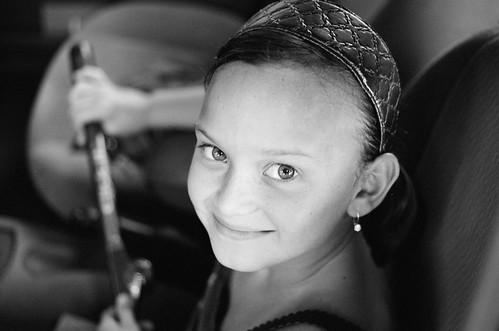

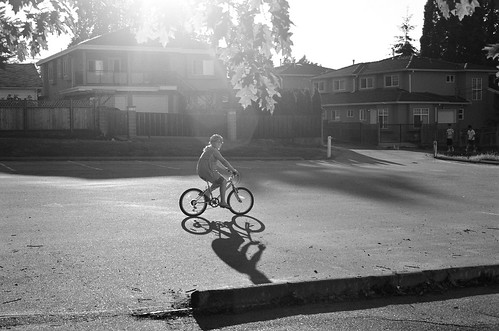

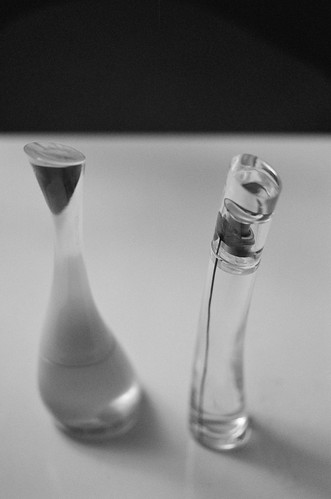
I didn't have to go far to get them either—I took all these pictures either in our house, in the yard, or at my kids' school up the street, all with natural light and no flashes or reflectors. I'm certainly not regretting my purchase of that used Nikon F4 or macro lens last year.
Time to pick up another roll or two of B&W, I think. I've run out for now.
Labels: film, geekery, nikon, photography
28 June 2009
Links of interest 2006-06-21 to 2006-06-27
While I'm on my blog break, more edited versions of my Twitter posts from the past week, newest first:
- My wonderful wife got me a Nikon D90 camera for my 40th birthday this week. I'm thinking of selling my old Nikon D50, still a great camera. Anyone interested? I was thinking around $325. I also have a brand new 18–55 mm lens for sale with it, $150 by itself or $425 together. I have all original boxes, accessories, manuals, software, etc., and I'll throw in a memory card, plus a UV filter for the lens.
- Roger Hawkins's drum track for "When a Man Loves a Woman" (Percy Sledge 1966): tastiest ever? Hardly a fill, no toms, absolutely delicious.
- Thank you thank you thank you to everyone who came to my 40th birthday party—both for your presence and for the presents. Photos from the event, held June 27, three days early for my actual birthday on Tuesday, are now posted (please use tag "penmachinebirthday" if you post some yourself).
- I think Twitter just jumped the shark. In trending topics, Michael Jackson passed Iran, OK, but both passed by Princess Protection Program (new Disney Channel movie)?
- AT&T (and Rogers, presumably) is trying to charge MythBusters' Adam Savage $11,000 USD for some wireless web surfing here in Canada.
- After more than 12 years buying stuf on eBay, here's our first ever item for sale there. Nothing too exciting, but there you go.
- Michael Jackson's death this week made me think of comparisons with Elvis, John Lennon, and Kurt Cobain. Lennon and Cobain still seemed to have some artistic vitality ahead of them. Feel a need for Michael Jackson coverage? Jian Ghomeshi (MP3 file) on CBC in Canada is the only commentator who isn't blathering mindlessly. But as a cancer patient myself, having Farrah Fawcett and Dr. Jerri Nielsen (of South Pole fame) die of it the same day is a bit hard to take.
- Seattle's KCTS 9 (PBS affiliate) showed "The Music Instinct" with Daniel Levitin and Bobby McFerrin. If you like music or are a musician, it's worth watching, even if it's a bit scattershot, packing too much into two hours.
- New rule: when a Republican attacks gay marriage, lets assume he's cheating on his wife (via Jak King).
- The blogs and podcasts I'm affiliated with are now sold on Amazon for its Kindle e-reader device, for $2 USD a month. I know, that's weird, because they're normally free, and are even accessible for free using the Kindle's built-in web browser, so I don't know why people would pay for them—but if you want to, here you go: Penmachine, Inside Home Recording, and Lip Gloss and Laptops. Okay, we're waiting for the money to roll in...
- Great speech by David Schlesinger from Reuters to the International Olympic Committee on not restricting new media at the Olympics (via Jeff Jarvis).
- TV ad: "Restaurant-inspired meals for cats." Um, have they seen what cats bring in from the outdoors?
- I planned to record my last segment for Inside Home Recording #72, but neighbour was power washing right outside the window (in the rain!). Argh.
- You can't trust your eyes: the blue and green are actually the SAME COLOUR.
- Can you use the new SD card slot in current MacBook laptops for Time Machine backups? (You can definitely use it to boot the computer.) Maybe, but not really. SDHC cards max out at 32GB (around $100 USD); the upcoming SDXC will handle more, but none exist in Macs or in the real world yet. Unless you put very little on the MacBook's internal drive, or use System Preferences to exclude all but the most essential stuff from backups, then no, SD cards are not viable for Time Machine.
- Some stats from Sebastian Albrecht's insane thirteen-times-up-the-Grouse Grind climb in one day this week. He burned 14,000+ calories.
- Even though I use RSS extensively, I find myself manually visiting the same 5 blogs (Daring Fireball, Kottke, Darren Barefoot, PZ Myers, and J-Walk) every morning, with most interesting news covered.
- I never get tired of NASA's rocket-cam launch videos.
- Pat Buchanan hosts conference advocating English-only initiatives in the USA. But the sign over the stage is misspelled.
- Who knew the Rolling Stones made an (awesome) jingle for Rice Krispies in the mid-1960s?
- Always scary stuff behind a sentence like, "'He is an expert in every field,' said a church spokeswoman."
- Kodachrome slide film is dead, but Fujichrome Velvia killed it a long time ago. This is just the official last rites.
- My friends Dave K. and Dr. Debbie B. did the Vancouver-to-Seattle bicycle Ride to Conquer Cancer (more than 270 km in two days) last weekend. Congrats and good job!
- My daughter (11) asks on her blog: "if Dad is so internet famous, I mean, Penmachine is popular, then, maybe I am too..."
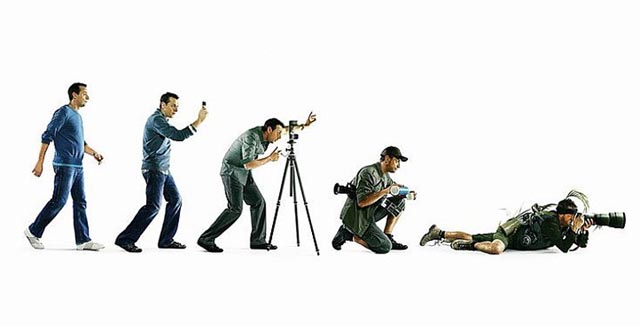
- Evolution of a photographer (via Scott Bourne).
Labels: amazon, apple, backup, birthday, cancer, film, geekery, linksofinterest, music, news, olympics, photography, politics, religion, science, space, television, twitter
09 May 2009
Redeeming the prequel
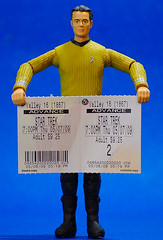 Remember back in 2006 when I raved about the then-new Casino Royale? It defined how to reboot a movie franchise. And the new Star Trek, which I saw tonight, learned that James Bond lesson, in spades.
Trek never shied away from time travel—the old crew used it to do everything from keeping the Nazis from winning the War to saving the whales (and the Earth). But the new movie is especially clever with it, managing to maintain the integrity of the original series and movies, and all their sequels, while giving the "new" crew entirely different directions to go.
In another way, that hardly matters. My kids enjoyed the movie tremendously, even though they know basically nothing about previous Treks. It's just a great big ball of fun. Despite all the praise it's received, it was also still considerably better than I expected.
But that was Winona Ryder? Didn't even recognize her.
Labels: film, movie, review, startrek
13 April 2009
My song "Meltdown Man" in a movie trailer
If you watch this trailer for the documentary film Paper or Plastic?, around the 1 min 35 sec mark, you'll hear my tune "Meltdown Man," which the filmmakers licensed from me last year:
The movie about the world grocery bagging championships. Yes, you read that right. I haven't seen the whole film yet, but it looks fun.
Labels: film, free, movie, music, penmachinepodcast
06 March 2009
Links of interest (2009-03-06):
- Transom.org has some wonderfully comprehensive audio articles for podcasters, like the stand mic shootout, handheld mic shootout, and recording phone calls tutorial (via Doug Kaye).
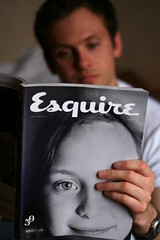
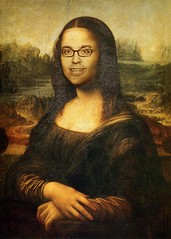
- PhotoFunia lets you put your own face into various stock photos (via J-Walk). Some work better than others. A couple of sample pictures of one of my daughters and me:
- Mac OS iPhone project (via Melanie). It was bound to happen.
- Photographic shit disturber Ken Rockwell points to these two great posts about film photography from John Sevigny, on the theme of digital cameras: the thrill is gone: "Many of the film oriented products introduced at PMA [this week's big photo tradeshow] are far more interesting than anything digital that bothered to show up to the party. [...] My advice: get [a used Nikon] FM2 for less than $500, three or four lenses for another $500 total, and a 35mm film scanner for another $500. [...] Use the remaining $6,500 to fly to Brazil, China, Mexico or Thailand and spend several months photographing there."
- Isabella and Raul have started organizing Mental Health Camp, an unconference here in Vancouver about mental health issues, April 25, 2009 in Gastown. (UPDATE: It now has its own URL at MentalHealthCamp.org.)
- Remember that crazy Leica R9 SLR camera I blogged about in 2007? Well, Leica long ago stopped making the digital back, and now they're discontinuing the camera and lenses too. But not to worry: an all-digital, autofocus R10 will come eventually. And will be amazingly high-priced, just like its upcoming big sibling the S2.
- Rebecca posts about Rudyard Kipling's visits to Vancouver in the 1800s and early 1900s, and how much our city changed during that time.
- The Onion's "San Francisco Historians Condemn 1906 Earthquake Deniers" is almost as good as the old "Evangelical Scientists Refute Gravity With New 'Intelligent Falling' Theory."
Labels: controversy, film, geekery, history, linksofinterest, mentalhealth, photography, podcast, recording, science, vancouver
02 March 2009
End of an era
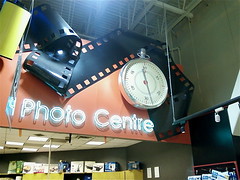 Today I brought some rolls of black-and-white film photos, which I'd taken at Northern Voice and our vacation last week, to the Save-On-Foods one-hour photo lab at Metrotown in Burnaby. Since the film was not regular silver halide B&W, but the kind that can be processed in a colour print minilab, Save-On developed, printed, and scanned the pictures in an hour.
But at the end of the week, Save-On is shutting down its one-hour lab. That's the end of an era for me—I've been having film developed, as well as both film and digital pictures printed there, for about 20 years. It's a sign. Hardly anyone but photo enthusiasts uses film anymore. Since I started shooting film again last summer, I've hardly ever seen anyone else bringing film into the Save-On lab. Usually the attendant is reading a book.
There are plenty of other options nearby, including the inexpensive Costco one-hour lab down the hill, the nearby London Drugs, and maybe one or two in the mall. There are also numerous proper pro labs in the city that will process and print nearly any kind of film with loving care—and for a price. But I'll miss the corner of Save-On with its now-outdated big-ass sign featuring a giant model film roll and 60-minute stopwatch.
Labels: film, geekery, history, photography, vancouver
06 January 2009
Geeky film lists
I've never heard of Den of Geek before, but they make some fun lists (via Kottke), such as these about movies:
- Top 50 movie special effects shots (Jason Kottle wonders if Titanic should have something in this list, but it gets into the next one)
- 24 worst special effects of all time
- Top 50 drug trips in movies
- 10 most depressing movie endings ever
- To 10 mindf**k movies
- 10 inappropriately bad acting performances
- 10 inappropriately good acting performances
...and, my favourite, just for the title:
- Top 10 exploding people—and no, while it's on there, Scanners is not #1!
Labels: film, geekery, lists, movie, web
16 October 2008
Links of interest (2008-10-16):
I'm still doped up on Tylenol 3's and pretty tired post-surgery, so am not up for much thinking or original posts. I'm also contemplating email bankrupcy again, mere months after my last one, as my inbox creeps up to 800 once more. Sigh. Anyway, here's some interesting stuff:
- What if all movies had cell phones? (There's a good reason No Country for Old Men was set in 1980, by the way.)
- A worthy quote in this electional season: "I like to pay taxes. With them I buy civilization." - Oliver Wendell Holmes (though it may be a folksier recasting of "Taxes are the price we pay for a civilized society").
- "Hey news executives! Try this newsroom pop quiz: Give each staff member a pencil and tell everyone to stop what they're doing and write out the tag that creates a hypertext link." (via Dan)
- Andrew Sullivan rounds up quotes from a number of last night's press and blogger reactions to the final McCain-Obama debate.
- Also from Sullivan, it's a bit sad how well this video reflects the approach of the McCain campaign right now.
- While Leica's upcoming S2 camera is quite large (especially the lenses) for a digital SLR, it has a medium-format size sensor, meaning that it is smaller and probably more ergonomic than most of its direct competitors, and that even the rumoured €10,000–20,000 price isn't as insane as it sounds. Nevertheless, the cost of a reasonably complete S2 system when it's released next year will rival that of a condominium. It also bodes well for future "lower end" (for Leica, at least) cameras from this legendary manufacturer.
- What's it like to write other people's term papers for a living? (via Kottke)
- The web comic Basic Instructions makes me laugh almost every single time a new one comes out.
- Vancouver locals Buzz Bishop and Darren Barefoot accurately summarize the Canadian election held this week, in which nothing much changed. The result (as I discussed earlier) bodes poorly for our country's environmental and climate policy, which is one subject we can't afford to waste time on, unfortunately.
Labels: environment, film, leica, linksofinterest, movie, news, photography, politics, school, telecommunications, web, writing
01 October 2008
I'm interviewed about film photography
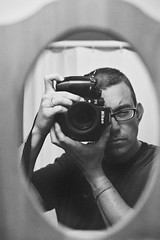 Last week fellow Canadian podcaster John Meadows, whose show is called "On the Log," interviewed me about my recent return to dabbling in film photography.
John's episode 38 (MP3 file) is titled "Film at 11." I talk about how I now approach making black and white pictures, as well as the cross-processed colour photographs I've taken in the past couple of months. Plus John and I discuss other differences between film and digital photography for archiving and backup.
The podcast is a good corollary to my recent talk at Vancouver's PhotoCamp and my Camera Works series here on the blog.
Labels: film, geekery, nikon, photography, podcast
30 September 2008
My black and whites are more popular
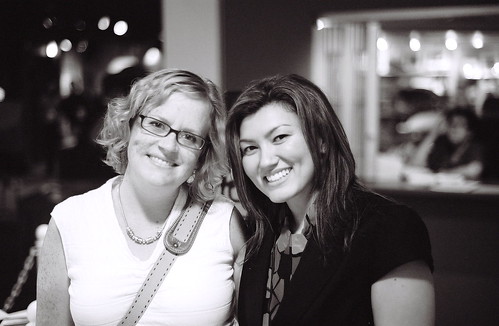
Since I started taking black and white film photos again back in July, I've noticed something. People like them a lot, on average more than my other pictures.

I'm not sure if it's that I take these photographs differently, because I know they are single shots on a limited medium, and will lack colour, so I compose and shoot them more carefully than others.

Or perhaps it's just that they are striking purely because they don't have colour and people aren't used to that anymore, epecially online. Maybe if I converted some of my other pictures to B&W, they might get a similar response too.
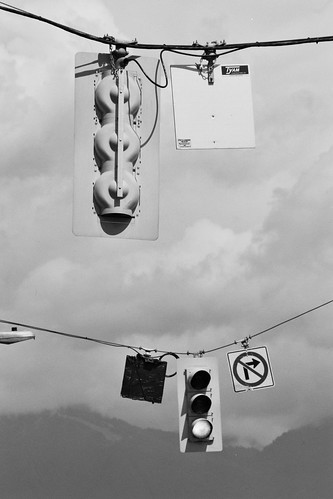
I know I enjoy making those images. It's pricey compared to digital photography, but that's part of what makes them different too.
Labels: film, friends, geekery, nikon, photography
27 August 2008
"Edison and Leo" hits the screen
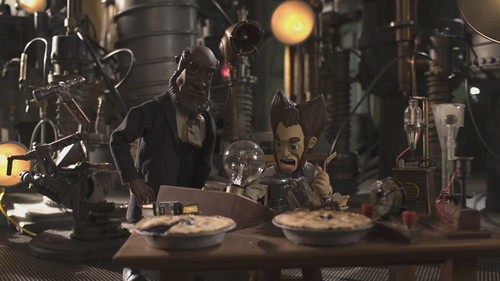
My friend Jeff is a movie publicist, and in January, he took me to visit the set of one of his projects: Edison and Leo, the first feature-length stop-motion animated movie ever made in Canada. At that time the film had already been shooting for eight months in a converted residential school in Mission, B.C., about an hour east of Vancouver, after several years of preproduction. Now, eight months after that, the film is ready.
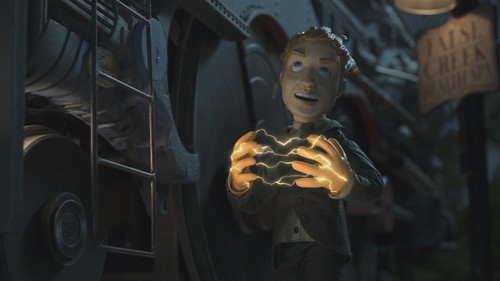
I haven't seen it yet, because Edison and Leo will premiere at the Toronto International Film Festival next week, on September 4.
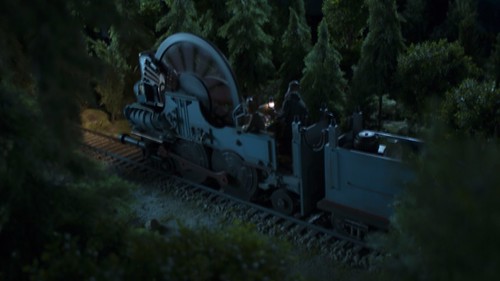
Just as I compared the impressive but bleak The Dark Knight to 1989's supposedly "dark" Tim Burton Batman, I suspect that Edison and Leo will better Burton's 1993 stop-motion production, The Nightmare Before Christmas, too.
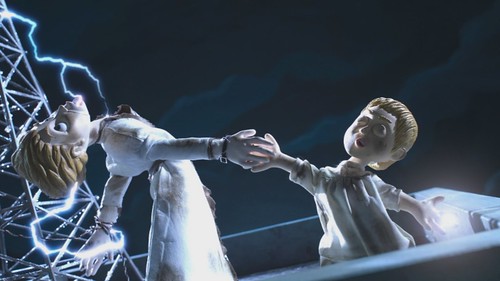
From what I know of it now and what I saw on the set, Edison and Leo shares elements with many scary elements of classic fairy tales: parental abandonment, evil meddlers, plotting siblings, strange castle compounds, and lightning bolts and electrocution. Okay, maybe that's more Dracula.
Not only is it the first stop-motion feature from Canada, it's also apparently the first such movie aimed at grownups anywhere. If it's as good as it seems it might be, there's always that Best Animated Film Oscar to shoot for as well.
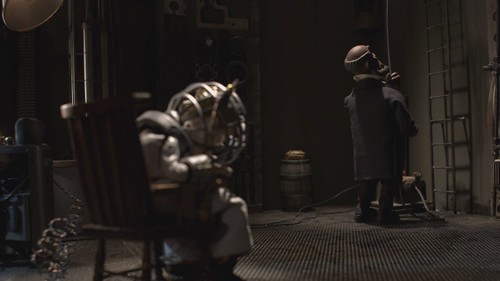
You can get an idea of the look of the film from my photoset at Flickr. I'm looking forward to a viewing.
Labels: animation, edisonandleo, film, movie
12 August 2008
Jeff and Podcast Puppy at the E! Online blog
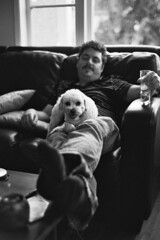 Our friend Jeff works in publicity for various movies, including the upcoming stop-motion animated film Edison and Leo. He's just been profiled for E! Online by our fellow Vancouver blogger Rebecca, a.k.a. Miss604.
The photo used at the E! website is one I took of Jeff and his dog Dizzy (a.k.a. Podcast Puppy) last week with my film camera. We were hanging out at his house. I also took a more formal portrait yesterday, but E! decided to use the black and white one, which I think is a better picture anyway.
That's one of Jeff's fine homemade margaritas in his hand, by the way.
Labels: blog, edisonandleo, film, photography, vancouver
10 August 2008
When did dark become bleak?
Remember when the Michael Keaton Batman was considered "dark and edgy?" Today, I couldn't even write that without the ironic quotation marks, and without laughing, a bit like the Joker. Because The Dark Knight, that's dark.
These must be dark times, at least for some of us, because even the dark movies are darker. Or not that, really. They are dark, but also bleak. Look at No Country for Old Men, or some earlier films of the same ilk. Alien3 and Leaving Las Vegas come to mind. I left them as I left The Dark Knight, impressed but a bit deflated. I needed a recharge after each one. Which characters don't lose in those movies?
That's not to say there wasn't much to like about The Dark Knight. Heath Ledger, as everyone's been saying, made the definitive Joker. Minutes into his performance, you know that every other version, whether in the comic books or in the hands of Jack Nicholson, only hinted at what the character was really about, and they're all forgotten. Insane and focused, yet unhinged and random, Ledger's is the real fearsome face we'd all dread if he haunted our city.
His Joker is one of the greatest of all movie villains, and yes, I'd still say that if the actor were alive. Right up there with Dracula, Hannibal Lecter, Darth Vader, HAL, Norman Bates, and Nurse Ratched.
But his Joker also dismantles the universe that the other characters live in. Batman included. Right and wrong, good choices and bad—no one knows what's what anymore. And not just inside the movie, but for me in the audience too. This Joker is so dastardly, so industrious, so fiendish, so insidious, that everything the good guys try near the end is fruitless, even when they "win." Again, Batman included. And you know, I'm not sure that's what I go to superhero movies for.
There was another extraordinary performance in a comic book movie this year: Robert Downey Jr. in Iron Man. Downey made that movie, and owned it, and it was fun. I wanted more, right away. In The Dark Knight, Ledger owns the movie too, as he deserves to, because his Joker steals it. How appropriate. But somehow, he steals it from us in the audience as well. Then he unmakes it.
Would I have watched more of Ledger's Joker if he had lived to play him in another Batman sequel? Yes, I think I would. He was mesmerizing. But that won't happen, and the Batman he and director Christopher Nolan have left behind is so hollowed out I'm not sure I want to see more of him. I wonder whether that feeling will linger in a few years when the next sequel arrives, Jokerless.
Labels: film, linkbait, movie, review
05 August 2008
More pictures
Before I continue with my Camera Works series, here are the latest pictures I took with my new/old film camera. I used both black and white and cross-processed slide film with crazy colours:


Labels: family, film, photography, travel, whistler