Penmachine
01 March 2010
I loved the Closing Ceremony of the Vancouver Olympics...
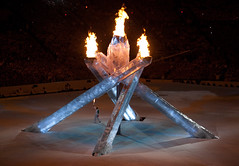 ...until the end part.
I wanted to like the whole thing, I really did. I've turned into a total Winter Olympics fanboy in the past two weeks, and I watched it on TV and made my way to several of the Olympic sites. I cheered and cursed and got myself in knots over curling (curling?!) and snowboard cross and hockey and bobsleigh and speed skating, and even events where Canada wasn't in the medal running, like the men's 4x10 cross-country ski relay.
First, let me note that the Derek Miller playing guitar and singing with Eva Avila and Nikki Yanofsky early on was not me, though since the camera angle was pretty wide, I probably could have gotten some good mileage from pretending he was. But no, he's won Juno awards and is way more talented than I am.
Anyway, watching the Closing Ceremony on TV today with my family, I liked its tone, happy and respectful when it needed to be, delightfully cheeky beyond that:
- The "repair" of the cauldron that malfunctioned at the Opening Ceremony, with Catriona Le May Doan on hand to relight it (she missed out on her earlier chance because of the snafu).
- The informal, casual return of the visibly relieved and tired athletes to the stadium—in a loose, milling throng instead of the regimented blocs of nations from the also-lovely Opening Ceremony a couple of weeks ago.
- The beautiful seaside figure skating piped in from Sochi, Russia as part of their feature during the event.
- The spontaneous (and lengthy) standing ovation after Vancouver chief organizer John Furlong's brief but apt tribute to dead Georgian luger Nodar Kumaritashvili.
- William Shatner's Canadian semi-slam poem. I mean, come on, The Shat, my friends! People joked about the idea online beforehand, and then IT ACTUALLY HAPPENED! Awesome. (I just wished they'd beamed him up at the end. After all, Scotty was from Vancouver, you know.)
- The whole every-Canadian-stereotype-and-the-kitchen-sink production number with Michael Bublé. Loved when the Mountie-ettes tore off his Red Serge uniform, when the giant inflatable beavers appeared, when the hockey players broke into a brawl. I'm not sure everyone around the world got the intended irony, but I don't care. It was hilarious.
Alas, the musical cavalcade during the finale was a disappointment. There is so much more diversity, talent, and power across the Canadian music scene, and much of it was on hand for the free LiveCity concerts during the course of the Games.
But not at the Closing Ceremony. Neil Young played "Long May You Run" as the flame was extinguished. Good job. k-os finished the evening with some of his distinctive and rousing hip-hop. Also good. In between, we got Nickelback, Avril Lavigne, Alanis Morissette, Simple Plan, Hedley, and Marie-Mai. All very mainstream, white, big-selling pop acts.
None of those acts, on their own, was particularly problematic. (Lots of people have a hate on for Nickelback, sure, but like the absent Céline Dion, they sell the records). However, all of them together reflected a profound lack of imagination.
The reaction among Canadians online, which had been mixed before that point, turned savage. Steven Page, former singer of the Barenaked Ladies (he or his old band should have been there), got in some of the best digs:
- "It's easy to make fun of Nickelback, but there are worse things. And Chad's hair looks nice. Like Katie Couric's."
- "I have nothing to say about Avril. Except I wish it was Anvil."
- "Wow. If I just arrived on Earth now, I'd believe that sports were better than music."
Entertainment Weekly piped up with, "Where is Rush? Be cool or be cast out, Canada..." Comments from my friends and other rank-and-file Twitter and Facebook users were less kind. At the end, my friend Ryan pointed me to Parveen Kaler, who summed it up with this:
- "FREE BIRD."
Think about some of the other options: Sloan, Blue Rodeo, Spirit of the West, Stompin' Tom Connors, Arcade Fire, Jessie Farrell, Tegan and Sara, Matthew Good, Alexisonfire, Bruce Cockburn, Hot Hot Heat, K'Naan, The Trews, Paul Anka, D.O.A., Mother Mother, Skydiggers, Lights, Sarah Harmer, Robbie Robertson, Metric, Diana Krall, The Tragically Hip, Bedoin Soundclash, Jann Arden, The Guess Who, Divine Brown, Odds (with my friend and sometime co-musician Doug on bass), The Stills, 54-40, Sam Roberts, Cowboy Junkies, Colin James, Great Big Sea, Bif Naked, Wide Mouth Mason, The New Pornographers, Shania Twain, Feist, and I could go on. Wouldn't it have been nice to see some of them in the mix?
I'm not even including French Quebec, jazz, country, blues, metal, R&B, folk, reggae, bhangra, and hip-hop artists I don't know much about. Doubtless there's a huge list there too.
So, as with its opening counterpart, I loved the ceremony part of the Olympic Closing Ceremony, and all the staff and volunteers did great work bringing it together. For this fan of Canadian music, alas, its musical finale felt like a fizzle.
Fortunately, the two-week-long street party that several parts of Vancouver have become continues, especially after the big hockey gold medal yesterday afternoon. I bet some of those revelers are singing Nickelback songs too.
Labels: band, controversy, music, olympics, sports, television, vancouver
22 February 2010
Shortest Winter Olympic event?
I asked this on Facebook already, but I'm still wondering. Curling seems to be the Winter Olympic discipline with the longest event time (matches can last for hours), but which event is the shortest? Moguls, snowboard halfpipe, and freestyle aerials seem to be candidates (tens of seconds per run)—anyone know which takes the shortest-event crown?
Let's ignore sports outside the Winter Olympics: events like the 100-metre dash or diving in the Summer Games are obviously extremely quick, under ten seconds.
Labels: geekery, olympics, sports, vancouver
18 February 2010
Out front
Many Olympic victories are won by the slimmest of margins. For example, today, Canada's Christine Nesbitt garnered a gold medal in speed skating by 1/50th of a second, while traveling as fast as a car.
But then there are those athletes who so dominate their runs that they're almost in a different race. Maëlle Ricker did that in her gold-medal snowboard cross event a couple of days ago, opening up a huge lead within the first five seconds and disappearing beyond the other riders' horizon shortly after.
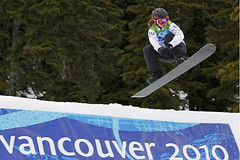
Photo by Gaeia
China's Wang Meng performed a similar feat in short-track speed skating, setting an Olympic record and leaving her rivals, including eventual silver medalist Mariane St-Gelais of Canada, to battle for the other two medals.
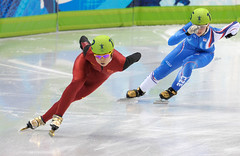
Photo by Harrison Ha
And of course there's Shaun White, the American snowboarder who already had the halfpipe gold medal sewn up, but used his second run to annihilate any prospect of competition from other riders. I was at the Irish House pavilion in downtown Vancouver when his run appeared on the big screen, and you could see jaws drop across the huge room. I don't know much about snowboarding, but even I knew that his near-impossible tricks meant no one could touch him.
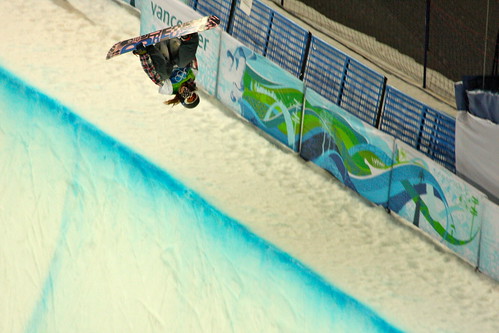
Photo by Lee LeFever
The Olympics often seems like a huge circus of media and entertainment and money and megaproject building. It can obscure the actual sports. But when you witness the achievements of truly outstanding individuals, you remember, and you have to admire what they can make the human body do.
Labels: olympics, sports, vancouver
15 February 2010
Discovering Vancouver's Winter Olympics vibe
Today, while the kids were at school, and after I had another one of my chemotherapy-induced random barfs at home, I took the SkyTrain into downtown Vancouver to check out the Winter Olympics vibe. And what a vibe it was.
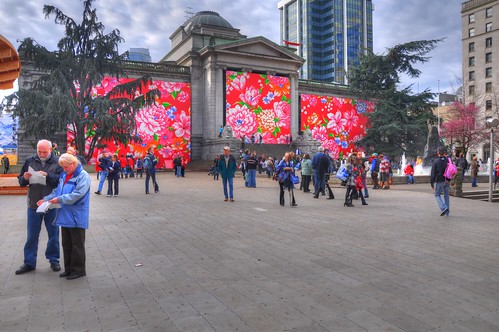
I walked from Science World (currently the Russian Pavilion) past the various provincial pavilions, up the downtown escarpment, along Georgia Street, to Robson Square, then down to Canada Place and the Olympic Cauldron on Coal Harbour. On the way I ate at the world famous Japadog hot dog cart for the first time (yes, even for a native Vancouverite!), and before I came home I had a coffee at the very civilized Cascades Lounge in the Pan Pacific Hotel.
I've lived my whole 40 years in Vancouver, and I have never seen it like it is this week. Even during Expo 86 (check this throwback I spotted), the crowds and events were largely confined to the Expo site on False Creek, while the Olympics—aside from being more intensely focused by being two weeks instead of five months long—permeate the downtown core, as well as extending elsewhere in Greater Vancouver and up to Whistler. But we are a more global, better-known city than we were 24 years ago too.

There are seas of people young and old downtown, night and day. Many are dressed in Canadian red, but others are sporting colours and languages from many other nations. Way out from downtown, at Metrotown near my house, the mall is full of Russians. There are flat-screen TVs all over the place showing live and repeat Olympic competitions.
I returned home, exhausted, to walk the dog, meet the kids on their way home from school, and then soak my feet. I didn't go inside any pavilions or Olympic attractions, and I hardly spoke to anyone. A number of my friends had been in the downtown area, but were busy at press conferences and other official events, and I was happy to go it alone, to get a sense of how downtown is transformed.
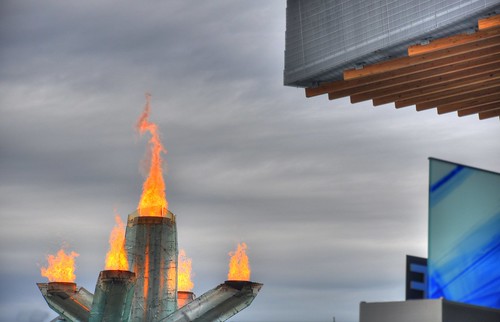
It is an odd thing, for a sporting event to energize my still-young, laid-back hometown. I expect something similar will happen when the next Winter Olympics come to Sochi, Russia in 2014. While almost the same age as Vancouver, Sochi is smaller and certainly less familiar to the rest of the world. It also has many palm trees—perhaps a first for a Winter Games host city? It may be unusually warm here for February, but it's not that warm.
Labels: food, olympics, sports, vancouver, whistler
14 February 2010
Happy birthday, Marina
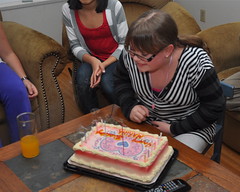 February 14 has many meanings for me. It's Valentine's Day, of course—the 16th my wife Air and I have spent together. It is also our daughter Marina's 12 birthday. But with the Winter Olympics here in Vancouver, including Canada's first gold medal of the event, there's extra resonance, since one of our athletes won gold on the day Marina was born back in 1998 too.
Air had a long, hard labour that February, and with the Nagano Olympics half a world away, we were able to watch many events live as a distraction in the middle of the night. Now our daughter is nearly a teenager, with her own mobile phone and Twitter account. (I got my first mobile phone when Air was pregnant that first time. I was 28. And getting on Twitter? I was 37.)
Happy birthday, Marina. Happy Valentine's Day to my lovely, wonderful, resourceful, smart, sharp, and stylish wife Air. Happy Olympics to all of you too.
Labels: anniversary, birthday, family, holiday, love, olympics, party
12 February 2010
Doing it right
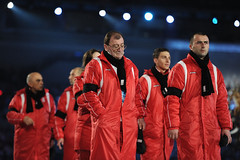 Tonight's Winter Olympics opening ceremony was impressive, if often a bit phallic. There was one technical glitch with the hydraulics for the first, indoor cauldron in B.C. Place Stadium, but the ceremony did the most important thing right.
That was to remember Nodar Kumaritashvili, who died this morning in a terrifying crash during a training run on the Whistler luge track, at the age of 21. (He was born the year the Winter Olympics were last in Canada, in Calgary in 1988.) He was the fourth athlete to die during a sporting event at the Winter Games since they began in 1924.
Jacques Rogge, the head of the International Olympic Committee, pre-empted his prepared remarks with a memorial to Kumaritashvili. Vancouver head organizer John Furlong also included the late athlete in his speech. There was a minute of silence during the ceremony, and a standing ovation for the remaining members of the small Georgian team, walking sadly wearing black armbands.
And the bonus? Instead of the rumoured Celine Dion, we got a spectacular k.d. lang. Good choice.
Labels: death, music, olympics, sports, television, vancouver
11 February 2010
One down
Three years ago, I set a couple of goals: to try to beat back cancer long enough to see the Winter Olympics come to Vancouver, and to live a couple of years longer so I could renew my driver's license when it expires in 2012.
Well, I hit the first one:
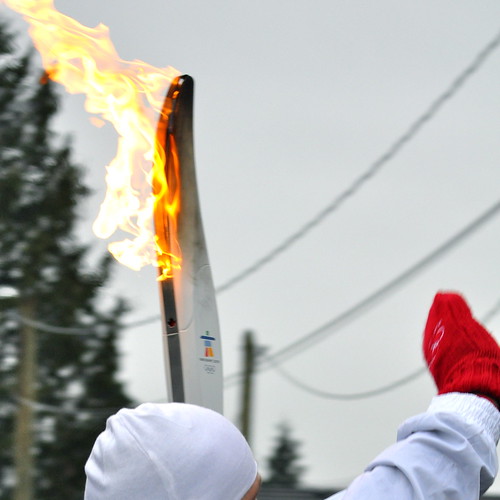
That's the Olympic torch being carried up Willingdon Avenue, about four blocks from my house, on its way through Burnaby and Vancouver to the opening ceremony tomorrow. Two years and a bit from now, maybe I'll get that new driver's license too.
Labels: cancer, death, driving, olympics
15 January 2010
Olympic mascot Quatchi visits the Downtown East Side
I like the Olympics, but I have to say the Flickr photo set where Quatchi the 2010 mascot tours Vancouver's poor Downtown East Side neighbourhood is clever and to the point:

Quick PR tip to the Vancouver Olympic Organizing Committee: trying to shut this piece of satire down as trademark infringement or something would probably be a bad idea.
I'm off to chemotherapy this morning, so don't expect much in the way of blog posts and such for three or four days while I sleep it off. Actually, it turns out my chemo is postponed a week: my neutrophil, platelet, and hemoglobin levels are borderline, so I need to recover more. Yay for no nausea for now; boo for offsetting plans we've made this month and in February based on my previous chemo schedule.
Labels: humour, olympics, photography, poverty, vancouver
16 December 2009
Lululemon's clever retail satire
 Last year, Old Navy tried making some unofficial Olympic clothing, but Vancouver's Olympic Organizing Committee (VANOC) and the International Olympic Committee shut that down because the jackets were too close to official trademarks for the upcoming Winter Olympics.
Now Vancouver yoga retailer Lululemon has tried a cheekier approach, releasing a line of clothes pushing the line of Olympic trademark infringement, without quite crossing it. The line is called the "Cool Sporting Event That Takes Place in British Columbia Between 2009 & 2011 Edition," which gave me a laugh.
I like the sporting events of the Winter Olympics, but VANOC and the IOC have been overzealous in emphasizing the business aspects of the event, rather than the sport. So I appreciate Lululemon's retail satire. The stuff looks good too, so I might buy some.
I wonder if it will be hard to get into Olympic events wearing the Lululemon clothes in February?
Labels: canada, clothing, controversy, money, olympics, politics, shopping, vancouver
28 June 2009
Links of interest 2006-06-21 to 2006-06-27
While I'm on my blog break, more edited versions of my Twitter posts from the past week, newest first:
- My wonderful wife got me a Nikon D90 camera for my 40th birthday this week. I'm thinking of selling my old Nikon D50, still a great camera. Anyone interested? I was thinking around $325. I also have a brand new 18–55 mm lens for sale with it, $150 by itself or $425 together. I have all original boxes, accessories, manuals, software, etc., and I'll throw in a memory card, plus a UV filter for the lens.
- Roger Hawkins's drum track for "When a Man Loves a Woman" (Percy Sledge 1966): tastiest ever? Hardly a fill, no toms, absolutely delicious.
- Thank you thank you thank you to everyone who came to my 40th birthday party—both for your presence and for the presents. Photos from the event, held June 27, three days early for my actual birthday on Tuesday, are now posted (please use tag "penmachinebirthday" if you post some yourself).
- I think Twitter just jumped the shark. In trending topics, Michael Jackson passed Iran, OK, but both passed by Princess Protection Program (new Disney Channel movie)?
- AT&T (and Rogers, presumably) is trying to charge MythBusters' Adam Savage $11,000 USD for some wireless web surfing here in Canada.
- After more than 12 years buying stuf on eBay, here's our first ever item for sale there. Nothing too exciting, but there you go.
- Michael Jackson's death this week made me think of comparisons with Elvis, John Lennon, and Kurt Cobain. Lennon and Cobain still seemed to have some artistic vitality ahead of them. Feel a need for Michael Jackson coverage? Jian Ghomeshi (MP3 file) on CBC in Canada is the only commentator who isn't blathering mindlessly. But as a cancer patient myself, having Farrah Fawcett and Dr. Jerri Nielsen (of South Pole fame) die of it the same day is a bit hard to take.
- Seattle's KCTS 9 (PBS affiliate) showed "The Music Instinct" with Daniel Levitin and Bobby McFerrin. If you like music or are a musician, it's worth watching, even if it's a bit scattershot, packing too much into two hours.
- New rule: when a Republican attacks gay marriage, lets assume he's cheating on his wife (via Jak King).
- The blogs and podcasts I'm affiliated with are now sold on Amazon for its Kindle e-reader device, for $2 USD a month. I know, that's weird, because they're normally free, and are even accessible for free using the Kindle's built-in web browser, so I don't know why people would pay for them—but if you want to, here you go: Penmachine, Inside Home Recording, and Lip Gloss and Laptops. Okay, we're waiting for the money to roll in...
- Great speech by David Schlesinger from Reuters to the International Olympic Committee on not restricting new media at the Olympics (via Jeff Jarvis).
- TV ad: "Restaurant-inspired meals for cats." Um, have they seen what cats bring in from the outdoors?
- I planned to record my last segment for Inside Home Recording #72, but neighbour was power washing right outside the window (in the rain!). Argh.
- You can't trust your eyes: the blue and green are actually the SAME COLOUR.
- Can you use the new SD card slot in current MacBook laptops for Time Machine backups? (You can definitely use it to boot the computer.) Maybe, but not really. SDHC cards max out at 32GB (around $100 USD); the upcoming SDXC will handle more, but none exist in Macs or in the real world yet. Unless you put very little on the MacBook's internal drive, or use System Preferences to exclude all but the most essential stuff from backups, then no, SD cards are not viable for Time Machine.
- Some stats from Sebastian Albrecht's insane thirteen-times-up-the-Grouse Grind climb in one day this week. He burned 14,000+ calories.
- Even though I use RSS extensively, I find myself manually visiting the same 5 blogs (Daring Fireball, Kottke, Darren Barefoot, PZ Myers, and J-Walk) every morning, with most interesting news covered.
- I never get tired of NASA's rocket-cam launch videos.
- Pat Buchanan hosts conference advocating English-only initiatives in the USA. But the sign over the stage is misspelled.
- Who knew the Rolling Stones made an (awesome) jingle for Rice Krispies in the mid-1960s?
- Always scary stuff behind a sentence like, "'He is an expert in every field,' said a church spokeswoman."
- Kodachrome slide film is dead, but Fujichrome Velvia killed it a long time ago. This is just the official last rites.
- My friends Dave K. and Dr. Debbie B. did the Vancouver-to-Seattle bicycle Ride to Conquer Cancer (more than 270 km in two days) last weekend. Congrats and good job!
- My daughter (11) asks on her blog: "if Dad is so internet famous, I mean, Penmachine is popular, then, maybe I am too..."
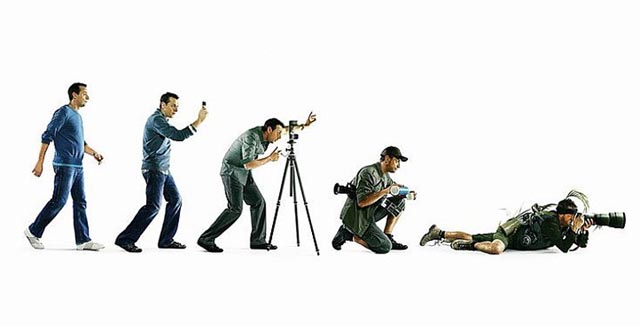
- Evolution of a photographer (via Scott Bourne).
Labels: amazon, apple, backup, birthday, cancer, film, geekery, linksofinterest, music, news, olympics, photography, politics, religion, science, space, television, twitter
26 April 2009
Taking photos doesn't make you a terrorist
As far as I know, no actual or suspected terrorist has ever scoped out a potential target by walking around or in it in plain view, with a big camera and lens, and taking pictures. The 9/11 hijackers didn't, the U.S.S. Cole attackers didn't, the bombers of the London Underground and Madrid and Bali didn't. The FLQ kidnappers in 1970 didn't. Ahmed Rassam didn't. Suicide bombers in Israel and Iraq and Afghanistan don't.
So ads like this one, postered at SkyTrain stations here in Vancouver as the 2010 Olympics approach, bother me:
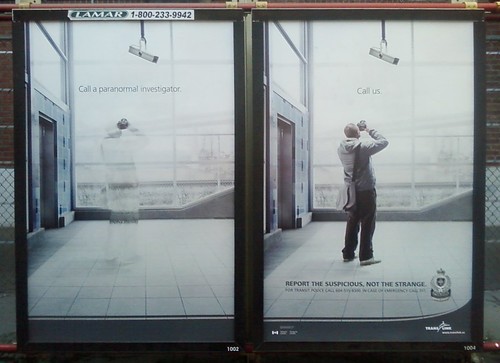
The theme of the ad campaign is "report the suspicious, not the strange." It's an odd slogan. What's the difference between, "Hey, that's strange" and "Hey, that's suspicious"?
And the examples it gives are ridiculous. In this particular instance, if you see a camera floating in mid-air with a translucent, ghost-like figure beneath it, you should apparently call a paranormal investigator. But if you see a man with a DSLR taking photos of the security camera in the station, report that to the Transit Police, because he could be a bad guy.
Here's the thing. Taking photographs in public places isn't illegal in Canada. (Is a SkyTrain station a public place? Interesting question.) Neither is it illegal in the U.S., nor in Britain—though laws are more restrictive in the U.K.
A U.S.-based lawyer has put together a quick PDF card about photographers' rights, and it's also interesting to note that TransLink itself has responded to photographers' concerns about the campaign:
Specifically, the image of the photographer is not intended to say photography and photographers are bad. It's intended to say that a person who is intently making records of specific transit security elements like cameras should raise a flag as suspicious activity.
...but:
They're taking pictures of wiring, pipes, electrical panels. Well, I'm sorry, not many people go around doing that.
Really? Sure about that? Hmm?
The problem, of course, is that while TransLink staff and police may understand that intention (I hope!), the implication is that if members of the general public see a photographer taking pictures of something other than friends and family, they should be suspicious and report it. In short, that they should be afraid.
There's a more general message in these types of campaigns, and the way some reporters and photography enthusiasts are treated by authorities, too: that big cameras with big lenses are particularly evil, as this satire notes:
I don’t want to be too technical, but the focal length of the lens is directly correlated with hatred of America. It goes something like this:
You have a a cell phone camera, point and shoot, or 20mm wide angle lens: you are a red blooded American who wants to celebrate our national heritage by taking pictures of popular tourist locations.
A 50mm lens: you are also, by and large, a good American, but you have a disturbing interest in “understanding” the terrorists and why they attack us.
An 85mm lens: you loathe your own country and secretly admire the 9/11 hijackers for giving us our comeuppance. You are not a terrorist, but your camera should probably be confiscated and your pictures deleted, lest they find their way to al Jazeera message boards. Your middle name may be Hussein.
A 200mm lens: you are an al Qaeda henchman actively scouting for security vulnerabilities.
A 300mm lens: you ARE bin Laden!
This approach, of course, is the very opposite of sensible. If terrorists really were checking out a target, they would probably work to be as surreptitious as possible. Use small cameras, like the camera phone I used to photograph the ad poster. Memorize things and sketch them out later. Steal plans. Not plop down a big-ass tripod out in the open and carefully compose an image with a huge DSLR and a monster chunk of lens mounted it. At the very least, all that gear would make it hard to get away quickly and unobtrusively.
You know what I think has really prompted this security theatre? Spy movies and TV shows. That's where you see the telephoto lenses in the hands of the bad guys, and the good guys, for that matter. (Then again, James Bond prefers small cameras.)
What this approach fails to notice is that those are fiction.
Labels: controversy, olympics, photography, terrorism, transportation
26 August 2008
Old Navy's non-Olympic clothing line
I'm sure that Old Navy (being part of the Gap/Banana Republic clothing empire) has some excellent lawyers, who must have had giggled a little when they checked out, and then approved, these hoodie designs I saw for sale last week at the store:
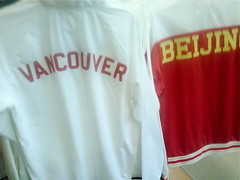
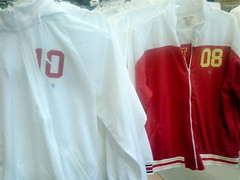
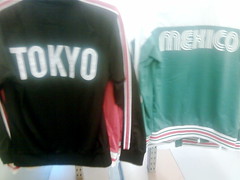
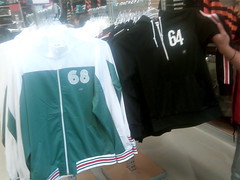
They're some reasonably funky retro Olympic track tops commemorating selected cities that have held or will hold Olympics over the past few decades (Tokyo, Mexico City, Los Angeles, Beijing, Vancouver). Except they're not, really. Old Navy is not an official Olympic sponsor or licensee. There are no Olympic logos or anything on these items of clothing, and the designers were careful to avoid even trademarked phrases, such as "Vancouver 2010."
Instead, you get a hoodie with "VANCOUVER" on the back and a simple "10" on the front, plus "BEIJING" and "08," "LOS ANGELES" and "84," "MEXICO" and "68," and "TOKYO" and "64." Simply commemorating a city and a number, see? Any Olympic association is purely coincidental, of course. I'm particularly impressed with the groovy lettering for Mexico, which cheekily apes the famous psychedelic '68 Olympics logo (scroll down at this Olympics branding site to compare). The Tokyo lettering is pretty similar too.
This might be an example of The Man thumbing his nose at The Man, but I have to admire the effort Old Navy expended to nearly, but just barely not, infringe on Olympic copyrights and trademarks. Given that, in many cases, very little of the billions of dollars that the IOC rakes in from sponsorships and licensing seems to go to the athletes themselves, I don't mind having a chuckle at it either.
Labels: clothing, controversy, copyright, design, olympics, shopping
06 April 2008
The Boot and Blade figure skating blog should cover the 2010 Olympics
Figure skating's not really my thing, but blogging is, and my mom sure loves the sport. Blogging colleague Julie has a figure skating blog over at BootAndBlade.com, and she is trying to get media accreditation for the 2010 Olympics here in Vancouver.
I think bloggers should totally be there in the media scrum, so as her husband Darren has requested, if you have a website and link over to her site (such as to her worst falls in figure skating post), it will help.
Labels: blog, friends, olympics
01 December 2007
I like the mascots just fine
 In the last week, there has been the expected consternation among cynical B.C. adults about the new 2010 Vancouver Olympic mascots Sumi, Quatchi, and Miga (and mysterious hanger-on Mukmuk).
I think they're reasonably cool, although there's no good reason a sasquatch (even a young one) should need earmuffs and boots, dammit. I think they're better than previous mascots (thanks to Scott at Facebook for the link), especially Canada's first, Amik, the 1976 Montréal plush lump that was supposed to be a beaver.
There does seem to be an early-21st century style developing, however—note the anime resemblance to the Fuwa mascots of the 2008 Beijing Games. Though maybe that doesn't carry over strongly to the plush and life-size versions.
What does bring out my cynicism, however, is having more than one mascot—that seems like a simple ploy to sell more stuff. If we had to pick one, I'd go with Quatchi: his "hey dude" slacker appearance, scratchy "why am I up before noon?" voice (check it out in Darren's unauthorized Olympic theme), and needless extra winter protection are very Vancouver. Though I guess if Sumi's oddball green tunic were Gore-Tex, that would do the job too.
Labels: olympics, shopping, toys, vancouver