Penmachine
13 September 2009
It looks like Leica is back, finally
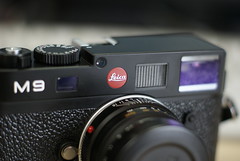 Back in the early 20th century, Leica cameras were the first to make 35 mm film practical for still photography (instead of movies). For decades, they defined well made, technically innovative photographic tools. But since the autofocus and digital revolutions of the 1980s and 2000s, Leica seemed to lose its way. Though the company made partnerships with Minolta and, more recently, Panasonic—repackaging Panasonic cameras as Leicas with a few cosmetic and firmware changes, and charging a lot more money for the name—its flagship German-made SLR and rangefinder cameras fell behind the rest of the industry.
Some professionals continued to use Leica cameras, mostly because of the superb lenses, but among amateurs and enthusiasts, the brand became more of a cult, with its extremely high-priced cameras and lenses fetishized by collectors, but used less and less by regular people taking pictures. In 1982, Leicas were the official cameras taken by the first Canadian expedition to reach the summit of Mt. Everest. Almost 30 years later, it would be hard to imagine such an expedition making a similar choice.
Yes, today's popular cameras (amateur and professional) include a lot of what the Leica Man would call superfluous. But even hard-core photographers—or especially them—now demand autofocus, intelligent computerized exposure metering, and state-of-the-art digital capture. Leica, in contrast to Japanese latecomers like Canon, Nikon, and even Sony, could offer none of these things. Technically, Leica's bulletproof M-series rangefinders were stuck in the '60s, and their R-series SLRs in the '70s. For the huge amounts of money Leica charged, their digital offerings like the crop-frame M8 rangefinder and Modul R digital back seemed (quite literally for the Modul R) like bolt-on afterthoughts.
But this week, Leica introduced these:
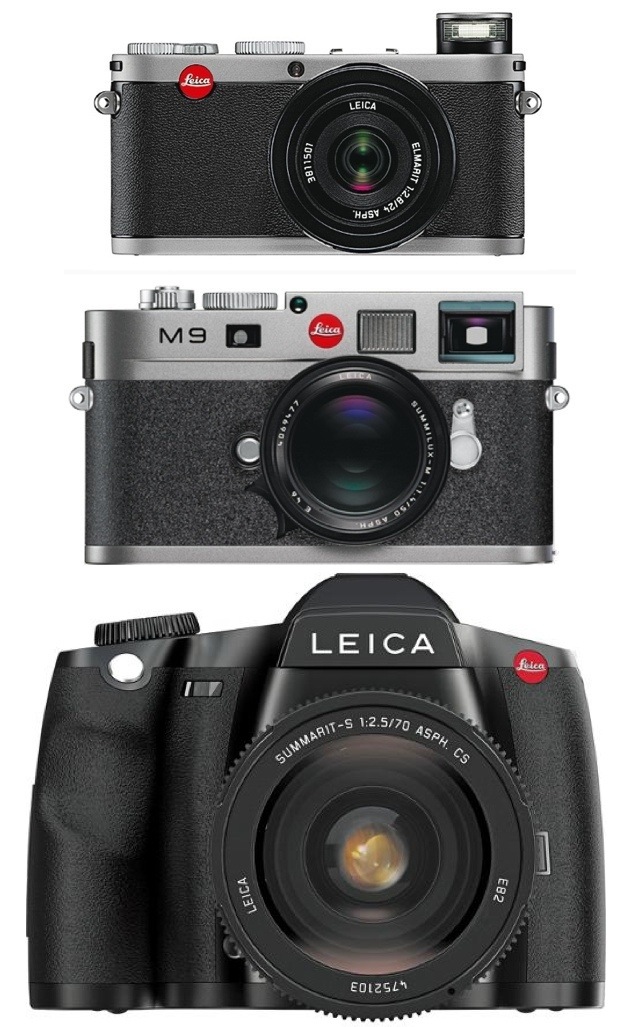
They are the new Leica X1 compact camera ($2000 USD), M9 full-frame digital rangefinder ($7000 USD), and S2 medium-format digital SLR ($22,000 USD). (The X1 and M9 are just announced; the S2 first appeared last year, but only now is getting near release, with an actual price.)
No, I did not accidentally add an extra zero to those prices. Leicas remain among the most expensive still cameras available to those outside the military, space programs, and specialized technical and scientific fields. Their lenses, if you can believe it, are even more upscale and (many say) of unsurpassed quality. For the M series rangefinder cameras, a "low end" f/2 Summicron 50 mm is $2000 USD, while its big brother, the top-of-the-line f/0.95 super–low-light Noctilux 50 mm is $10,000 USD. The S-series lenses start at $4500.
And yet, for once, these cameras are unique and innovative. All three are assembled in Germany, to start. The X1 is probably still overpriced, but it does include a genuine Leica lens and an unusually large (and thus low-noise) sensor for a compact camera. The M9 is, for many aficionados, the holy grail they've been waiting for since digital cameras became mainstream: a Leica rangefinder, of the same dimensions and metallic heft of its predecessors, fully compatible with nearly every Leica M lens made since 1954, yet with a full-frame 18-megapixel digital sensor like those in high-end digital SLRs.
The S2, while well out of reach of any normal photographer (even those who might consider an M9), is the really unusual one: Leica's first real foray into medium-format photography. The sensor is more than 50% larger than a full-frame 35 mm chip, but the camera itself is similar in size to Canon's smaller-sensored 1D and 1Ds Mark III and Nikon's D3 and D3x cameras, and has a much simpler interface than other modern DSLRs.
The S-series lenses are huge and heavy, but until now (with the marginal exception of the Mamiya ZD), digital medium-format photography hasn't had the convenience of autofocus SLR handling and simplicity. From the initial quick impressions of people who've tried it, Leica may have created a winner for high-end studio and landscape photographers in the S2. And, for the first time in many years, Leica has a truly modern camera that no one else can match. For now.
Labels: canon, geekery, leica, nikon, photography, sony
07 January 2009
Are there perhaps too many digital SLRs on the market?
One way to get lots of people to see a photo of yours on the image sharing site Flickr is to take a good picture. That requires talent, skill, and dedication. A few of my pictures have become popular simply because they're good photographs—at least I think so.
But my most popular pictures on Flickr aren't like that at all. They're nerdy: pictures of wacky guitars or geek conferences, of old computers or Linux running on a Mac.
And what do you do to attract huge numbers of viewers and comments and favourites? Simple, go full nerd: just make a picture of a whole bunch of cameras and encourage people to argue about them. More than 38,000 views in six months, 208 favourite votes, and dozens and dozens of comments:
Old image of almost 25 cameras
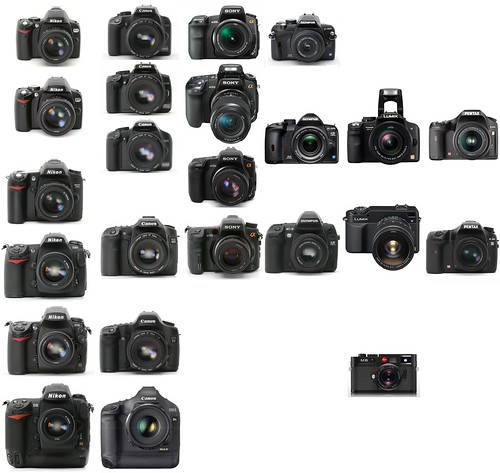
State of the DSLR market - June 2008 (old)
An earlier attempt of mine at the same thing even had commenters threatening to kill each other about the kind of camera they like! But my favourite comment was from Axl Van Goks: "I like the black one with the buttons and stuff."
Since the digital camera market changes like crazy, my big collage from June 2008 was out of date within weeks. I waited for all the pre-Christmas camera introductions to shake out, and now I've made a new version that includes all the current digital SLR cameras I could find (almost 40) from Nikon, Canon, Sony, Olympus, Pentax, Panasonic, Leica, Samsung, Sigma, and Fujifilm:
New image of almost 40 cameras
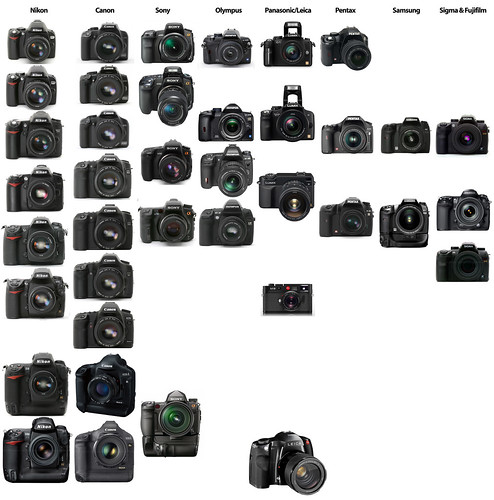
State of the DSLR market - January 2009 (new)
I expect the arguing to begin soon in the comments. The picture has 139 views and 4 favourites since I posted it three and a half hours ago. And yes, yes, I know, I know: they're not all strictly SLRs, but I think they're all of interest to SLR buyers.
Ah, art. Have at it.
UPDATE: My thesis appears to be correct. As a rule of thumb, the more cameras you put in a picture on Flickr, the more popular it is:
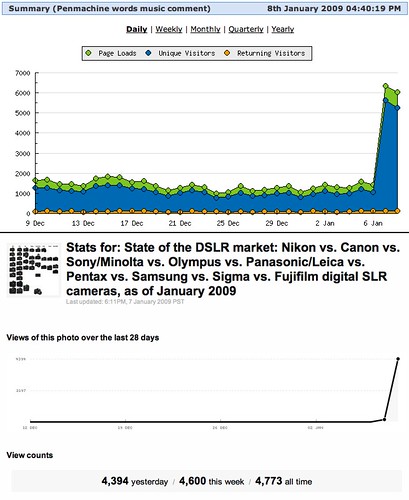
Links from John Gruber and 37signals didn't hurt either.
Labels: canon, controversy, flickr, geekery, leica, linkbait, nikon, olympus, panasonic, pentax, photography, sony
01 September 2008
Links of interest (2008-09-01):
- It's a fact: I find it astonishing that the governor of Alaska (Alaska!), and new vice-presidential running mate for John McCain, doesn't think that climate change is human-generated. I'm guessing her house isn't built on melting permafrost.
- I'll let Dan Savage give his trademark trenchant take on the other Sarah Palin news.
- This past week Canon introduced its new EOS 50D SLR (a nice upgrade from the 40D), and Nikon followed with its D90 (which supersedes the D80 and takes movies, a first for an SLR camera). While I use Nikon myself, and the D90 would be great if I needed a new camera, for people just getting into the market, I still think the Pentax K200D is an excellent deal.
- Speaking of photography, the always-snarky Ken Rockwell has (as usual) excellent advice on how to carry less stuff so you make better pictures. I should have heeded his advice when I went up Whistler mountain a few weeks ago. I took a bunch of photos, but only used one lens, even though I schlepped a whole bag's worth of stuff (plus a tripod I never unfolded) up there—just like the guys Ken was making fun of at the zoo.
- I'm a little too old to have ever been all that interested in going to Burning Man, but I'm particularly glad to have avoided this year's dust storm. Yuck.
- Looks like Americans won't be the only ones having an election this fall.
Labels: canon, environment, linksofinterest, nikon, pentax, photography, politics
18 August 2008
Photo gearheaddery from Sigma, Canon, and DPReview
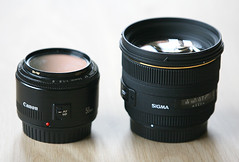 Photo buffs (yeah, like me) will be interested to read two new gear reviews at DPReview today:
- Sigma's new 50 mm f/1.4 lens is unusual: the first genuinely modern 50 mm lens design in a long time, not from one of the camera manufacturers, and both huge and expensive compared to lenses made by Canon, Nikon, and Pentax (whose comparable lens is half the weight and price!).
- Canon's $8000 EOS 1Ds Mark III is the top of the heap for price and resolution among digital SLR cameras. It's taken awhile for DPR to review it, but it's interesting to see how it compares to Nikon's very different top model, the D3.
Labels: canon, nikon, photography, review, sigma
03 July 2008
State of the digital SLR market: Nikon, Canon, Sony, Olympus, Panasonic, Pentax, and Leica
Last year I created a little composite image of the various interchangeable-lens digital single-lens reflex (DSLR) cameras then available from Nikon and Canon, the two leading camera manufacturers. It turned out to be one of my most popular pictures at the Flickr photo sharing service, of course because photo enthusiasts like to argue about Canon vs. Nikon almost as much as Mac and PC people do about their computers.
It became out of date pretty fast, with models discontinued and new ones introduced. But people kept looking at the image and commenting. So I decided to go further and create a similar composite visual chart of DSLRs currently available, as of the end of June 2008, from all the major camera makers: Nikon, Canon, Sony/Minolta, Olympus, Panasonic/Leica, and Pentax. The pictures are all the companies' publicity photos, sometimes sourced directly from their websites, sometimes from others such as DP Review and DC Resource:
No wonder people are confused about which camera to buy! Prices here range from around $500 (with lens) to about $8000 (no lens). The smallest cameras in this bunch are the Leica M8 (off by itself on the lower right, and not an SLR, see below) and the Olympus E-420 (top of the fourth column, see this review for real-life size comparison photos). The heaviest are the two pro monsters, the Nikon D3 and Canon 1Ds Mark III, in the lower left.
I have excluded a few other makers, such as Fuji and Sigma, and rebadged models from Samsung (nearly the same as some Pentaxes) and Leica (almost identical to the Panasonics). These images reflect the main line of SLRs (plus the M8) as of this writing.
Relative camera sizes are not exact. The positions of the various models vaguely reflect my impressions of a combination of price, features, and market segment. That's quite subjective, so you could easily argue with my placement of some of them. Take the image as a general guideline. Look down the columns to see how different cameras from a single manufacturer compare from low-end to high-end; look across the rows to see roughly comparable cameras (in features, price, or both) from different makers that compete with one another.
Nikon and Canon are (currently) alone in providing full-frame size semi-pro and professional DSLRs: the D700, EOS 5D, D3, and EOS 1Ds Mark III. The Leica M8 is the real outlier—not an SLR at all, but a digital version of the classic Leica M rangefinder; I put it here because a significant number of photographers looking at the high-end Nikons and Canons might also consider it.
The most crowded market segments are the introductory level (with something, and sometimes several confusing models, from every manufacturer), and the midrange enthusiast section (with some interesting choices like the D80, D300, 40D, A700, E-3, DMC-L1, and K20D). With all the choices, this might be the most interesting time in the history of single-lens reflex cameras, certainly in the digital era.
I also left out some models. Canon's pro sports-focused 1D Mark III, which looks and works essentially identically to the 1Ds Mark III, is one—the difference is that the "s" indicates a larger full-frame sensor (Canon needs a serious simplification of its naming scheme). The Nikon D40 is also the same body as the D40x (and the D60), but with a lower-resolution sensor. Some of these models, such as the D40x and the Canon XTi, may be theoretically discontinued now or soon, but remain widely available.
Finally, there will probably soon be updates rendering this composite chart at least partially obsolete. Canon is expected to replace the three-year-old EOS 5D any old time, Nikon might do the same for the similarly aged D80, Sony may release a full-frame DSLR (since they make Nikon's full-frame sensor, I believe), and Nikon could bring out a D3x or similar model with a higher-resolution full-frame sensor like the 1Ds Mark III. I'll let you know.
Labels: canon, gadgets, geekery, leica, nikon, olympus, panasonic, pentax, photography, sony
18 June 2008
Buying your first serious digital SLR camera
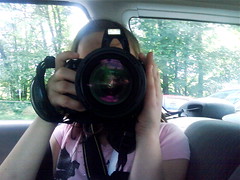 I get emails out of the blue sometimes, and yesterday a guy who found me via Flickr asked my advice on buying his first serious digital SLR (single-lens reflex) camera. He's already quite a good photographer, with a keen eye, and he's trying to decide between the Nikon D300 and Canon EOS 40D.
He likes the Canon's interface, but prefers the features of the D300, as well as the more vivid colours it produces (at least in JPEG mode). He wants low noise, good low-light performance, and good ability to take landscapes, high dynamic range (HDR) photos, and macro (closeup) pictures.
When you're starting out buying an SLR, what you're doing is committing yourself to a camera system, particularly with lenses. Chances are you will keep and use the lenses for much longer than you use that camera. For instance, I have a Nikon D50 I bought in 2006, but my lenses include a zoom that I bought in 1995 for my old film Nikon, and which still works great. I've been using Nikon SLRs since the early 1980s—had I chosen Canon or some other camera back then, I'd probably still be using that brand, just because of the inertia.
Both Nikon and Canon are good choices—but don't forget Pentax's K20D (Pentax provides some of the best values in both SLRs and quality lenses these days) and even Sony's A700 (Sony took over Minolta's camera business, and offers very nice Zeiss lenses too, some of the best available). I'm not a fan of the four-thirds system from Olympus and Panasonic/Leica, but you might like it.
The D300 is about 50% more expensive than the 40D (around $1800 Cdn vs. $1300 Cdn), so that might make the decision for many people. (The closest competing Nikon is actually the aging D80.) One way that price difference could affect your decision might be with lenses: if you can only afford an expensive body (like the D300) with cheaper lenses, you'd be better off getting a less expensive body (like the 40D) with better lenses like Canon's top-end L series. Again, the lenses will be around your kit longer than the body.
And for any camera you get, rather than buying yourself a standard zoom lens, I would recommend getting one or two good-quality prime (non-zoom) lenses instead. They are better optically, faster (i.e. have a larger maximum aperture letting in more light), and will also make you think about your compositions more carefully.
So I said to my questioner that if he doesn't have a brand preference for other reasons, and if he can afford the Nikon D300 with a quality lens or two, then I'd recommend it over the Canon 40D. The D300 offers excellent low-light performance, an amazing LCD screen (much better than anything Canon has), and lots of other features. Not that there's anything wrong with the 40D, but by most objective measures the D300 is superior.
As far as lenses go, if I were starting from scratch, I'd get a basic fast prime like the $140 Nikon 50 mm f/1.8 or the $500 digital-only Sigma 30 mm f/1.4. For a second lens, I'd look at either a general-purpose stabilized zoom like Nikon's well-reviewed $750 18-200 mm, or (more likely in my case) a moderate telephoto prime that can also act as a macro lens, such as Nikon's $900 Micro-Nikkor 105 mm f/2.8. If I had more money to spend, I might get both of those, or go crazy and buy the $1500 manual focus Zeiss Makro-Planar 100 mm f/2.
Canon has similar standard prime, telephoto-style macro, and zoom lenses. So do Pentax (prime, macro, zoom) and Sony/Zeiss (prime, macro, zoom, or Zeiss zoom).
It would be a pleasant luxury to be starting an SLR system from scratch, and to have maybe $4000 to spend on it. But no matter how you start, if you're a photography enthusiast, you'll get more lenses and other accessories (flash, battery grip, tripods, etc.) over time. Just don't cheap out with your lenses to start, and you'll be happier in the long run.
Labels: canon, gadgets, geekery, hdr, leica, macro, nikon, olympus, pentax, photography, sony
07 April 2008
Lovely aerial night city photos from Doc Searls
Check out this beautiful set of pictures of city lights from Doc Searls. He took them while flying on a commercial jet up the U.S. East Coast:


It's a shame that we waste so much energy radiating light out into space, but it's pretty.
Labels: airport, art, canon, docsearls, environment, flickr, photography
28 February 2008
Handy handstrap
A couple of years ago I spotted Kris using a handstrap with his Canon DSLR at Northern Voice 2006. Such a strap can be quite convenient when you don't want to use a full neck strap, and in recent weeks I've thought that getting one would make my grip on my Nikon D50 a little more secure.
Alas, Nikon's own leather strap is stupidly expensive (more than $100 in Canada—you can buy a whole decent point-and-shoot camera for that!). The Canon version was much cheaper, but requires a camera with a bottom strap loop, which few have. Luckily, there was a perfectly acceptable no-name alternative at Amazon. I had to have it shipped to a friend's U.S. post box, since it wasn't available to be shipped to Canada. I received it early this week.
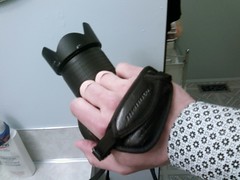
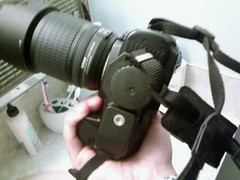

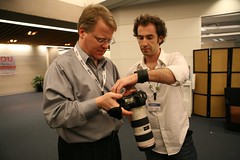
If you look at my camera bottom photo, you can see there's an extra strap hook on the other side of the grip mount, so you can use both the hand and a neck straps at the same time.
What that does mean is, if you use the regular neck strap that way, your camera hangs sideways, but that's fine once you get used to it. Also, the grip mount is well built plastic with key metal bits, but it's fairly large, so if you already have a big SLR, especially with a battery grip, you're heading into the massive Nikon D3/Canon 1D size territory. So check the size of your camera bag before you get one.
Labels: canon, gadgets, nikon, photography
29 January 2008
Nikon's new D60 isn't what I expected
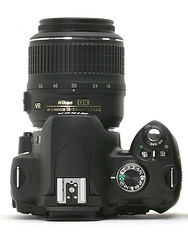 I was right that Nikon would introduce a new digital SLR soon, but totally wrong about where it would fit in their lineup. The new D60 is an introductory-level camera that doesn't seem to incorporate many of the revolutionary new technologies from Nikon's high end D300 and D3.
No-nonsense photographer Ken Rockwell thinks it's a higher-end machine than I do, with image processing that may give the D80 a run for its money. But to me, the D60 looks like it will replace the D40 and D40x—it uses the same body design, but adds some interesting new features such as a stop-motion movie mode, next-generation sensor dust removal, and a digital rangefinder for focusing lenses manually.
That last item is useful, because like the D40 and D40x, the D60 lacks an autofocus motor in the camera body, so only newer Nikon-mount lenses with the focus motor in the lens (called AF-S and AF-I by Nikon) will focus automatically. Many nice lenses, even ones Nikon still manufactures, such as the AF Nikkor 50mm f/1.8 I use—as well as numerous older lenses, both primes and zooms—can therefore only be focused manually with the D60.
Still, it is a nice camera, and a strong direct competitor to Canon's new Digital Rebel XSi announced a few days ago. Nikon's aging D80, like Canon's EOS 5D, remains in the lineup, and unless both manufacturers have further surprises up their sleeves, that's the way it looks to be for the next little while. Despite the D60's niceties, my D50 (released back in 2005) remains a better camera for my needs, primarily because it still has that autofocus motor for the three of my four lenses that lack their own.
Labels: canon, gadgets, geekery, nikon, photography
24 January 2008
More DSLR competition
UPDATE: Via John Gruber, here's an excellent introductory article on buying a digital SLR camera. I think author Mike Davidson should expand from his emphasis on Nikon and Canon alone, but all his essential advice is good regardless of brand. As you'll see in the rest of my blog post here, though, you might want to see what Nikon announces in the next couple of weeks.
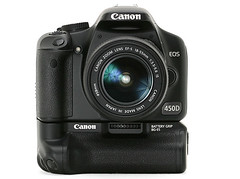 In advance of the upcoming PMA photo tradeshow, camera manufacturers have started spewing out announcements about their new products. I'm most interested in information about digital single-lens reflex (DSLR) cameras, because a Nikon D50 SLR is what I use now, and SLRs (film and digital) are what I have used for most of my photo-taking life, which stretches back almost 30 years to when I first started to figure out my dad's old film Pentax with "Asahi Pentax" viewfinder cover.
The DSLR market is especially hot right now—I was amazed at how many pre-Christmas ads were not for the regular point-and-shoot digicams most people still use, but the bulkier yet more powerful and flexible SLRs that enthusiasts prefer. It helps that the DSLRs are a whole lot cheaper than they were even a couple of years ago. Now that digital is the way everyone shoots, it makes sense that a good number of average buyers would be hitting the limits of their little cameras and wanting to take nicer pictures—not to mention that manufacturers get more money out of both the higher-priced cameras and the greater range of lenses and accessories we love to buy for them.
So far I've seen news about new intro-level DSLRs from Sony (who bought out Konica-Minolta's old camera business), Pentax (who also have a new higher-end model), Samsung (almost the same as the Pentax, since the two companies collaborated on the design), Canon, and even an almost-SLR from Fuji, which has a fixed lens but the bonus of a flip-out LCD screen and a movie mode, which true SLRs all lack. Nothing from Olympus, Panasonic, or Nikon yet, but that will come.
Since Canon and Nikon are the heavyweights in this field, Canon's new Rebel XSi (a.k.a. 450D) is the highest-profile of the bunch, though I have to say that Pentax, after languishing for some years, is really coming on strong with their recent DSLR range. The Canon XSi is a descendant of the Rebel XT (350D) my dad owns—Canon's Digital Rebel DSLRs have hugely dominated the market since they first appeared. On Flickr, for instance, it looks like there are more photgraphs taken with the XT and XTi than all other DSLRs combined. (Canon also overwhlems all other point-and-shoot makers too, by the way.)
Since Nikon (and Canon) recently introduced new high-end prosumer and multi-thousand-dollar professional SLRs, I'm wondering whether Nikon might have something less spendy to counter this new Canon model. The low-end D40 and D40x are already a success, and are not especially old either. So while I could see a new introductory Nikon, I think it's much more likely that we could see a successor to the D80, which came out in 2006, around the same time as the XSi's older sibling the XTi (400D).
Features that the D80 doesn't have, but which are becoming common in DSLRs, include dust reduction, live view (like point-and-shoots all have) on a large rear LCD screen, and of course faster-better-more in burst shooting, image quality, and maybe megapixels—although Nikon has been surprisingly smart in not letting the megapixel wars infiltrate their SLR sensors too much.
So, a D90 (or whatever) would be cool to fill in the (rather wide) gap between the D40x and the D300, and once again to fit in nicely among Canon's midrange and pro offerings, which now include the 40D and full-frame 5D—also showing its age, even if it is the current favourite among many professionals.
Labels: canon, gadgets, geekery, nikon, photography
13 January 2008
Photos of the "Edison and Leo" stop-motion movie set
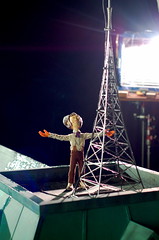 For a good chunk of the past year, several dozen animators have been working in a former native residential school near Mission, B.C., rented out to them by the current owners the Sto:lo Nation, on what looks to be a fascinating movie, Edison and Leo, which should come out later this year.
It's the first feature-length stop-motion film made in Canada, which is suprising considering this country's long history of innovative animation projects. I visited the set last week with my friend Jeff, who is working on publicity for the project.
Edison and Leo has a dark, retro, steam-punk look (it's set in the 19th century), and when production was at its peak late in 2007, there were as many as 14 sets in use simultaneously. Now that the main shooting process is winding down, there are only a few sets left, but it's still a strange experience if you've ever visited a movie set before.
Unlike computer or traditional animation, stop-motion has actual sets, with all the wiring, lighting, and construction that entails. However, the sets are at a strange scale, built for characters a few inches high. And while live-action sets require absolute silence and very careful tiptoeing around, with Edison and Leo Jeff and I were able to wander about, say hi to people as they worked, take photos, and generally feel at ease—because each animator produces, on average, less than 10 seconds of footage a day, one frame at a time. Take a look:


There were some neat details. "Filming" actually takes place with modern Canon digital still cameras, hooked up (oddly) to old manual-focus Nikon lenses. They're connected into computers next to each set, which the animators can use to check their work, and then through a jury-rigged fibre-optic cable network run through the old school to a set of storage servers, and also to a room where the movie can be edited on the fly.
The production facility is almost completely self-contained: all the sets, costumes, and characters are built on site, which gives the team a lot of flexibility and also keeps costs down. (Most of the staff are from other parts of Canada, and have been living in trailers on the property.) Other than the sets themselves, the building still looks like a school, which is pretty creepy considering its history.
If you'd like to read up on the project, check The Province, the Victoria Times-Colonist, the Deadwood blog, the MTV Movies blog, Playback, Telefilm Canada, and IMDB.
Labels: animation, canon, edisonandleo, film, geekery, movie, nikon, photography