Penmachine
20 November 2009
See the world
 Since 1972, the Landsat satellites have been photographing the surface of the Earth from space. However, the amount of data involved meant that only recently could researchers start assembling the millions of images into an actual map, where they could all be viewed as a mosaic.
NASA has posted an article explaining the process. The map covers only land areas (including islands), but it is not static—it includes data from different years so you can see changes in land use and climate.
Here's the neat thing. Back in the 1980s, while the information was there, putting even a single year's images into a map would have cost you at least $36 million (USD). Now you can get the whole thing online for free. Take a look. If you poke around, there's a lot more info than in Google Earth.
Labels: astronomy, geekery, photography, science, space
03 November 2009
Scary stuff, kiddies
 For a long time (maybe a couple of years now), I've been having an on-and-off discussion with a friend via Facebook about God and atheism, evolution and intelligent design, and similar topics. He's a committed Christian, just as I'm a convinced atheist. While neither of us has changed the other's mind, the exchange has certainly got each of us thinking.
Something that came up for me yesterday when I was writing to him was a question I sort of asked myself: what elements of current scientific knowledge make me uncomfortable? I try not to be someone who rejects ideas solely because they contradict my philosophy. I don't, for instance, think that there are Things We Are Not Meant to Know. However, like anyone, I'm more likely to enjoy a teardown of things I disagree with. Similarly, there are things that seem to be true that part of me hopes are not.
Don't be afraid of the dark
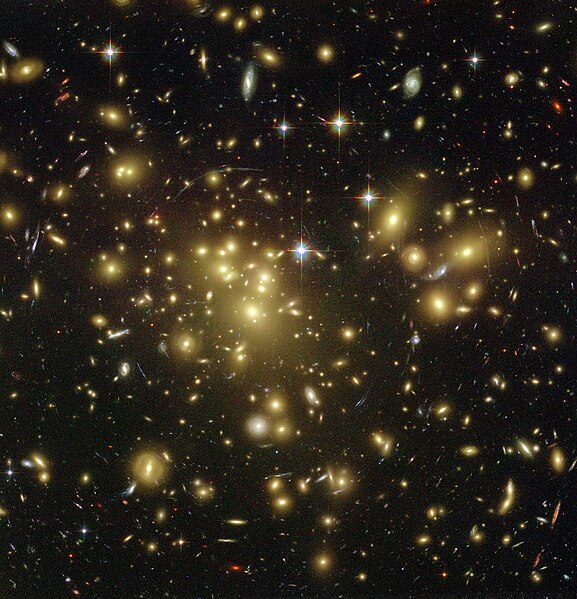
Recent discoveries in astrophysics and cosmology are a good example. Over the past couple of decades, improved observations of the distant universe have turned up a lot of evidence for dark matter and (more recently) dark energy. Those are so-far hypothetical constructs physicists have developed to explain why, for instance, galaxies rotate the way they do and the universe looks to be expanding faster than it should be. No one knows what dark matter and dark energy might actually be—they're not like any matter or energy we understand today.
But we can measure them, and they make up the vast majority of the gravitational influence visible in the universe—96% of it. So the kinds of matter and energy we're familiar with seem to compose only 4% of what exists. The rest is so bizarre that Nova host and physicist Neil deGrasse Tyson has said:
We call it dark energy but we could just as easily have called it Fred. The same is true of dark matter; 85 percent of all the gravity we measure in the universe is traceable to a substance about which we know nothing. We can call that Wilma, right? So one day we'll know what Fred and Wilma are but right now we measure the distance and those are the placeholder terms we give them.
We've been here before. Observations about the speed of light in the late 1800s contradicted some of the fundamental ideas about absolute space and time in Newtonian physics. Analysis yielded a set of new and different theories about space, time, and gravity in the early years of the 20th century. The guy who figured most of it out was Albert Einstein with his theories of relativity. It took a few more years for experiment and observation to confirm his ideas. Other theorists extended the implications into relativity's sister field of quantum mechanics—although there are still ways that general relativity and quantum mechanics don't quite square up with each other.
And if that seems obscure, keep in mind how much of the technology of our modern world—from lasers, transistors, and digital computers to GPS satellite systems and the Web you're reading this on—wouldn't work if relativity and quantum mechanics weren't true. Indeed, the very chemistry of our bodies depends on the quantum behaviour of electrons in the molecules that make us up. Modern physics has strange implications for causality and the nature of time, which make many people uncomfortable. But there's no rule that reality has to be comfortable.
Bummer, man
To the extent that I understand them, I've come to accept the fuzzy, probabilistic nature of reality at quantum scales, and the bent nature of spacetime at relativistic ones. Dark matter and energy are even pretty cool as concepts: most of the composition of the universe is still something we have only learned the very first things about.
But dark energy in particular still gives me the heebie-jeebies. That's because the reason physicists think it exists is that the universe is not only expanding, but expanding faster all the time. Dark energy, whatever it is, is pushing the universe apart.
Which means that, billions of years from now, that expansion won't slow down or reverse, as I learned it might when I was a kid watching Carl Sagan on Cosmos. Rather, it seems inevitable that, trillions of years from now, galaxies will spread so far apart that they are no longer detectable to each other, and then the stars will die, and then the black holes will evaporate, and the universe will enter a permanent state of heat death. (For a detailed description, the later chapters of Phil Plait's Death From the Skies! do a great job.)
To understate it rather profoundly, that seems like a bummer. I wish it weren't so. Sure, it's irrelevant to any of us, or to any life that has ever existed or will ever exist on any time scale we can understand. But to know that the universe is finite, with a definite end where entropy wins, bothers me. But as I said, reality has no reason to be comforting.
Either dark energy and dark matter are real, or current theories of cosmology and physics more generally are deeply, deeply wrong. Most likely the theories are largely right, if incomplete; dark matter and energy are real; and we will eventually determine what they are. There's a bit of comfort in that.
Labels: astronomy, death, science, time
24 July 2009
Splashdown
Today we mark 40 years since the Apollo 11 Command Module Columbia splashed down in the middle of the Pacific Ocean, a few hundred kilometres from the now-closed Johnston Island naval base:
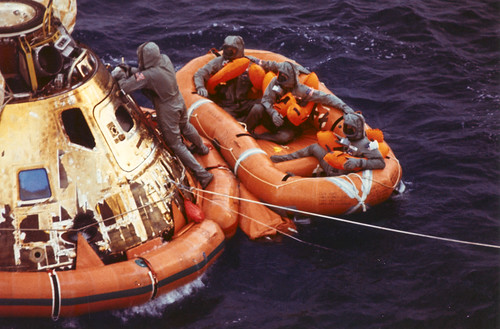
Our first (and sixth last!) trip to the surface of the Moon was over. The seared, beaten Columbia (weighing less than 6,000 kg, and which had remained shiny and pristine until its re-entry into the Earth's atmosphere), with its passengers, was the only part of the titanic Saturn V rocket (3 million kg) to return home after a little over one week away. Every other component had been designed to burn up during launch or return, to stay on the Moon's surface (where those parts remain), to smash into the Moon, or to drift in its own orbit around the Sun.
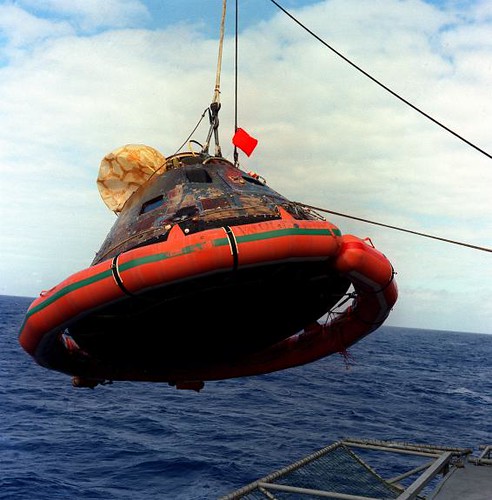
All three astronauts returned safely, and suffered no ill effects, despite being quarantined for two and a half weeks, until August 10, 1969, when I was six weeks old.
Labels: anniversary, astronomy, holiday, moon, oceans, science, space
21 July 2009
Going home
Just before noon today, Pacific Time, marks exactly 40 years since Neil armstrong and Buzz Aldrin launched their Lunar Module Eagle and left the surface of the Moon, to rendezvous with their colleague Michael Collins in lunar orbit:

They were on their way home to Earth, though it would take a few days to get back here.
Labels: anniversary, astronomy, holiday, moon, science, space
20 July 2009
Today was the day
The beginnings of human calendars are arbitrary. We're using a Christian one right now, though the start date is probably wrong, and the monks who created it didn't assign a Year Zero. Chinese, Mayan, Hindu, Jewish, Muslim, and other calendars begin on different dates.
If we were to decide to start over with a new Year Zero, I think the choice would be easy. The dividing line would be 40 years ago today, what we call July 16, 1969. That's when the first humans—the first creatures from Earth of any kind, since life began here a few billion years ago—walked on another world, our own Moon:
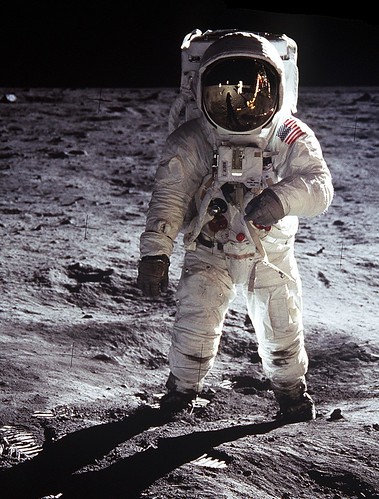
They landed their vehicle, the ungainly Eagle, at 1:17 p.m. Pacific Daylight Time (the time of my post here). Just before 8 PDT, Neil Armstrong put his boot on the soil. That was the moment. All three of the men who went there, Armstrong, Buzz Aldrin, and Michael Collins, are almost 80 now, but they are still alive, like the rest of the relatively small slice of humanity that was here when it happened (I was three weeks old).

If the sky is clear tonight, look up carefully for the Moon: it's just a sliver right now. Although it's our closest neighbour in space, you can cover it up with your thumb. People have been there, and when the Apollo astronauts walked on its dust, they could look up and cover the Earth with a gesture too—the place where everyone except themselves had ever lived and died. Every other achievement, every great undertaking, every pointless war—all fought over something that could be blotted out with a thumb.
Even if it doesn't start a new calendar (not yet), today should at least be a holiday, to commemorate the event, the most amazing and important thing we've ever done. Make it one yourself, and remember. Today was the day.
Labels: anniversary, astronomy, holiday, moon, science, space
16 July 2009
Launch day
Forty years ago today. July 16, 1969, 9:32 a.m. EDT, Launch Complex 39A, Cape Canaveral, Florida. Three nearly hairless apes—human beings in pressure suits—left for the Moon:
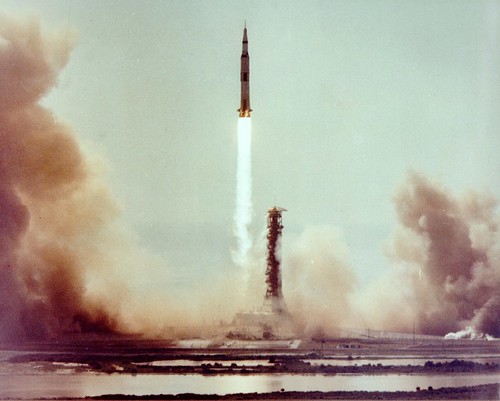
They were aboard the world's greatest machine, which put out about 175 million horsepower during launch. Less than three hours later, they exited Earth orbit and were on their way.
Labels: anniversary, astronomy, moon, science, space
21 December 2008
Science is amazing
Okay, so here's a movie (via Bad Astronomer) of Jupiter's moon Ganymede passing behind the giant planet. Pretty darn amazing and cool:
Now here's the really amazing part. The movie was assembled from a series of images taken not from a probe sent to Jupiter from Earth. Nope, they were taken by the Hubble Space Telescope, in low orbit around our own planet. These pictures were taken, over the course of two hours in April 2007, from here, something like 600 million kilometres away from the subjects. The light from Ganymede and Jupiter took almost an hour to reach the Hubble camera.
Talk about your telephoto lens.
Labels: astronomy, movie, photography, science, space, video
14 November 2008
Today, it's Japan, China, and India at the Moon
 Remember when the U.S. and Russia were the only countries with space programs and their own rockets? Then came the European Space Agency, mostly launching commercial satellites from French Guyana. Somehow my 1970s kid brain is still stuck in that mindset.
But it's wrong, wrong, wrong. Yes, the U.S. still sends plenty of astronauts into orbit, and has wonderful robotic probes venturing throughout the solar system. But how about the Moon? As far as I can tell, the last time America sent anything to the Moon was ten years ago, when the Lunar Prospector orbited, then intentionally crashed into a crater to test for water. Russia hasn't sent anything since the Luna 24 probe in 1976. The ESA was there more recently, with its SMART 1 five years ago.
Who is sending spacecraft to the Moon now? That would be Japan, China, and (most notably today) India, which hit the moon with a flag-painted impact probe sent from its Chandrayaan-1 lunar orbiter mere hours ago.
The U.S. has a lunar orbiter scheduled to launch next year, and both it and Russia have grand plans to send people back, but for now, it is the countries of Asia that are telling us about our nearest neighbour in space. I think that's pretty cool.
Labels: astronomy, geekery, moon, politics, science, space
30 October 2008
Spooky black holes
Here is Bad Astronomy's list of ten things you don't know about black holes. I'd never heard of a low-density black hole, for instance.
28 September 2008
The world's greatest machines
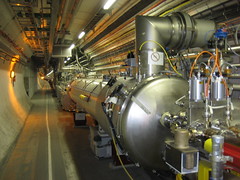 There's been a lot of talk recently about how the Large Hadron Collider (LHC) is the largest and most powerful machine ever built. I guess it is that. But there is another machine I still like better: the Apollo Saturn V moon rocket, retired more than 35 years ago. Each one was constructed not for years and years of experiments by thousands of people, as the LHC is, but for a single task lasting a mere week: to get three men to the moon and back.
The Saturn V was the most powerful machine of its time. I still think it is the most important device we've ever built, and as far as I know it remains the most expensive—in adjusted dollars, the Apollo program cost about $135 billion, many times the price of the LHC.
 I've just watched In the Shadow of the Moon again, this time on television. (It was worth seeing in the movie theatre before, for the size of the images.) I was less than three weeks old during the launch and the eventual landing of the Lunar Module. If I'd been an adult, I think I would have burst into tears at both events. I've come pretty close just watching the footage, almost 40 years later.
I'm very happy that people think basic physics important enough to spend billions of dollars constructing the LHC. But, while it is impressive, that device is an experimental apparatus, carefully assembled over many years. Although the Apollo rockets were also a massive endeavour, it happened instead in an astounding rush, a little over eight years from conception to success, less time than it takes for Peter Gabriel to make a new album. It remains the only time we've taken people to another world. That's some really awesome machinery.
Labels: astronomy, moon, movie, science, space
26 September 2008
Eternal sunshine
This is pretty cool: there are a couple of high spots at the moon's south pole (one a mountain, one the rim of a crater) where the sun never sets. Ever.
Labels: astronomy, moon, science
09 August 2008
Now that is serious dynamic range
I've created a few high dynamic range (HDR) photographs recently, where I combine a series of exposures (usually 3 or 5) of different durations (and which therefore see different amount of detail in shadows and highlights) into a single tone-mapped image. But nothing like this:
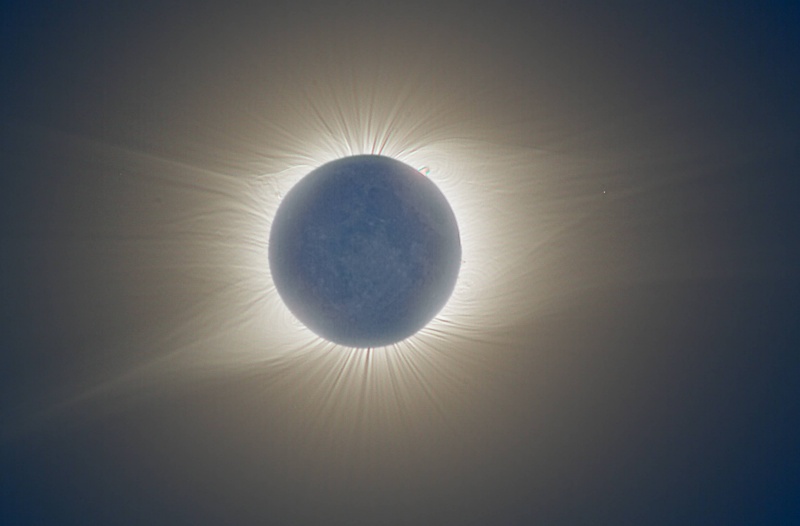
Yesterday's Astronomy Picture of the Day, that image, by Hartwig Luethen, combines 28 (!) pictures of last week's solar eclipse (visible mostly in northern Asia). The dynamic range is so great that the final image shows not only detail of the stupefyingly-hot corona of the Sun (photographed at 1/1000th of a second), but also features on the face of the Moon eclipsing it, lit only by the reflection from us, the Earth (photographed with a 2-second exposure).
That's pretty nifty-keen.
Labels: astronomy, geekery, hdr, photography, science
30 June 2008
Rock from on high
One hundred years ago today, St. Petersburg, Russia, would have been annihilated by an enormous explosion—if the detonation had occurred less than five hours later than it actually did. But as it turned out, the event happened thousands of kilometres further east, smack dab in the middle of Siberia. St. Petersburg was lucky, saved by the rotation of the earth.
The fireball now known as the Tunguska Event was the mid-air explosion of an extraterrestrial object of some sort (link via PZ Myers), likely a meteorite or fragment of a comet—fairly big, perhaps 50 or 60 metres in diameter, like a condominium tower falling from the sky at several thousand kilometres per hour—which disintegrated violently in the atmosphere. The place is still a remote Siberian forest, several hundred kilometres northwest of Lake Baikal. Trees that fell then still lie on the ground a century later. The heat created microscopic glass beads in the soil. There would be no airburst of similar magnitude until the invention of the hydrogen bomb.
It took almost 20 years for a Soviet scientific expedition, led by Leonid Kulik, to visit the area and survey the still-extensive damage in 1927: while there was no obvious crater, trees had been stripped of their branches and bark, as well as flattened by the shock wave, in a region some 50 km wide. Had the Tunguska Event occurred in a populated area, tens or hundreds of thousands of people might have died.
It was nothing, of course, compared to other impact events on earth, such as those linked with mass extinctions in the more distant past. But I still wouldn't have wanted to be anywhere near it.
Incidentally, Tunguska shares its centenary not only with my 39th birthday today, but also with something else I'd probably prefer to steer clear of: the 45th birthday of Yngwie Malmsteen.
Labels: anniversary, astronomy, birthday, disaster, guitar, history
18 March 2008
Farewell to Sir Arthur
While I have to admit that his fiction was sometimes a bit wooden, Sir Arthur C. Clarke, who died today, was one of the true visionaries of the last century. Geostationary telecommunications satellites—the ones we all use now for all sorts of things—were his idea. He helped with the deployment of radar in World War II. And in novels like Rendezvous With Rama and Childhood's End, he imagined how humans might react if we find out we aren't alone in the universe.
In many ways, he helped build the frame around our modern ideas about astronomy, cosmology, and space travel. He was no doubt disappointed that we didn't pursue the kind of space program started in the 1950s and '60s. We're certainly far from the routine orbital and lunar trips he and Stanley Kubrick forecasted in 2001.
He was, in many ways, an eccentric, married only once, briefly, decades ago, and spending the last 50 years of his life in Sri Lanka after leaving his native Britain. He was also a master of pithy quotes: "Any sufficiently advanced technology is indistinguishable from magic." "If there are any gods whose chief concern is man, they cannot be very important gods." "Any teacher that can be replaced by a machine should be!" "There is hopeful symbolism in the fact that flags do not wave in a vacuum." "I don't believe in astrology; I'm a Sagittarian and we're sceptical."
I read a lot of his stuff when I was young, and he is one reason I turned into a geek and a science major. He lived a long life, to 90, but it's still a sad day that he's gone.
Labels: age, arthurcclarke, astronomy, books, death, science, sciencefiction
09 March 2008
Links of interest (2008-03-09):
- "You call this traveling? Twenty-one days, 15 countries, 45,000 miles—without setting foot outdoors."
- "The more affluent a country gets, the more things parents come to see as essential for raising children [so] as long as the world keeps creeping out of poverty, families will continue to shrink."
- jamNOW lets you jam online with other musicians, interact with fans, and listen to live streams from nightclubs all over the place. Haven't tried it, so I'm not sure how well it works.
- Looks like the iMac DV in our kitchen is finally officially obsolete. It's slow, but it still works pretty well.
- Are things really this bad for biology teachers in significant portions of the U.S.A.?
- "If all you do is work, your value judgements are unlikely to be sound."
- "I rejoice in this life that I have, and in the grandeur of a world that preceded me, and an earth that will abide without me."
- "Studies have shown that abstinence-only education does virtually nothing to prevent kids from having sex [and that] abstinence-only group[s] used birth control less frequently."
- "When I get a resume, the first thing I do is type the person's name into Google. If nothing comes up, I trash the resume without reading it."
- "I don't want my ISP looking at how I use the Internet to target ads to me, period, any more than I want the phone company listening in on my conversations in order to sell me stuff."
- TripIt looks like one of the best online travel resources out there, though I haven't tried it.
- How to make your website or blog faster.
- The Universe is 13.73 billion years old, give or take only about 120 million years. Now that is a cool finding.
Labels: apple, astronomy, evolution, family, google, linksofinterest, music, school, science, sex, space, travel, web
20 February 2008
Lunar eclipse photos from Vancouver
In Vancouver, the clouds cleared just long enough for some beautiful views of the lunar eclipse. I got some nice pictures (and so did my dad):
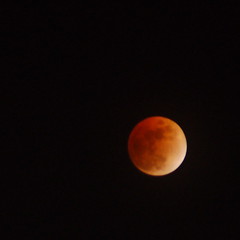


Mine were taken with a Nikon D50 camera on a tripod, and attached to a Sigma/Quantaray 70-210 mm zoom lens set at f/5.6, ISO 800, exposures generally between a half-second and two seconds. My dad took his with a Canon Digital Rebel XT attached to a Celestron C90 reflector telescope on a tripod, acting as a 1000 mm f/11 lens, with similar exposure times and ISO settings.
Labels: americas, astronomy, eclipse, moon, photography, science, vancouver